

Binance stablecoin netflow turns negative while Bitcoin’s Stock-to-Flow reversion hits 1.1, signaling possible extreme undervaluation ahead. BTC price analysis.
Stablecoins were supposed to be sitting on Binance, ready. That picture is changing.
Netflow data for ERC-20 stablecoins on Binance has flipped negative across several recent sessions, according to CryptoQuant’s latest QuickTake analysis. The current reading sits at negative $89.3M. That means more stablecoin value left the exchange than entered. Capital that market participants once treated as dry powder waiting to buy is not waiting there the way it was.
Bitcoin was trading near $59.5K when the chart was captured. The on-chain data from CryptoQuant over recent sessions showed whale accumulation spiking to historic levels even as retail sold. Those two things happening at the same time is the kind of setup that tends to resolve loudly, one direction or the other.
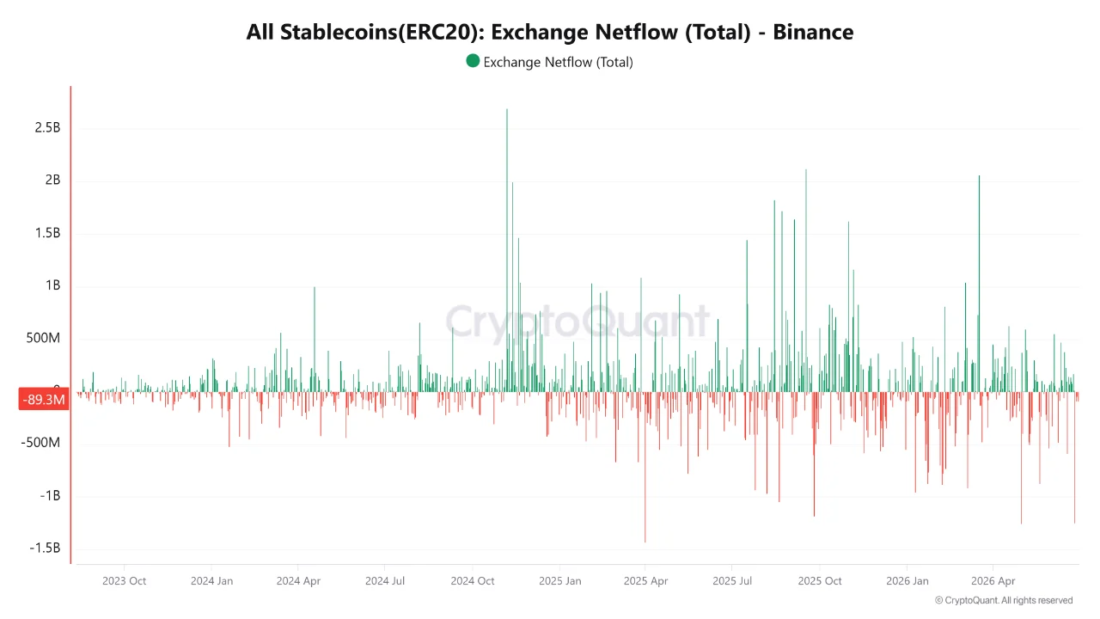
All Stablecoins (ERC20): Exchange Netflow (Total) — Binance | Source: CryptoQuant (https://cryptoquant.com/insights/quicktake/6a4249537a878621f5275ee0-Stablecoin-Flows-on-Binance-Are-Declining)
Binance Stablecoin Flows: The Exit Nobody Noticed
When stablecoin flows on a major exchange soften, it does not always mean investors are leaving crypto. CryptoQuant’s analysis noted three possible explanations: growing caution about short-term positioning, lower overall trading activity, or capital rotating to other platforms rather than exiting altogether.
The problem for BTC is timing. Outflows from spot Bitcoin ETFs had already been running for weeks before this stablecoin reading showed up. Per earlier CryptoQuant data, net BTC inflows to exchanges reached +91,000 BTC while stablecoin reserves moved the other direction.
The CryptoQuant QuickTake was direct about what Bitcoin needs. For any recovery attempt to hold, stablecoin flows on Binance have to return to a positive state. Right now, that signal is not there. The liquidity is somewhere. It is just not on the largest exchange in the market.
The Stock-to-Flow Model Just Did Something Unusual
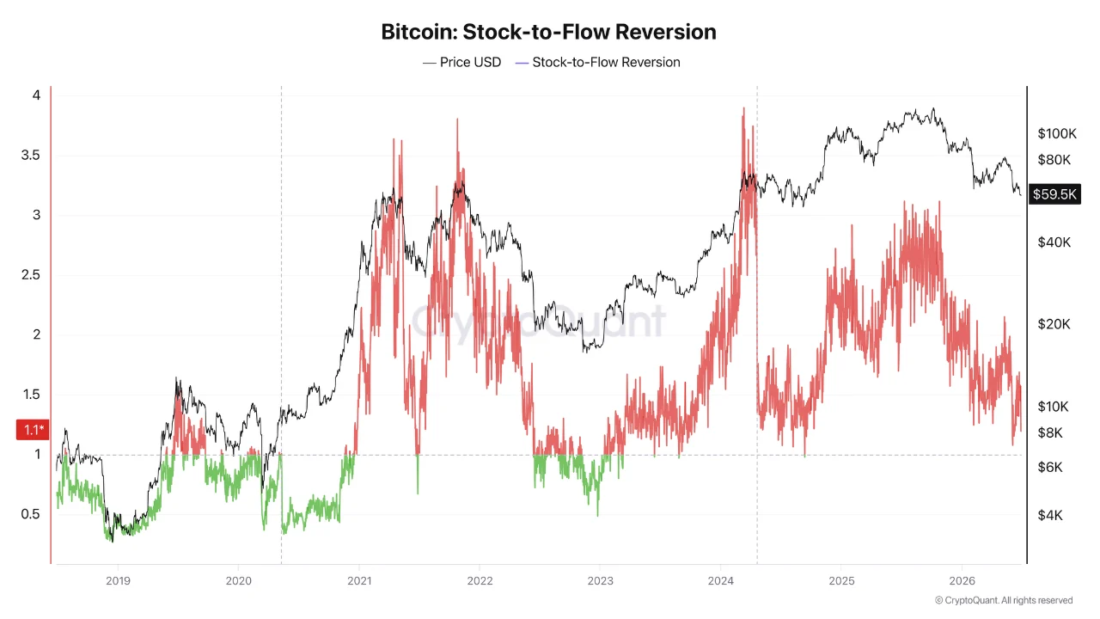
Bitcoin: Stock-to-Flow Reversion | Source: CryptoQuant (https://cryptoquant.com/insights/quicktake/6a425e1c7a878621f5275f18-Bitcoins-Stock-to-Flow-Reversion-Signals-Approaching-Extreme-Undervaluation)
Separately, a different CryptoQuant QuickTake published this week flagged a reading that rarely gets this quiet. The Stock-to-Flow Reversion model, which measures how far Bitcoin’s price deviates from the fair value implied by its supply structure, now sits at 1.1. That is the green zone on the chart.
The green zone on the S2F Reversion chart corresponds to readings below 1. That level, historically, has marked bottom formation before a trend reversal. The model last broke below 1 in September 2024. BTC was trading around fifty-seven thousand dollars at that point. The current reading at 1.1 is not quite there. Getting close.
On the other end of the scale, readings above 2.5 to 3 have historically matched short-term tops. The model hit that range during the 2021 peak, the 2024 run, and last year. What the chart shows now looks nothing like those periods. Per the CryptoQuant analysis, BTC is approaching extreme undervaluation territory, not overheating.
One More Capitulation Wave Before the Bottom
The CryptoQuant analyst writing on the S2F model was careful with language. The note described BTC as being ‘on the edge of a cliff,’ with a possible final capitulation wave before a more stable floor forms. It is not the first indicator making that case.
A separate livebitcoinnews.com analysis published just one day ago noted Bitcoin’s Power-Law Quantile dropped to 6.2%. That same zone appeared at the cycle bottoms of 2015, 2020, and 2023. Traders are watching. Confirmation has not arrived.
Two indicators converging near historical floor readings while stablecoin liquidity drains from the biggest exchange is a combination that tends to matter. Whether the next move is one more flush or the start of recovery depends largely on whether that sidelined capital comes back. Per CryptoQuant. Both of them.




Leave a Reply
You must be logged in to post a comment.