
Crypto Regulation & Policy: The CLARITY Act, MiCA, SEC/CFTC, and the Multi-Country Map
A decade ago, digital asset markets operated at the edge of the financial system, largely outside serious legislative attention. That has changed fast. Clear rules on issuance, custody, and trading now give exchanges, token issuers, and institutional investors something to build on instead of constant legal guesswork, and they give ordinary users at least some […]

A decade ago, digital asset markets operated at the edge of the financial system, largely outside serious legislative attention. That has changed fast. Clear rules on issuance, custody, and trading now give exchanges, token issuers, and institutional investors something to build on instead of constant legal guesswork, and they give ordinary users at least some protection against fraud and mismanagement. Regulation isn’t a side issue crypto markets can dodge indefinitely. It’s closer to a precondition for the industry reaching a wider audience and being treated as a legitimate part of the financial system, rather than a walled-off experiment.
What Crypto Regulations Actually Are
Issuance, trading, custody, disclosure, enforcement: crypto regulation touches all of it, and none of those rules live in the same place. A rule about how a stablecoin issuer backs its tokens has almost nothing to do with a rule about when a securities exchange needs a license, and an enforcement action brought against a project for fraud is a different animal again. Headlines routinely blur these together, mentioning an ETF approval, a stablecoin licensing requirement, and a token classification ruling in the same breath, as though they were all one process. They aren’t. An ETF approval is a securities-product decision, full stop. A stablecoin rule usually belongs to banking or payments law instead. And a token classification ruling settles something more basic: whether an asset counts as a security, a commodity, or something else, which in turn decides which regulator even has authority to act.
Why Crypto Regulation Matters
Regulation has moved from being a background risk factor to one of the main forces shaping how the crypto market develops. Three areas show why.
Regulation Shapes Market Access
Licensing requirements, custody rules, and banking access all trace back to how clear the policy is. An exchange that can’t get a bank account because of regulatory ambiguity won’t serve customers reliably, no matter how good its technology happens to be. Token listings work the same way. Without a settled legal classification, a trading venue would rather skip listing an asset than risk enforcement action down the line.
Regulation Shapes Product Design
Stablecoins, staking products, DeFi protocols, tokenized assets, derivatives- all of it gets built differently depending on how the law treats it. A stablecoin issuer under a strict reserve-backing rule designs its product in a completely different way than one facing no reserve requirement at all. The legal environment isn’t just a constraint bolted onto the technology afterward. It shapes what gets built in the first place.
Regulation Shapes Capital Flows
Institutional allocators, pension funds, and larger asset managers tend to sit out until the regulatory picture clears before committing meaningful capital to digital assets. That’s a rational response to legal risk, not excessive caution on their part. A firm allocating client funds into an asset class with an unsettled legal status is taking on consequences it can’t fully model, and plenty would rather just wait it out until the rules are actually set.
The US Map: SEC, CFTC, and the CLARITY Act
Crypto presales in the US sit at the center of a long-running turf war between two regulators- the SEC and the CFTC with each trying to exert its authority. This confusion may be finally coming to an end, with the air being cleared by the Clarity Act.
US Crypto Rules Live Between SEC, CFTC, and Congress
US crypto regulation plays out as a three-lane story: the SEC, the CFTC, and market-structure bills such as the CLARITY Act. Joint guidance and cooperation pacts try to cut down the “which agency?” ambiguity that’s followed digital assets for years now, even as Congress keeps debating the text and the timing. Leadership picks and “years behind” framing can shift the tempo of that debate, but they aren’t finished statutes on their own.
SEC vs CFTC in Plain English
What is the SEC actually protecting? Investors, mostly, and it does that through disclosure requirements, registration of securities offerings, and antifraud enforcement. Ask the same question about the CFTC, and the answer looks quite different. Its toolkit was built for futures and swaps in commodities and derivatives markets, not securities offerings. Plenty of crypto assets fall into the gray zone between the two agencies regardless. A token can behave like a commodity in one context and look like an investment contract in another, depending on how, and to whom, it was actually sold.
What the CLARITY Act Tries to Do
H.R. 3633, formally the Digital Asset Market Clarity Act, tries to settle that gray zone through statute instead of case-by-case interpretation. At the center of the bill sits one idea: the “digital commodity,” a category covering tokens that fall under CFTC oversight, not SEC securities rules, once their underlying blockchain network hits a sufficient level of decentralization. Registration and disclosure requirements for exchanges and other intermediaries handling these assets round out the rest of the bill.
Why the CLARITY Act Matters
How this bill is finally worded decides a lot: exchange registration requirements, issuer disclosure obligations, and the legal test for what even counts as a “digital commodity.” A settled statute would hand US exchanges and token issuers a fixed rulebook to build against, rather than leaving them to guess how decades-old securities and commodities law might stretch to cover a technology it was never written for.
Current Status and Policy Debate
Few crypto-specific bills get this far. The House passed it on July 17, 2025, by a lopsided 294-to-134 margin, with more than seventy Democrats, more than most expected, crossing over to back Republicans. Then came May 14, 2026: the Senate Banking Committee advanced its own version 15 to 9, and a June 1 calendar placement made the bill formally eligible for a full floor vote, no further committee action needed.
A floor vote is the one thing still missing. Most observers treat August 10, the start of the Senate’s state work period, as the real deadline before senators head home for summer recess. Senate Majority Leader John Thune has already told reporters he doesn’t expect the bill on the floor before the recess kicks off around August 7. Ethics rules for government officials and illicit-finance provisions remain unresolved between Republicans and the crypto-friendly Democrats needed to get this across the line. One prediction market tracking the bill’s odds priced passage this year at just 28 percent on July 30, a steep drop from a peak of 82 percent earlier in 2026. Miss the August window, and the next realistic shot doesn’t come until mid-September.
MiCA Explained: The EU’s Crypto Rulebook
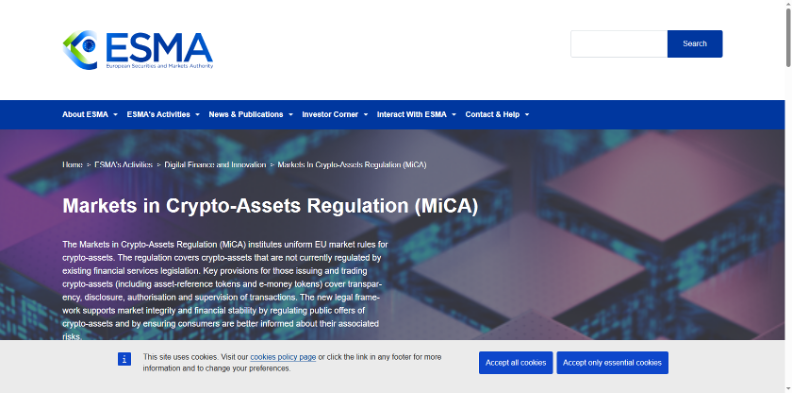
Twenty-seven different national rulebooks for the same asset class were never going to work. The Markets in Crypto-Assets Regulation, known as MiCA, replaced that patchwork with one EU-wide framework instead, covering crypto-asset markets across every member state at once.
What MiCA Covers
Disclosure, compliance and licensing: these are the pillars MiCA sets requirements around for crypto-asset service providers and stablecoin issuers alike. Passporting is the part that actually changes daily business. Once a firm is authorized in one EU member state, it can generally operate across the rest of the bloc without reapplying for a license country by country.
Why MiCA Is Important
Fragmented national rules used to be the norm across the EU, and MiCA replaced that with a single, harmonized approach, which is part of why it has become something of a global reference point. Regulators well outside the EU have studied its structure, even where they haven’t adopted it outright. There simply aren’t many full crypto frameworks that have gone from proposal to actual implementation the way MiCA has.
MiCA Makes EU Access a License Pathway
MiCA turns EU crypto service access into a matter of national licensing and passporting. Individual firm license headlines are just instances of that system at work. The durable mechanism underneath is the license pathway itself, plus the market-structure fights still playing out around it, order-book rules among them. Member states continue to add their own local crypto-asset and data laws on top, and the European Commission has explored more centralized oversight models alongside MiCA.
What Crypto Businesses Need to Know
Getting licensed under MiCA is not a one-time paperwork exercise. Firms need to maintain ongoing supervision and operational readiness, covering governance, reserve management for stablecoin issuers, and reporting obligations that continue well after the initial authorization is granted. MiCA functions as an operating framework a business has to live inside, not a headline law that gets satisfied once and forgotten.
US vs EU: MiCA vs SEC/CFTC
Legal Philosophy
Enforcement under old securities and commodities law, stretched case by case to cover a technology those statutes never anticipated: that’s the US approach, boiled down to one sentence. Brussels took the opposite route, building a dedicated licensing and disclosure framework from scratch, one written specifically with crypto-assets in mind rather than litigated onto them years later.
What Each Model Means for Crypto Firms
There’s a real trade-off buried in that difference. A firm operating under the US model has to interpret how decades-old statutes apply to an asset class those statutes never mentioned, which brings ambiguity but also a certain flexibility a fixed rulebook can’t offer. Go the EU route instead, and the rulebook is clearer from day one, just stricter and more detailed once a firm is actually inside the system.
Who Benefits Most
Not every crypto business wants the same thing out of a regulatory system. Exchanges, token issuers, stablecoin companies, DeFi teams, and custodians all face different trade-offs depending on where they operate. Take a stablecoin issuer weighing MiCA’s defined reserve rules against the still-uncertain path to favorable treatment under the US GENIUS Act; it might well prefer the EU’s certainty. A DeFi protocol without a clear legal entity behind it could land in the opposite spot, finding the EU’s licensing paperwork harder to satisfy than the messier, but more flexible, US approach.
The Multi-Country Crypto Map
The multi-currency crypto map denotes the varying levels of regulations each country has implemented towards cryptocurrencies. Keeping track of these jurisdictions helps pick those with the durable rules that would shape the financial infrastructure for tomorrow.
Regulated Markets
A defined legal path to operate is exactly what a handful of jurisdictions have managed to build. The EU under MiCA is the biggest of them, but Switzerland got there through a different route entirely, folding crypto into its existing financial-market law rather than writing a dedicated statute. Japan’s licensing regime for exchanges and custodians belongs in the same category, and newer entrants like the United Arab Emirates and Singapore have joined it too.
Developing Markets
Not every major economy has finished the job. Take the United States for example. The country with the most active enforcement and some of the deepest capital markets in the world still doesn’t have a single finished market-structure statute, which is exactly why CLARITY Act-style legislation remains unresolved as of mid-2026. India tells a different version of the same story. Trading is legal there and taxed heavily, yet a full regulatory framework covering exchanges and custodians hasn’t been finalized, even while reporting rules have tightened fast, with stricter transaction-reporting requirements and daily fines for inaccurate filings kicking in from April 2026.
Restricted or Unclear Markets
Then there’s the smaller group that never opened the door at all. China hasn’t budged: mining, trading, exchange services, even marketing, all of it stays prohibited. Algeria and Bolivia go a step further, treating crypto activity as a criminal matter rather than something a regulator handles civilly. What matters here isn’t the size of this group. It’s that a product perfectly legal in one country can carry criminal exposure in another, and nothing about the technology itself warns a user which set of rules actually applies to them.
Why a Country Map Matters
Crypto regulation is no longer a single global rulebook, if it ever was one. It is a patchwork that changes by jurisdiction, sometimes sharply, and founders and users both need to understand where a given product is welcomed, where it is tolerated under conditions, and where it is banned outright, before assuming a service that works in one country will work, or stay legal, in another.
Cross-Border Coordination Hits Privacy and Alignment Friction
UK-US task forces, FSB and G20 warnings that privacy laws are slowing supervisory data sharing, and non-US CASP timelines such as Brazil’s all point to the same picture: crypto rules form a multi-jurisdiction map rather than one shared system. Global alignment remains partial, and privacy rules alongside differing national calendars keep creating friction between regulators trying to compare notes.
What Crypto Regulation Covers
Crypto regulations can be broken down into multiple parts based on the type of product for ease of understanding. Some of these prominent categories are listed below.
Licensing and Registration
Exchanges, custodians, brokers, and other service providers generally need some form of registration or licensing before they can legally operate, though the exact requirements vary sharply by jurisdiction, from MiCA’s EU-wide passporting to the state-by-state licensing regimes still common in parts of the United States.
Stablecoins
Stablecoin rules typically cover reserve backing, issuance limits, redemption rights, and the obligations an issuer owes to holders if the peg breaks. The US GENIUS Act, signed into law in mid-2025, created three categories of permitted issuer: a subsidiary of an insured bank, a nonbank issuer supervised federally by the Office of the Comptroller of the Currency, and a state-qualified issuer that must transition to federal oversight once its outstanding tokens cross ten billion dollars. Wise’s revised trust-bank application under similar stablecoin rules shows how individual firms are already adjusting their structures around these thresholds.
DeFi and Tokenization
Decentralized protocols and tokenized real-world assets pose a harder problem for regulators built around licensing intermediaries, since a DeFi protocol may not have a clear company or person to license in the first place. Regulatory approaches here remain the least settled part of the crypto rulebook across most jurisdictions, with agencies still working out whether to regulate the protocol, the developers, the front-end interface, or none of those directly.
Tax and Reporting
Know-your-customer checks, anti-money-laundering rules, transaction reporting, and local tax obligations apply to crypto activity in most regulated markets now, even where a full licensing framework is still missing. India’s flat tax on digital asset gains and its tightened daily reporting requirements are one example of a jurisdiction moving faster on tax enforcement than on market-structure rules.
How to Read Crypto Policy News
Staying up to date about crypto policies across the world will help one form an outlook for the industry over the coming years. Depending on the level of involvement in the industry, the information can come in handy in the decision-making process as well.
Watch Legislative Milestones
Committee votes, floor-vote scheduling, and rulemaking deadlines tend to matter more than press statements about a bill’s overall direction. A bill can enjoy broad political support and still stall for months over a scheduling disagreement, exactly as the CLARITY Act has.
Watch Regulatory Agency Statements
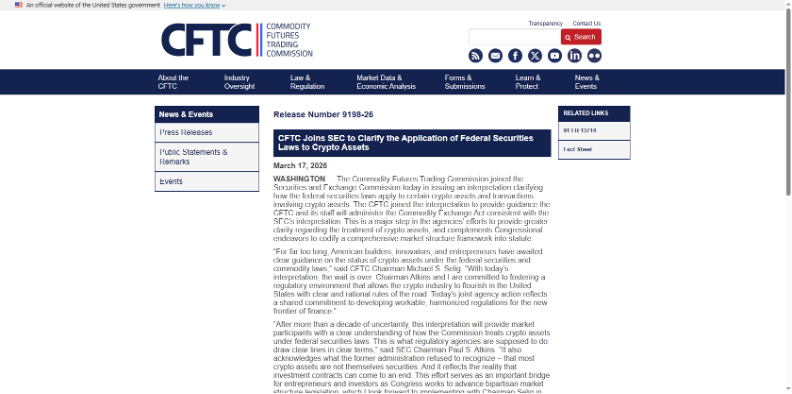
Joint statements from agencies such as the SEC and CFTC, or from national regulators like Japan’s FSA and central banks such as Brazil’s, often signal a shift in enforcement priorities well before any new law is passed. The March 2026 joint interpretation from the SEC and CFTC is a case in point: it changed how eighteen major crypto assets are treated under federal law without Congress passing anything at all. The CFTC’s own rulemaking calendar keeps moving in parallel with these bigger legislative fights, too. Its extended comment period on a proposal to allow 24/7 futures trading is one example of that ongoing, lower-profile rulemaking work.
Watch Cross-Border Convergence
MiCA-style frameworks are now used as a reference point by regulators outside the EU, even when they are not adopted wholesale. Watching whether a new framework mirrors MiCA’s structure, or deliberately departs from it, is often a useful signal for how that jurisdiction intends to treat crypto firms already operating under MiCA.
Watch Market Structure Impacts
Exchange listing decisions, banking access, custody arrangements, and institutional adoption all respond to regulatory change with a lag. A rule change announced today may not visibly affect which tokens are listed on major exchanges for months. A policy shift is best read as a leading indicator rather than an immediate market event.
Risks and Open Questions
Jurisdictional Fragmentation
Move the same token across a border and its legal status can flip entirely. That gap between jurisdictions shows no sign of closing quickly, and a token treated as a commodity in the US might get treated as a security somewhere else altogether, with real consequences for where it can actually be listed and traded.
Enforcement Uncertainty
A settled statute doesn’t guarantee settled enforcement. Agency leadership changes, political priorities shift, and suddenly the same law gets applied differently, exactly the kind of swing the difference between the prior and current SEC’s posture toward crypto has already demonstrated.
Compliance Costs
Smaller projects and startups feel licensing fees, audits, ongoing reporting, and legal overhead as a real barrier, even when nobody disputes that the underlying rules are reasonable. A well-funded exchange shrugs off MiCA’s supervisory costs in a way a small DeFi team simply can’t.
Policy Lag vs Innovation
Technology moves, and the law meant to govern it consistently trails behind. That gap is widest in DeFi and tokenization, where products change faster than legislative processes can keep up. Few teams can actually afford to wait for perfect legal clarity before shipping something.
Why This Matters for Crypto Users and Builders
For Traders
Which tokens get listed, how liquid a market stays, whether a platform can even legally serve users in a given country: all of it traces back to regulatory decisions somewhere upstream. A delisting driven by a sudden classification change can hit ordinary traders with almost no warning.
For Builders
Where a team chooses to incorporate ends up shaping its product design, its compliance costs, and its ability to raise money at all, given that plenty of institutional investors simply won’t commit capital to a structure sitting in an obvious legal gray area.
For Investors
Confidence tends to follow policy clarity, and clarity can unlock capital that had been sitting on the sidelines for years. Legal risk never fully disappears, though, not even in the best-regulated markets, because rules keep changing long after capital has already gone in.
FAQs
What is crypto regulation?
Crypto regulation is the body of law and agency rules covering how digital assets are issued, traded, custodied, disclosed, and enforced. It spans securities law, commodities law, banking law, and tax law all at once, rather than sitting inside a single statute.
What is crypto regulation news?
Not every crypto headline about a lawsuit or a token price move counts as regulation news. The category properly covers legislative votes, agency guidance, enforcement actions, and licensing decisions: developments that change the legal rules a business or investor has to operate under.
What is the CLARITY Act?
A US federal bill, formally the Digital Asset Market Clarity Act (H.R. 3633), designed to divide oversight of digital assets between the SEC and CFTC based on a token’s degree of decentralization. It passed the House in July 2025 and cleared the Senate Banking Committee in 2026, but had not passed a full Senate vote as of early August 2026.
What does “SEC crypto” mean?
The phrase usually refers to how the Securities and Exchange Commission treats a given digital asset or transaction under federal securities law, specifically whether it counts as a security requiring registration and disclosure.
What is MiCA?
MiCA, the Markets in Crypto-Assets Regulation, is the European Union’s unified framework for licensing and supervising crypto-asset service providers and stablecoin issuers across all member states.
Is MiCA the same as the CLARITY Act?
Not quite. MiCA is a finished, enforceable EU regulation already in effect. The CLARITY Act is a proposed US statute that, as of publication, had not yet passed the Senate. Both address a similar problem: full rules for crypto markets, through very different legal systems and timelines.
How does the Ripple SEC case fit into the current regulatory picture?
The case is fully resolved. The SEC and Ripple jointly dismissed all remaining appeals in March 2026, with Ripple paying a reduced $125 million penalty and admitting no wrongdoing, closing one of the longest-running enforcement disputes in US crypto history.
Does Bitcoin get treated differently from other crypto assets by regulators?
In several major frameworks, yes. The March 2026 SEC-CFTC joint interpretation classified Bitcoin, alongside Ethereum, Solana, and fifteen other assets, as a “digital commodity” falling under CFTC rather than SEC oversight. That distinction matters because it changes which agency’s rules apply to trading and custody.
Are stablecoins regulated the same way as other crypto assets?
No. Stablecoins are typically regulated as payment instruments or narrow banking products rather than as general crypto-assets, with rules focused on reserve backing and redemption rights. The US GENIUS Act and the EU’s MiCA both carve out separate, stricter categories for stablecoin issuers specifically.
Is this legal advice?
No. This article explains how crypto regulation works in general terms and should not be treated as legal or financial advice for any specific situation. Anyone making a compliance or investment decision should consult a qualified professional familiar with the rules in their own jurisdiction.