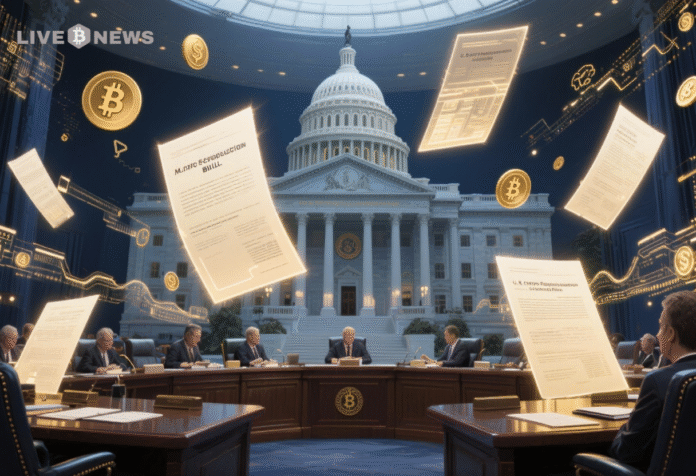

- The CLARITY Act seeks to divide crypto oversight between the SEC and CFTC to end regulatory uncertainty.
- Banks warn stablecoin rewards could trigger deposit flight from the $25T U.S. banking system.
- Senate negotiations continue as lobbying intensifies around crypto market structure rules.
The banking sector in the U.S. has intensified its attack on cryptocurrency companies with lawmakers debating the CLARITY Act. Large banking entities caution that companies dealing with digital assets will have unfair advantages to the extent that the rules are not even.
The conflict revolves around stablecoins, market regulation, and who will dominate the new generation of financial infrastructure. Washington now faces a growing policy battle between traditional banks and crypto platforms.
Crypto Market Structure Debate Centers on the CLARITY Act
The Digital Asset Market Clarity Act of 2025, also known as the CLARITY Act, is still being discussed by lawmakers in Washington. The bill is meant to finally establish clear guidelines on how digital assets are regulated in the United States.
The proposal has already sailed through the House of Representatives in July 2025 with partisan support. That vote was followed by a discussion in the Senate where it is still being revised.
The core issue in the bill is the proposal to split the supervision between two regulators. Securities and Exchange Commission would regulate crypto assets that are viewed as securities, and the Commodity Futures Trading Commission would regulate the digital commodities.
Under the framework, tokens used to raise capital would initially fall under securities regulations. If the underlying network later becomes decentralized, those assets could transition to commodity status.
The legislation also creates a separate category for fiat-pegged payment stablecoins. Banking regulators would oversee their issuance, while the SEC and CFTC would retain authority over fraud and trading activity.
Supporters say the structure could bring long-awaited clarity to the industry. For years, U.S. crypto companies have argued that enforcement actions replaced clear regulatory guidelines.
U.S. Banking Industry Pushes Back on Crypto Rules
The American Bankers Association has warned lawmakers about what it calls an uneven competitive landscape. The group argues that crypto firms offering bank-like services should follow bank-level regulations. Bank representatives raised concerns about digital asset platforms replicating traditional financial products.
Stablecoin rewards remain the largest point of contention. According to posts from the industry-focused account CryptosRus on X.
THE $25T U.S. BANKING INDUSTRY IS PUSHING BACK ON CRYPTO 🚨
The American Bankers Association just warned against what it calls an “uneven playing field” in crypto.
Their message: if crypto firms want to offer bank-like products, they should follow bank-like rules.
This comes… https://t.co/2NBjwcSlrK pic.twitter.com/FvsYBxkOgi
— CryptosRus (@CryptosR_Us) March 11, 2026
The U.S. banking sector holds roughly $25 trillion in assets. That scale gives it significant influence in Washington’s regulatory debate. Lobbying efforts have intensified as Senate negotiations continue. Banking groups have focused heavily on the stablecoin reward provisions within the proposed legislation.
The issue touches core banking functions such as deposits, lending, and interest generation. Regulators must decide whether crypto platforms can operate similar models.
Stablecoin Yield Debate Raises Deposit Competition Concerns
Stablecoins sit at the center of the current dispute. These tokens maintain a fixed value by tracking fiat currencies such as the U.S. dollar. Under the CLARITY framework, permitted payment stablecoins would operate under banking supervision. The rule aims to protect users and ensure reserve transparency.
However, lawmakers continue debating whether platforms can offer yield on stablecoin holdings. Banks argue that interest-like rewards could shift deposits into digital asset platforms. Financial advisor and digital asset advocate Ric Edelman addressed the issue during recent public discussions.
He described the dispute as a broader competition over financial infrastructure. Edelman noted that stablecoins represent a direct challenge to traditional banking models. Deposits historically provide the funding base for lending and credit creation.
Some crypto firms argue that stablecoin rewards support innovation. They claim the model expands financial access and creates new digital payment systems.
Senate Negotiations Shape the Future of U.S. Crypto Regulation
The CLARITY Act now sits in the Senate Banking Committee. Lawmakers have held several sessions to amend the House version. Negotiations also involve a separate Senate proposal called the Responsible Financial Innovation Act. Both frameworks must align before a full vote.
The White House has encouraged lawmakers to reach a compromise. Officials previously set early March as a target for progress. Bank lobbying has slowed the legislative process. Stablecoin rewards remain the central sticking point.
At the same time, the bill includes broader reforms beyond stablecoins. It introduces new registration categories for digital commodity brokers, dealers, and exchanges. The framework also addresses custody requirements for digital assets. The proposal mandates qualified custodians to safeguard customer funds.
Another provision protects self-custody and decentralized development. Developers who build software or validate blockchain transactions could qualify for regulatory exemptions. These factors are designed to retain blockchain innovation in the United States.
The outcome will determine whether banks or digital asset platforms dominate emerging financial rails.