
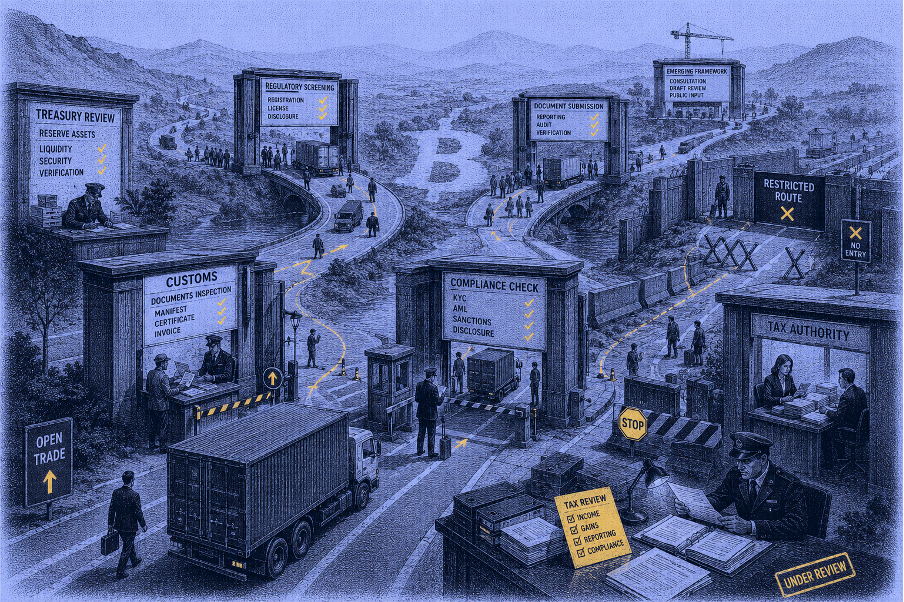
Bitcoin rules continue to change as more governments introduce laws for digital assets. Some countries welcome Bitcoin under clear licensing rules, while others impose strict limits or ban crypto activity altogether. As a result, anyone buying, selling, or holding Bitcoin should understand local requirements before making transactions.
Latest Bitcoin Regulations by Country
Knowing a country’s Bitcoin legal status helps individuals and businesses use the crypto asset within the confines of the law and avoid compliance issues. The list of latest Bitcoin regulations across different countries could make it easier for crypto users to follow the laws of the land.
Countries Where Bitcoin Is Legal
Many countries now allow people to own and trade Bitcoin through regulated platforms. Even so, legal access usually comes with conditions. Exchanges, wallet providers, and other crypto businesses often need licenses and must follow anti-money laundering (AML) and counter-terrorist financing (CFT) rules.
Countries such as the United States, Canada, Japan, Australia, the United Kingdom, Germany, France, Italy, Spain, and Portugal all permit Bitcoin trading under regulatory oversight. Other countries where Bitcoin holds legal status include the Netherlands, South Korea, Brazil, South Africa, and the United Arab Emirates.
Financial authorities in these countries have also introduced stricter rules for customer protection, reporting, and business operations. In many of these markets, Bitcoin is not recognized as legal tender. Instead, it is treated as a digital asset that individuals can own, trade, or invest in while following applicable laws.
Countries With Legal but Restricted Access
Some governments allow Bitcoin ownership but place tighter controls on crypto-related businesses. Under these systems, exchanges, custodians, miners, and other service providers must register with regulators before operating.
Countries following this model include Kenya, Ghana, Pakistan, Bahrain, Oman, Samoa, Uruguay, Belize, Rwanda, Mongolia, Armenia, Azerbaijan, and Zambia. Others that also tow this line include several island nations across the Caribbean and Pacific. In these jurisdictions, private ownership is generally allowed, but businesses must meet licensing and compliance requirements before serving customers.
Faroe Islands, Seychelles, Cuba, Cape Verde, Dominica, Saint Lucia, Saint Kitts and Nevis, Antigua and Barbuda, Vanuatu, and Monaco also follow similar approaches by permitting Bitcoin while regulating commercial crypto services.
Countries Without Dedicated Crypto Laws
Not every country has adopted specific Bitcoin legislation. Some governments rely on existing financial, tax, consumer protection, or AML rules instead of creating separate crypto laws. New Zealand is one example.
Bitcoin ownership is not prohibited, yet regulators continue using existing financial rules rather than a dedicated crypto framework. Similar approaches exist in Ecuador, Colombia, Peru, Jamaica, Panama, Costa Rica, Tanzania, Barbados, Venezuela, Bosnia and Herzegovina, and several African and Pacific nations.
In these countries, banks may decide independently whether to support crypto businesses. Regulatory expectations can also change quickly as governments continue reviewing digital asset policies.
Countries That Restrict Banking Support
Several governments allow some level of Bitcoin ownership while preventing banks and regulated financial institutions from supporting crypto transactions. Saudi Arabia, Uganda, Ethiopia, Guyana, Honduras, Dominican Republic, Cambodia, Jordan, Cameroon, Gabon, the Republic of Congo, Equatorial Guinea, and the Maldives fall into this category.
Residents may still hold Bitcoin in certain situations, but access through traditional banking services remains limited. These restrictions often affect payments, exchange deposits, withdrawals, and banking relationships rather than personal ownership itself.
Countries That Ban Bitcoin Activity
A smaller group of countries continues to prohibit major cryptocurrency activities. In these jurisdictions, authorities may ban trading, exchange operations, promotions, or other crypto-related services.
China remains one of the strictest markets, with authorities maintaining broad restrictions on cryptocurrency trading and related activities. Bangladesh, Morocco, Kuwait, Myanmar, Libya, Fiji, and Algeria also maintain prohibition policies under current regulations. People living in these countries should review local laws carefully before participating in any Bitcoin-related activity.
India’s Special Regulatory Approach
India takes a different path from many other countries. Even though Bitcoin ownership and trading are allowed, Bitcoin is not legal tender. Instead of introducing one standalone crypto law, authorities rely on tax rules, financial monitoring, and reporting requirements to supervise the market. Anyone trading Bitcoin in India should also understand local Bitcoin taxes, since dedicated tax provisions apply to many virtual digital asset transactions.
El Salvador’s Updated Position
El Salvador made headlines after recognizing Bitcoin as legal tender. More recent legal changes have adjusted that approach. Amendments approved in 2025 removed mandatory Bitcoin acceptance for businesses and reduced the government’s role in Bitcoin payments. Private ownership and trading remain lawful, but the country’s framework now operates under more limited conditions than before.
SEC and Bitcoin News
New steps from the U.S. Securities and Exchange Commission could reshape digital asset markets, as regulators prepare a policy that may allow crypto companies to offer blockchain-based versions of publicly traded stocks. Although the proposal focuses on tokenized equities, it also reflects a wider shift in how regulators view digital assets and Bitcoin regulation.
According to recent reports, SEC Chair Paul Atkins plans to introduce an “innovation exemption,” allowing selected companies to test new digital asset products without meeting every existing SEC requirement. Since the policy would be temporary, regulators could monitor market activity before deciding whether broader rule changes are appropriate.
Meanwhile, major crypto firms are preparing for the opportunity. Coinbase has said it intends to launch tokenized stock trading in the United States once approval is granted, while Robinhood and Kraken already provide similar products in several international markets. Growing interest from established platforms suggests tokenized assets could become a larger part of modern financial services.
Supporters believe tokenized stocks can make markets more efficient because blockchain technology allows trading at any time instead of limiting activity to regular market hours. Faster settlement may also reduce delays and lower some transaction costs, which could attract more investors and increase market participation.
However, not everyone shares that optimism. Some legal experts and financial firms argue that reduced regulatory requirements may introduce new risks for investors. Concerns remain about market oversight, investor protection, and how digital trading platforms would operate alongside traditional brokerages.
Recent market data also shows how quickly interest has grown. Tokenized public stocks have expanded from a market valued at only a few million dollars at the end of 2024 to several billion dollars today. As a result, regulators are paying closer attention to digital financial products and their place in the broader financial system.
Tax Rules for Bitcoin Investors
Tax obligations for Bitcoin investors depend largely on local laws, as every country follows its own approach to digital assets. Some impose high taxes on crypto transactions, while others charge little or nothing at all. Rules also vary based on how authorities classify cryptocurrencies, making bitcoin taxes an important topic for anyone who owns or trades Bitcoin.
Many governments treat cryptocurrencies as property or investment assets. Under that approach, taxes usually apply when you sell, trade, or spend your holdings. Income earned through mining, staking, or receiving Bitcoin as payment may also be taxable. Since tax rules differ across jurisdictions, checking the latest guidance in your country or consulting a qualified tax professional is always a wise decision.
Transactions That May Trigger Tax
Several Bitcoin activities can create a tax obligation, although the exact rules depend on where you live. Selling Bitcoin for traditional currency often results in capital gains tax if your investment has increased in value. Likewise, exchanging Bitcoin for another cryptocurrency is commonly treated as a taxable event because one digital asset is being disposed of in exchange for another.
Using Bitcoin to pay for goods or services may also trigger taxes. Many tax authorities treat those purchases as a sale of your cryptocurrency, meaning any gain could become taxable. Similarly, Bitcoin earned through mining, staking, or employment is generally treated as income and taxed under ordinary income rules in many countries.
Transactions That Are Often Tax-Free
Not every Bitcoin transaction creates a tax bill, and several common activities are usually exempt. Buying Bitcoin and holding it without selling is generally not taxable because no gain has been realized. In the same vein, transferring Bitcoin between wallets that you personally own is not usually taxed since ownership remains unchanged. Even so, local tax laws may include additional reporting requirements, so reviewing the rules in your country remains important.
How Different Countries Tax Bitcoin
Bitcoin tax treatment varies significantly from one country to another. For instance, Bitcoin is treated as property in the United States. Short-term gains are taxed as ordinary income, while long-term gains often qualify for lower tax rates. Mining and staking rewards are generally taxed as income, and eligible capital losses may reduce taxable gains within annual limits.
The US’s neighbor, Canada, classifies cryptocurrencies as commodities. In most cases, only half of a capital gain is subject to tax after selling or trading crypto. Business-related crypto income follows separate tax rules, while eligible trading losses may reduce future taxable income.
In the United Kingdom, capital gains tax applies when gains exceed the annual allowance, with rates depending on your income bracket. Bitcoin earned through mining, staking, or employment is generally taxed as income. Investors may also use eligible losses to offset future gains.
Like the U.S., Australian tax authorities treat Bitcoin as property. Selling within one year is generally taxed at ordinary income rates, while holding assets for more than one year may qualify for a capital gains discount. Income earned through mining or staking is also taxable.
Japan has some of the highest cryptocurrency tax rates in the world. Depending on total income, tax rates can exceed 50%. Current rules also place limits on how losses can be used, although discussions about future reforms are still ongoing.
Countries With Low or No Crypto Taxes
Several jurisdictions have adopted favorable tax policies, making them attractive to cryptocurrency investors. The United Arab Emirates does not charge personal income tax or capital gains tax on cryptocurrency. Companies operating in the crypto sector, however, may still be subject to corporate tax.
Malta also offers attractive tax treatment. Long-term cryptocurrency gains may qualify for a 0% tax rate, although short-term trading income can still be taxed depending on individual circumstances. Likewise, the Cayman Islands impose no personal income tax, capital gains tax, or corporate tax on cryptocurrencies. As a result, many blockchain businesses and crypto investment firms choose to establish operations there.
Future Changes to Crypto Tax Rules
Governments continue to refine Bitcoin regulation as digital assets become more widely used. Many countries are introducing clearer tax guidance, while reporting requirements for exchanges and investors are becoming stricter. In many cases, crypto platforms must now share transaction data with tax authorities.
At the same time, international cooperation could lead to more consistent reporting standards across multiple jurisdictions. Those efforts are intended to reduce tax evasion while improving compliance.
Government Bitcoin Reserves
Bitcoin is no longer held only by individual investors and companies. Over the past few years, governments around the world have accumulated significant Bitcoin reserves through purchases, mining operations, asset seizures, and donations. As Bitcoin continues to gain recognition as a strategic digital asset, several countries now control large amounts of the cryptocurrency.
The United States currently holds the largest known government Bitcoin reserve, with approximately 328,372 BTC valued at more than $21.6 billion. These holdings largely come from Bitcoin seized during law enforcement operations and criminal investigations. China follows closely behind with 190,000 BTC worth about $12.5 billion, much of which was obtained through enforcement actions against large-scale crypto fraud cases.
The United Kingdom ranks third with 61,245 BTC, while Ukraine holds 46,351 BTC. Ukraine’s Bitcoin holdings are unique because a significant portion comes from cryptocurrency donations received during times of conflict and national emergency.
Among countries actively embracing Bitcoin, El Salvador remains the most notable example. The country currently holds 7,684 BTC worth more than $500 million and continues to add to its reserves as part of its long-term Bitcoin strategy. Since adopting Bitcoin as legal tender, El Salvador has positioned itself as a global leader in government cryptocurrency adoption.
Other countries with notable Bitcoin reserves include the United Arab Emirates (6,420 BTC), Bhutan (4,973 BTC), and Kazakhstan (3,544 BTC). Bhutan has attracted attention for building part of its Bitcoin holdings through environmentally friendly mining operations powered by hydroelectric energy.
Smaller Bitcoin holders include North Korea (803 BTC), Venezuela (240 BTC), Taiwan (210 BTC), and Finland (90 BTC). Meanwhile, countries such as Germany and Bulgaria previously held Bitcoin but currently report no significant reserves.
In total, government entities collectively control approximately 649,932 BTC, representing about 3.1% of Bitcoin’s maximum supply of 21 million coins. This growing level of government ownership highlights Bitcoin’s increasing role as a strategic financial asset and strengthens its position within the global financial system.
CBDCs vs Bitcoin
Central Bank Digital Currencies (CBDCs) and Bitcoin are both digital forms of money, but they serve different purposes and operate in different ways. CBDCs are issued and managed by central banks, while Bitcoin runs on a decentralized network without government or institutional control. Knowing how each system works helps explain why both are shaping discussions around bitcoin regulation and the future of finance.
What Is Bitcoin?
Bitcoin is a decentralized digital currency that operates on a blockchain maintained by thousands of computers worldwide. As a result, users can send and receive funds directly while retaining greater control over their assets
Some of Bitcoin’s defining features include:
- A decentralized network with no central authority.
- A fixed supply of 21 million coins, making it resistant to inflation.
- A public blockchain that permanently records transactions.
- Wallet addresses that provide pseudonymity instead of exposing personal identities.
- Strong security supported by cryptography and a distributed network.
What Are CBDCs?
Central Bank Digital Currencies (CBDCs) are digital versions of a country’s national currency issued and regulated by central banks. Unlike Bitcoin, they operate within existing financial systems and remain under government oversight. Many countries see CBDCs as a way to improve payment speed and increase the efficiency of digital transactions.
Key features of CBDCs include:
- Issued and regulated by central banks.
- Backed by a country’s fiat currency.
- Integrated into the existing banking system.
- Digital transaction records that can provide greater government oversight.
- Faster and more efficient digital payments.
Although CBDCs offer greater payment efficiency, they also raise concerns about financial privacy. Unlike cash, every transaction creates a digital record, giving authorities greater visibility into how money is spent. Critics also argue that government-controlled systems could eventually allow spending restrictions or other financial controls under certain policies.
Several countries have already introduced or tested CBDCs. China continues expanding trials of the digital Yuan, while the European Union is developing the digital euro. The Bahamas launched the Sand Dollar, and Nigeria introduced the eNaira. However, Nigeria’s rollout struggled to gain widespread adoption despite government efforts to encourage its use. Many citizens continued choosing cryptocurrencies instead, suggesting that public trust remains just as important as technological progress.