



Institutional outflows and macro uncertainty drove ETF declines, with Bitcoin holding a stronger positioning than Ethereum.
Bitcoin spot exchange-traded funds reversed a recent upswing as investors pulled $296 million in net outflows for the week ending March 27, according to SoSoValue data. The withdrawal streak pushed total net assets down 7.5%, dropping from a March 23 peak of $91.7 billion to $84.8 billion by Friday’s close. Market jitters also spread beyond U.S. venues, with global digital asset investment products posting $414 million in outflows.
Macro Headwinds Push Crypto Funds Into Outflows as Bitcoin Pulls Back
CoinShares Head of Research James Butterfill pointed to the first net withdrawals in five weeks. He said the pressure showed up most strongly among major institutional providers, not just in scattered marginal activity.
iShares led with $282 million in redemptions, followed by Grayscale at $96 million and Bitwise at $85 million. That concentration suggested core allocators were actively reducing risk rather than reacting to low-volume sentiment.
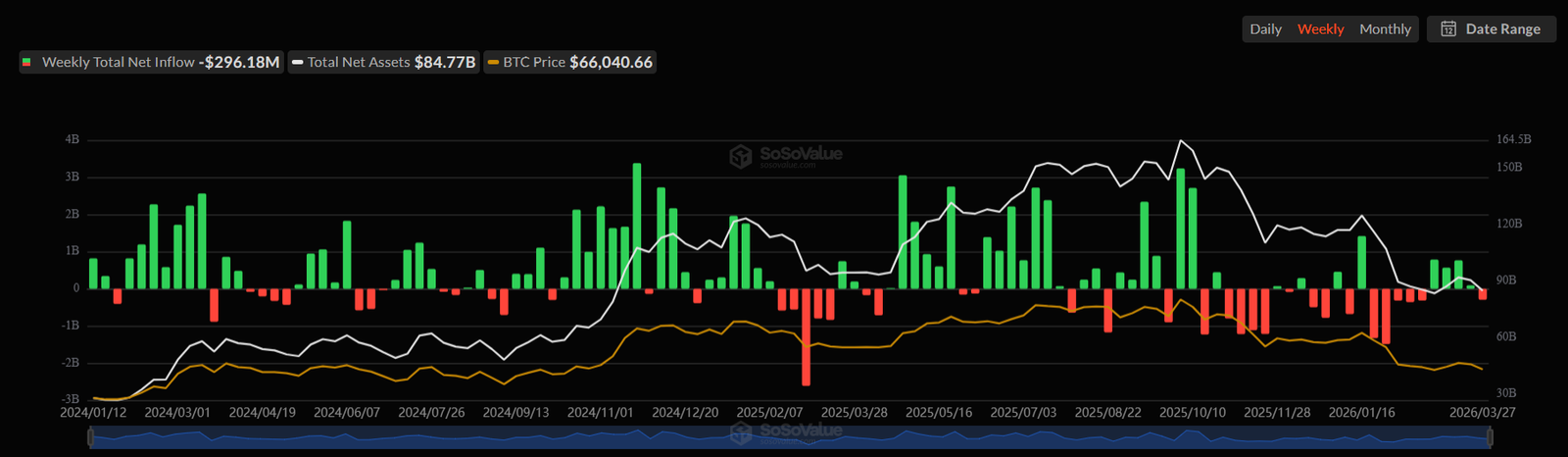
Image Source: SoSoValue
Butterfill tied the wider outflow pattern to growing unease around the drawn-out Iran conflict and rising inflation concerns. He also noted that June FOMC rate expectations flipped from cuts toward hikes. As those macro worries intensified, digital asset allocations appeared to cool, as both prices and capital left investment products.
Across all global funds, assets under management fell to $129 billion. That level matched roughly the period of April 2025 seen during the first phase of Trump’s tariffs, the report said.
The AUM decline reflected two forces working together: Bitcoin’s pullback and continued redemptions. Bitcoin fell from above $71,000 to near $65,000 during the same week, shifting risk appetite downward.
U.S. Outflows Weigh on Global Crypto Funds Despite Overseas Dip Buying
The United States accounted for $445 million of global outflows, essentially driving the entire net withdrawal. Germany and Canada recorded inflows of $21.2 million and $15.9 million, respectively.
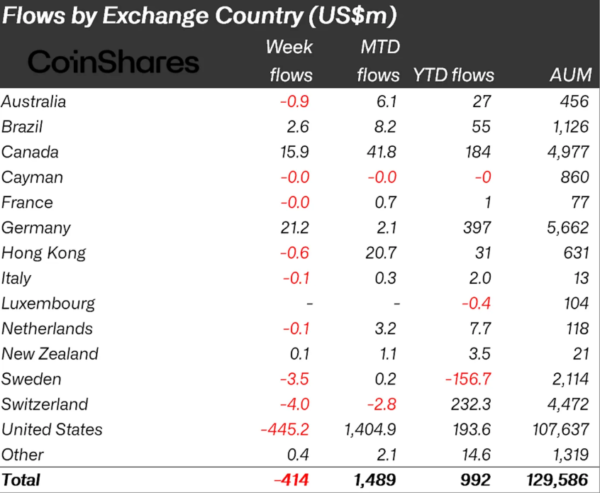
Image Source: CoinShares
Meanwhile, Switzerland saw a smaller $4 million outflow. Those numbers suggested some investors bought dips outside U.S. markets, even as U.S. flows stayed negative.
At the product level, Ethereum investment vehicles took the hardest hit. They saw $222 million in weekly outflows and ended the year-to-date period with net negative flows of $273 million, the weakest position among major digital assets.
Institutional Selling Hits Bitcoin ETFs as Assets Drop to $84.8 Billion
Bitcoin-focused funds posted $194 million in global net outflows yet remained in positive year-to-date territory with $964 million in net inflows. In practice, Bitcoin held a stronger structural positioning than Ether during the rotation.
Still, the selloff did not look entirely uniform. Minor inflows were observed in assets such as XRP and Solana, as well as in multi-asset products. Short-Bitcoin products added $4 million in inflows, suggesting tactical hedging amid price declines. Under the surface, some reallocation occurred rather than straight market capitulation.
U.S. spot Bitcoin ETF outflows were driven by a sharp single-day decline on March 27, when $225.5 million left products that day. BlackRock’s IBIT led the largest fund-level drop, shedding $201.5 million in one session, the biggest outflow among funds during the five-day window.
The volatility followed a mid-week bounce that briefly pushed Bitcoin above $71,000 before it retreated to $65,000 by Friday. The largest coin exchanged hands around $67,376 early Monday, up about 1.4% over the prior 24 hours, as investors weighed macro pressure against remaining ETF inflows.


