

ETF inflows and falling exchange reserves signal tightening Bitcoin supply as institutions accumulate during the market’s recent pullback.
Bitcoin exchange-traded funds are showing early signs of renewed demand after months of persistent withdrawals. Fresh inflows during March suggest institutional investors may be gradually returning to the market. Recent data also indicates that selling pressure has eased compared with earlier in the year. Combined with shrinking exchange balances, the shift may point to a stabilizing market structure.
Bitcoin ETFs Add 18,000 BTC in March After Four Months of Outflows
Spot Bitcoin ETFs have absorbed roughly 18,000 BTC since the start of March. That marks a clear reversal after four consecutive months of net outflows. Activity during late 2025 and early 2026 showed consistent withdrawals as macro uncertainty weighed on sentiment.
Bitcoin ETF demand is finally showing signs of life.
Since the start of March, spot Bitcoin ETFs have already absorbed roughly +18K BTC. That is a sharp break from the previous four months, all of which ended in net outflows.
It does not mean the recovery is confirmed yet. But… pic.twitter.com/bDsoZHPbSW
— ecoinometrics (@ecoinometrics) March 14, 2026
Data compiled by Ecoinometrics illustrates the shift in flows. Each point on the dataset represents a day of ETF inflows or outflows. Earlier months are dominated by blue markers, reflecting sustained periods of negative demand.
On February 25, these investment vehicles posted the most significant single-day outflow in the dataset. That withdrawal occurred during the first wave of volatility linked to new U.S. tariff measures. Meanwhile, broader financial markets also faced pressure during that period.
In March, red markers now appeared more frequently across the chart, indicating consistent daily inflows into spot Bitcoin ETFs. Rather than one large inflow day, the pattern shows steady demand spread across multiple sessions.
Gradual inflows often suggest allocation from longer-term investors rather than short-term speculation. Institutions typically scale positions over time rather than entering markets in a single trade.
Current inflow levels remain smaller than the surge recorded during November’s breakout above $100,000. Even so, the shift in direction carries importance. Sustained ETF demand has historically appeared during accumulation phases in the Bitcoin market.
Institutional exposure through ETFs continues to grow as well. As per data from SoSoValue, spot Bitcoin ETFs now manage about $91.83 billion in assets. That figure represents roughly 6.43% of Bitcoin’s total market capitalization.
Such ownership means ETF flows now carry greater weight in market liquidity. Large inflows or outflows can influence price movement more directly than in earlier cycles.
Exchange Reserves Drop by 500,000 BTC as Supply Tightens
Bitcoin held on exchanges has been declining for more than two years. CryptoQuant data shows reserves falling from around 3.2 million BTC in early 2024.
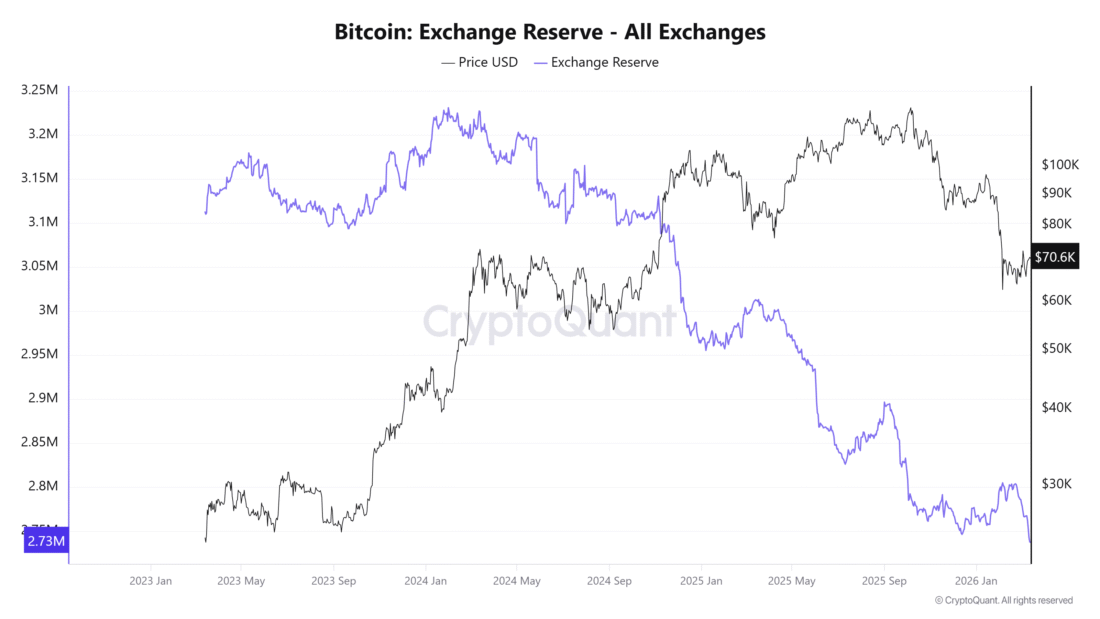
Image Source: CryptoQuant
Current exchange balances stand near 2.73 million BTC. That represents a drop of nearly 500,000 BTC in available trading supply.
Lower exchange reserves often indicate coins moving into long-term storage or institutional custody. Investment vehicles such as ETFs also absorb part of that supply shift.
Bitcoin has recently corrected from above $100,000 to roughly $70,000. Despite the pullback, coins continue to leave exchanges rather than return for sale. Long-term holders appear reluctant to distribute holdings at current levels.