

BTC supply on exchanges falls as ETF demand holds strong, reducing selling pressure and supporting price stability.
Bitcoin inflows to exchanges are declining, suggesting a shift in market behavior. Activity on Binance, the largest exchange by volume, is leading this change. Data shows fewer coins moving onto trading platforms, while withdrawals continue to rise. Combined with steady institutional demand, this trend is shaping a tighter supply environment for Bitcoin.
BTC Inflows to Binance Decline as Exchange Reserves Continue to Shrink
Recent data shows Bitcoin inflows to Binance have dropped to their lowest levels since 2020. As spotted by analyst Darkfost, the 30-day moving average now sits near 4,900 BTC. This is well below the usual range of 10,000 to 15,000 BTC. Lower inflows suggest that fewer investors are sending coins to exchanges to sell.
📉 Bitcoin inflows collapse to 2020 record lows on binance
The 30-day moving average of Bitcoin inflows to Binance has just reached the lowest level ever recorded since 2020.
—> With around 4,900 BTC sent to Binance on average per month, we are far below the historical average,… pic.twitter.com/nwDyhKt6d8
— Darkfost (@Darkfost_Coc) March 18, 2026
Such a move points to easing sell-side pressure in the short term. Reduced inflows often mean traders are less willing to exit positions. Instead, many appear to be holding onto their assets.
According to CryptoQuant, total Bitcoin held on exchanges is also declining. Exchange reserves have fallen from about 2.81 million BTC to roughly 2.72 million BTC in recent weeks. This steady drop signals that coins are leaving exchanges at a faster pace.
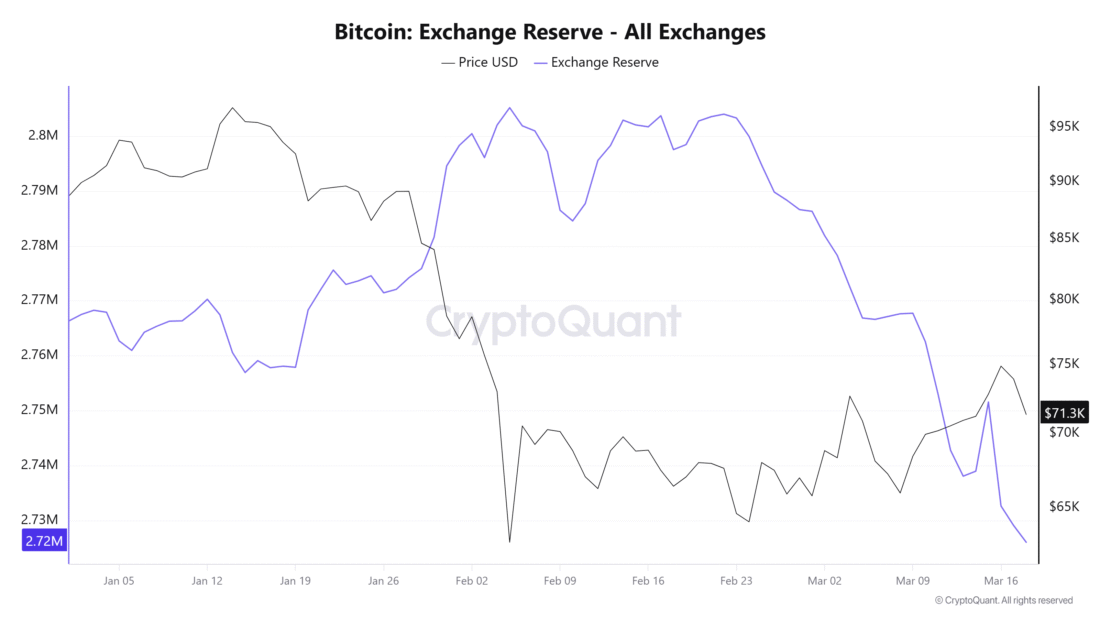
Image Source: CryptoQuant
Shrinking reserves reduce the amount of Bitcoin available for immediate selling. Lower supply on exchanges often supports price stability over time. Past market cycles show similar patterns during early accumulation phases.
Binance plays a key role in this trend as the exchange holds close to 20% of total Bitcoin reserves across all platforms. Changes in Binance flows often reflect wider market behavior. A decline in inflows on Binance therefore carries broader significance.
At the same time, volatility appears to be moderating. Changes in exchange reserves are smaller compared to the swings seen in 2021. This may point to a more stable holder base and reduced speculative activity.
Declining Exchange Supply Meets Strong ETF Demand in Bitcoin Market
Demand remains steady, especially from institutional investors. Spot Bitcoin ETFs recorded around $401 million in weekly inflows. Total assets under management are approaching $96.7 billion. These figures suggest that capital continues to enter the market through regulated channels.
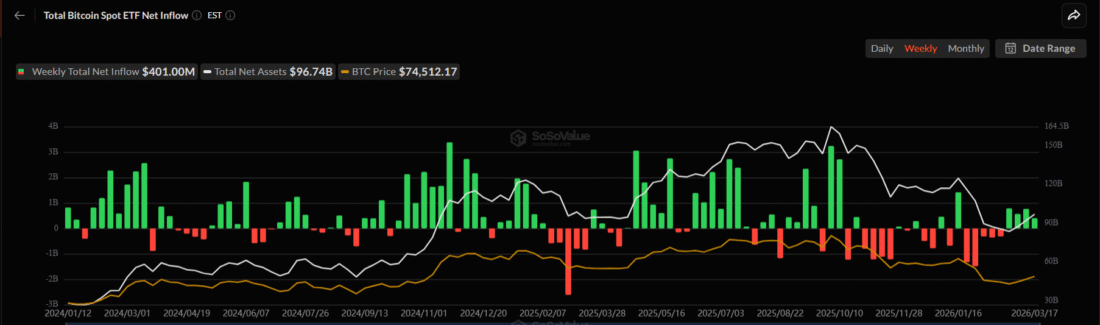
Image Source: CryptoQuant
Coins leaving exchanges are likely being absorbed rather than sold. Institutional products such as ETFs provide an alternative path for accumulation. And as such, this creates a tighter balance between supply and demand.
Fewer coins on exchanges, combined with steady inflows, support a constructive setup. Reduced selling pressure allows prices to stabilize and build upward momentum over time.
Meanwhile, rising geopolitical tensions and persistent inflation continue to weigh on risk assets. Bitcoin has often reacted to these pressures in previous cycles.
Current data, however, suggests a gradual shift in behavior. Market structure appears to rely more on supply constraints and holding patterns. Bitcoin is showing signs of maturing beyond purely macro-driven moves.
Declining Binance inflows reflect more than a short-term signal. Combined with falling reserves and steady institutional demand, they point to a market entering a new phase of accumulation.