

Stablecoin outflows and cooling ETF flows signal weaker liquidity, while falling Bitcoin exchange reserves tighten available supply.
Bitcoin continues to hold relatively stable levels even as liquidity steadily leaves crypto markets. Several indicators now point to tightening capital conditions across the digital asset sector. Stablecoin flows, institutional activity, and macroeconomic signals all reflect a cautious market mood. Analysts say these factors could influence Bitcoin’s short-term stability.
Stablecoin Flows Signal Liquidity Strain Across Crypto Markets
Macroeconomic conditions remain a major source of uncertainty for financial markets. According to market analyst Darkfost, recent economic data has made the outlook for the U.S. Federal Reserve more complicated.
Inflation remains persistent, while consumer demand continues to show resilience. At the same time, unemployment has started rising again, creating mixed signals for policymakers.
Meanwhile, the latest nonfarm payrolls report added another layer of uncertainty. Job cuts came in above expectations, raising concerns about labor market strength and overall economic momentum.
Darkfost said these mixed signals leave the Federal Reserve in a difficult position. As a result, policymakers are likely to remain cautious and delay aggressive policy changes until clearer trends emerge.
🗞️ Macro headwinds continue to pressure crypto markets
The crypto market continues to struggle in this difficult environment for risk assets.
⚠️ The latest macroeconomic data is making the task of the Federal Reserve even more complicated. With sticky inflation, demand still… pic.twitter.com/VM51LVOWW8
— Darkfost (@Darkfost_Coc) March 8, 2026
Liquidity pressure is also appearing across traditional financial markets. Even large asset managers have started to feel the strain.
Recently, BlackRock restricted withdrawals in one of its funds due to limited available liquidity. The move reflects tightening financial conditions across the broader financial system.
Within crypto markets, stablecoin flows offer a clear view of changing liquidity conditions. Stablecoins remain the main source of dollar liquidity used for trading digital assets.
Stablecoin Outflows Signal Liquidity Leaving Crypto Exchanges
Data tracked by Darkfost shows stablecoin exchange netflows have stayed negative since the beginning of the year. In simple terms, capital has been leaving exchanges instead of entering them.
Binance accounts for a large share of those outflows. The world’s largest exchange currently records monthly netflows near negative $2 billion. Such figures point to consistent liquidity withdrawals from trading platforms. Bitfinex also records a similar trend, with roughly $336 million leaving the exchange.
Essentially, these numbers reinforce the broader pattern of capital gradually exiting crypto trading venues. However, the pace of withdrawals appears to be slowing. On February 15, Binance recorded outflows near negative $6.7 billion.
Compared with that spike, current figures remain negative but far smaller. Liquidity pressure therefore, appears less intense than earlier in the year.
Stablecoin supply trends provide another view of market conditions. Total stablecoin market capitalization currently stands near $313 billion. Supply has grown by roughly $3.1 billion over the past week. Liquidity therefore still exists within the broader crypto ecosystem.
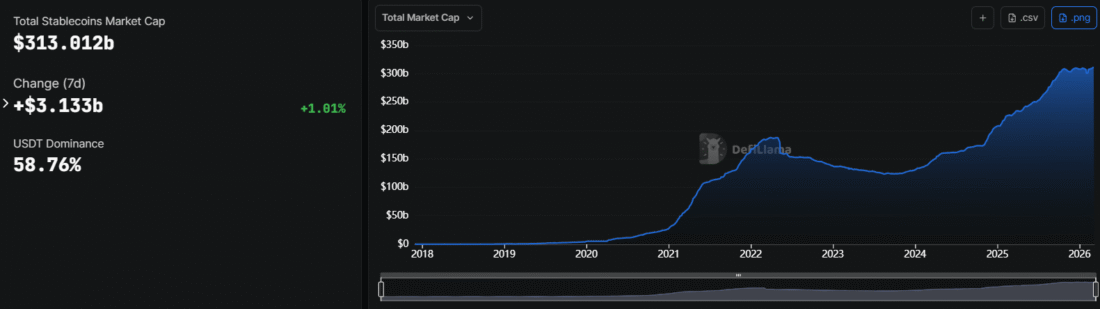
Image Source: DeFiLlama
Even so, the pace of new capital entering the market has slowed compared with earlier growth periods.
Stablecoin concentration is also increasing. Tether’s USDT now represents about 58.7% of total stablecoin supply. Such dominance suggests investors prefer holding a widely trusted asset during uncertain periods. Capital appears parked in stablecoins rather than moving into risk assets.
Bitcoin Supply Shock Builds as Coins Leave Exchanges
Spot Bitcoin ETFs played a major role during the previous rally. Recently, ETF flow data has shown more frequent outflows. Some institutional investors appear to be reducing exposure or locking in profits. Even so, the latest weekly data still recorded around $568 million in net inflows, according to SoSoValue.
Meanwhile, exchange reserves have continued to fall across major trading platforms. Early 2024 data showed roughly 3.25 million BTC held on exchanges. Current balances have dropped to around 2.7 million BTC.
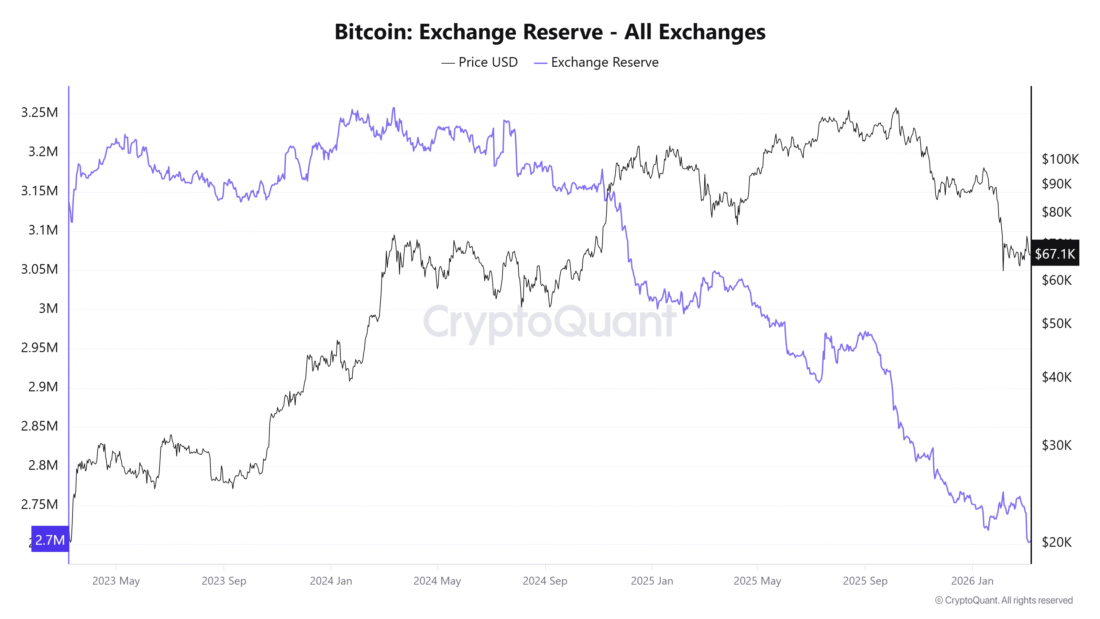
Image Source: CryptoQuant
More than 500,000 BTC have therefore left exchange wallets over that period. Many of those coins likely moved into long-term storage or institutional custody. Lower exchange reserves reduce the amount of Bitcoin available for immediate selling. Such conditions often support price stability during periods of tightening liquidity.