

Bitcoin supply remains concentrated among long-term holders as exchange reserves fall, pointing to slower redistribution than in past cycles.
Bitcoin’s current cycle is showing clear differences from past market patterns. On-chain data shows that long-term holders still control most of the circulating supply. Earlier cycles often saw heavy selling from these investors near market peaks. Current data instead points to a slower and more gradual redistribution of coins.
Bitcoin Supply Redistribution Slower Than 2021 as Long-Term Holders Retain Control
Supply movement between long-term holders (LTHs) and short-term holders (STHs) has followed a different path in the present cycle. Around 79% of Bitcoin’s total supply is still held by long-term investors. That level remains high compared with earlier market peaks.
🔁 In this cycle, the transfer of supply between LTH and STH has not occurred in the same way as in previous cycles.
First, it is important to note that the majority of the supply is still held by LTHs.
—> Today, they represent roughly 79% of the total supply.
Instead of… pic.twitter.com/cPwbvDFpjW
— Darkfost (@Darkfost_Coc) March 15, 2026
During the 2021 cycle, long-term holder supply dropped quickly as prices rose. Data shows the share fell from about 82% to 70% in just over six months. That decline reflected strong selling from early investors as speculative demand surged.
However, liquidity from short-term traders was not deep enough to absorb the pressure smoothly. As a result, coins moved rapidly across the market. That shift created a sharp redistribution of supply.
In contrast, the current cycle has unfolded more gradually. Supply transfers have occurred in several waves rather than a single aggressive phase. Each time long-term holders sold part of their supply, new buyers stepped in.
Over time, many of those buyers continued holding their coins. After several months, those same investors joined the long-term holder group. Analysts have identified roughly six redistribution waves during the present cycle. Step-by-step transfer suggests a more balanced market structure.
Long-Term Holders Still Control Most BTC Supply Despite Multiple Profit-Taking Waves
Bitcoin held on exchanges has steadily declined throughout the cycle. Reserves dropped from about 3.02 million BTC in early 2025 to roughly 2.75 million BTC by early 2026.
In total, more than 270,000 BTC left exchange wallets during that period. Many of those coins likely moved into long-term storage rather than remaining available for quick selling.
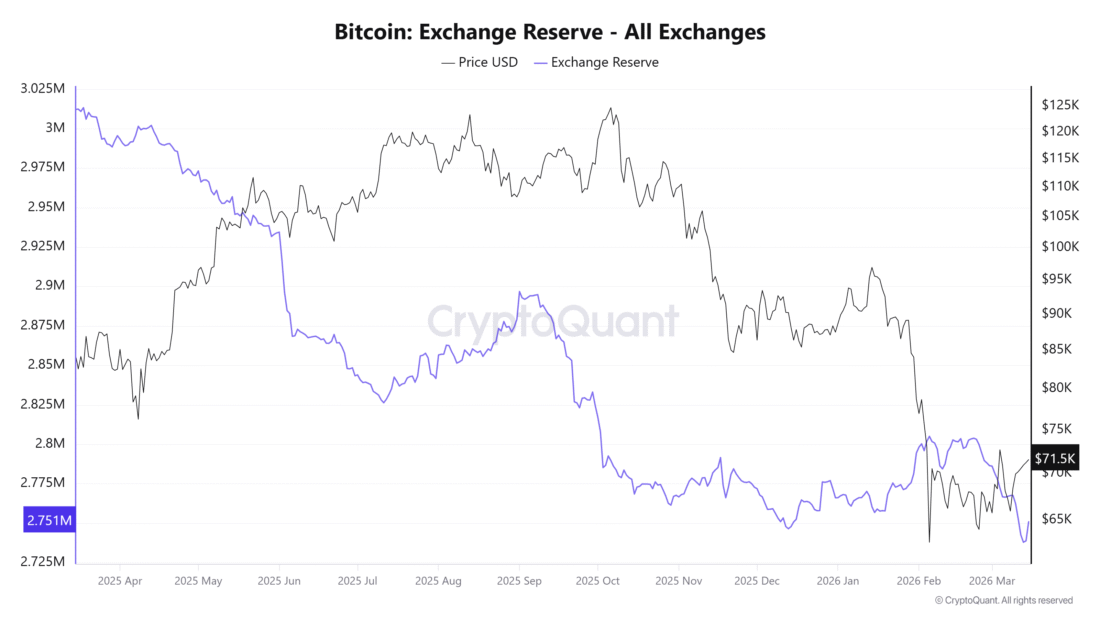
Image Source: CryptoQuant
Earlier cycles often showed the opposite behavior. Rising prices usually pushed more coins onto exchanges as investors prepared to sell. Yet in the current cycle, exchange balances have continued to fall even during strong rallies.
That shift helps explain why long-term holder supply has stayed elevated. Coins sold during profit-taking waves appear to have been absorbed by investors willing to hold them longer.
At the same time, institutional participation has added another layer to market dynamics. Spot Bitcoin ETFs and digital asset treasury companies have accumulated large amounts of BTC. Custodial storage used by these entities usually keeps coins away from trading venues.
Essentially, these factors point to a changing supply structure. Liquidity appears strong enough for long-term holders to sell portions of their holdings without triggering a sharp drop in dominance.
Meanwhile, short-term speculation remains active. Some traders sell shortly after their coins cross the six-month threshold in order to secure profits.