

Bitcoin shows early accumulation as spot demand improves, but weak liquidity and Fed uncertainty continue to limit upside strength.
Bitcoin is beginning to see buyers return after weeks of steady selling. Market data suggests early signs of accumulation are forming. Price has also held near recent highs, showing some resilience. However, tight macro conditions and limited liquidity are still capping momentum.
Buyer Activity Returns as Market Eyes Fed Decision
According to Darkfost, buyer activity is slowly coming back after heavy distribution in February. Spot market data from major exchanges supports this shift. Back on February 16, the 30-day volume delta showed strong selling pressure. Binance recorded -$145 million, while Coinbase saw -$88 million. Both retail and institutional participants were selling at the same time.
🗞️ Buyer activity returns to bitcoin after heavy february selling
Despite escalating tensions in Iran, Bitcoin continues to show a degree of resilience, particularly compared to equities and commodities, which are increasingly displaying toppish market structures.
This is all… pic.twitter.com/NoAMPr8HFD
— Darkfost (@Darkfost_Coc) March 17, 2026
Since then, conditions have started to improve. For instance, the 30-day volume delta has now turned positive, reaching about +$21 million on Binance and +$14 million on Coinbase. Basically, this signals that buyers are stepping into the picture once again.
Even then, the rising tensions in Iran mean that uncertainty across global markets remains. More so, the chances of an unchanged interest rate in the upcoming FOMC meeting stand at 99%.
Despite these factors, the OG crypto has shown relative strength. Compared to equities and commodities, which are showing weaker structures, Bitcoin has held up better. This suggests that the crypto market may be stabilizing despite broader uncertainty.
Bitcoin Finds Support as Weak Hands Exit and Selling Pressure Eases
Open interest has dropped sharply from over $45 billion during late last year to around $22 billion–$25 billion. Despite this decline, Bitcoin’s price remains elevated between $70,000 and $75,000.
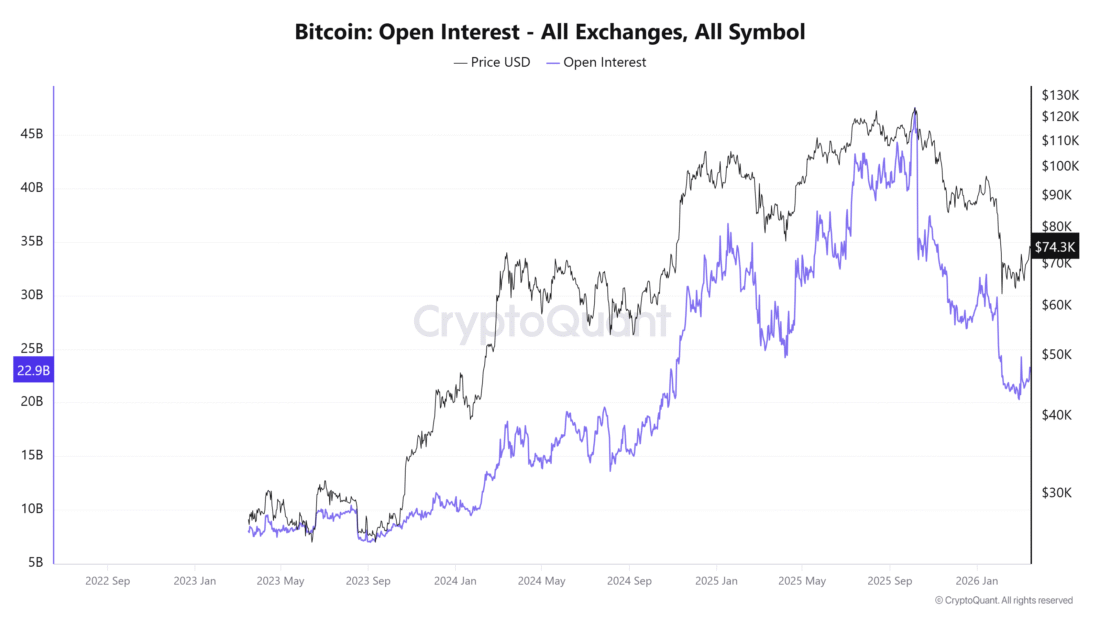
Image Source: CryptoQuant
This divergence suggests that excess leverage has been flushed out of the market, reducing the impact of highly speculative positions. As a result, price action is now being driven more by spot demand, where real buying and selling activity plays a larger role than leveraged trading.
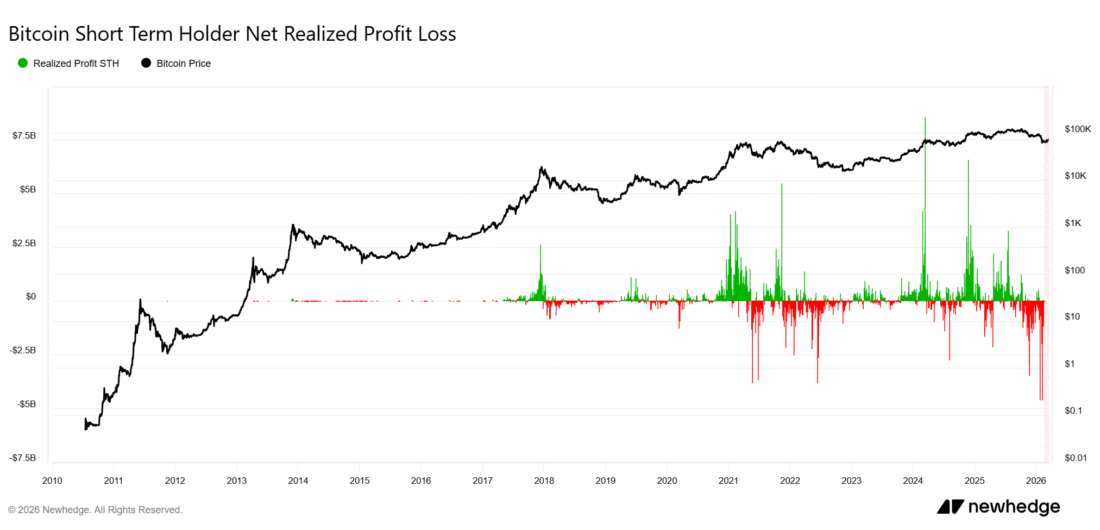
Image Source: NewHedge
Short-Term Holder Net Realized Profit/Loss also supports this view. As per data, many investors have been selling at a loss in recent weeks. However, the pace of these losses appears to have stabilized. In many cases, this type of behavior appears near local bottoms, as weaker hands exit and stronger buyers step in.
Interestingly, the total stablecoin market capitalization is around $316.5 billion, with a weekly increase of about $2.25 billion. While this points to some capital returning, overall market depth is still thin. Because of this, Bitcoin may continue to trade within a range in the short term, with any upward moves facing limited follow-through.