

Shorter Bitcoin cycles and a 900K BTC drop in exchange reserves point to ongoing accumulation despite the recent correction.
Bitcoin’s recent correction has made the downturn feel longer than it actually is. Price volatility and a prolonged pullback from the highs have reinforced that perception. Yet historical data suggests the current phase may still be relatively early compared with past cycles.
Data Suggests Bitcoin Recoveries Are Happening Faster Than Before
Bitcoin reached its cycle peak on October 6 at around $126,230. Since then, the asset has been correcting for roughly 159 days. While the pullback feels extended, earlier cycles took far longer before a new all-time high appeared.
Earlier Bitcoin cycles took much longer to reach a new all-time high after a market peak. After the 2017 peak, Bitcoin needed about 1,180 days to set a new record price. The 2021 cycle took around 1,093 days. In comparison, the 2025 cycle reached a new all-time high after roughly 849 days.
🎯 The cycle top for Bitcoin was marked on October 6 at around $126,230.
Some investors may feel like BTC has been correcting forever, but in reality it has only been correcting for 159 days since that cycle top.
When we compare this with previous corrections or bear markets… pic.twitter.com/BBsIfizCFf
— Darkfost (@Darkfost_Coc) March 14, 2026
These numbers suggest the time between major price peaks is gradually getting shorter. As Bitcoin grows and attracts more liquidity, market recoveries may happen faster than in the past.
Historically, halving events have also influenced these cycles. A halving cuts the reward miners receive for adding new blocks to the Bitcoin blockchain. This event occurs every 210,000 blocks, or about once every four years.
When Bitcoin started in 2009, miners received 50 BTC for each block they added. After four halvings, the April 2024 event reduced the reward to 3.125 BTC. Fewer new coins entering circulation means the supply grows more slowly over time.
Past cycles usually saw a new all-time high after a halving. The 2025 cycle broke that pattern, largely due to structural shifts in market demand.
Shrinking Exchange Supply Signals Continued Bitcoin Accumulation
According to Darkfrost, the introduction of spot Bitcoin ETFs in January 2024 likely disrupted the traditional cycle rhythm. Institutional capital entered the market earlier than in previous cycles, altering the usual timing between halvings and price peaks.
Bear market bottoms also tend to form before a halving occurs. Recovery phases often begin months ahead of the supply reduction event. Even so, halvings still influence the long-term supply side of the market.
Lower issuance gradually reduces the steady selling pressure created by miners. On-chain data support the view that long-term investors continue to accumulate during the current correction. Exchange balance metrics provide a clear signal of that behavior.
At the beginning of 2024, centralized exchanges held more than 3.3 million BTC. Over the past year, balances declined to roughly 2.5 million BTC. That shift represents a reduction close to 900,000 BTC leaving trading platforms.
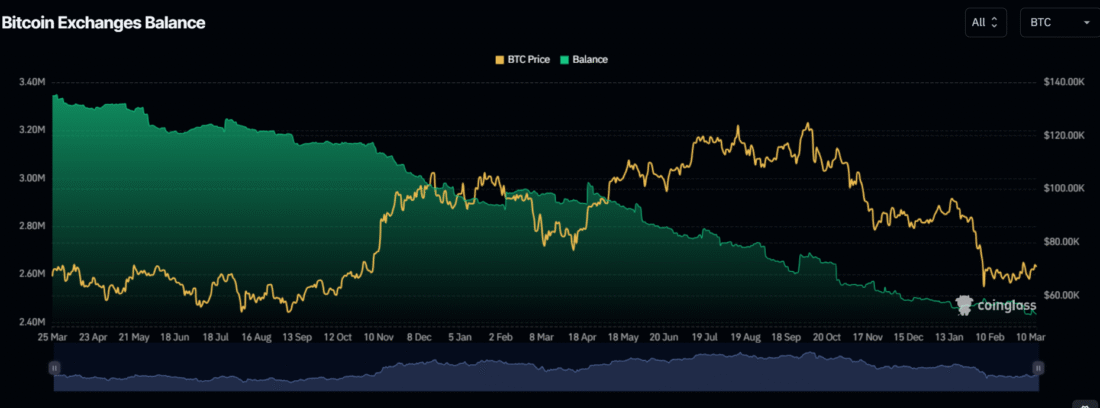
Image Source: Coinglass
Limited exchange supply reduces the number of coins readily available for sale. Such conditions can tighten liquidity when demand returns.
Interestingly, exchange reserves kept falling even as Bitcoin corrected from the $120,000 range. Previous bear markets often showed rising exchange balances during price declines as investors prepared to sell.