
Willy Woo explains how FTX’s collapse quietly rigged the crypto market, leaving altcoin investors at a loss while Bitcoin surged 400%.
Crypto analyst Willy Woo has a pointed explanation for why altcoin investors struggled between 2023 and 2025. He shared it in a detailed post on X.
According to Woo, the collapse of FTX set off a chain of events that quietly drained value from retail crypto holders. Bitcoin surged over 400% to around $88,000 by late 2025. Altcoins, by comparison, barely moved.
How FTX’s Bankruptcy Triggered Altcoin Sell Pressure
When FTX collapsed in 2022, bankruptcy administrators stepped in with one goal: liquidate everything. That included massive amounts of locked Solana tokens.
I'm seeing crypto folk falling into the trough of dispair after an abysmal bull market with mainly losers and BTC outperforming their "beta".
Let me tell you a story that tells you why you got screwed. It starts with the end of FTX.
When the bankruptcy folk came in to liquidate…
— Willy Woo (@willywoo) March 25, 2026
Woo explained that administrators sold these tokens through off-chain legal agreements, promising future delivery in exchange for immediate payment.
Hedge funds jumped at the opportunity.
They purchased the locked SOL at discounts exceeding 60%, then shorted SOL futures to hedge their exposure. The result was a near risk-free return of 70–80%, combining staking yields, basis yields, and the token discount.
Retail investors, unaware of this dynamic, bought in at elevated prices and absorbed the losses.
Woo argued this was not an isolated incident. He noted that similar arrangements spread across the broader crypto ecosystem, with project backers and foundations selling locked tokens to hedge funds.
Those funds then offloaded the risk through futures markets, effectively dumping on ordinary investors before unlocks even occurred.
Bitcoin Dominance Rose as Altcoins Stalled
While altcoins struggled, Bitcoin told a very different story. BTC dominance climbed to between 55% and 60% during this period. Its price surged past $88,000 by late 2025, reflecting strong institutional and retail demand.
Altcoins, weighed down by hidden sell pressure, flatlined.
Woo summed up the situation bluntly in his post.
He wrote that all the alpha retail investors expected went straight to market-neutral hedge funds, capturing risk-free yield. The crypto “beta” play that many investors counted on simply did not materialize.
Current market data from CoinGecko shows Bitcoin trading at $71,285, up 2.47% in the past 24 hours.
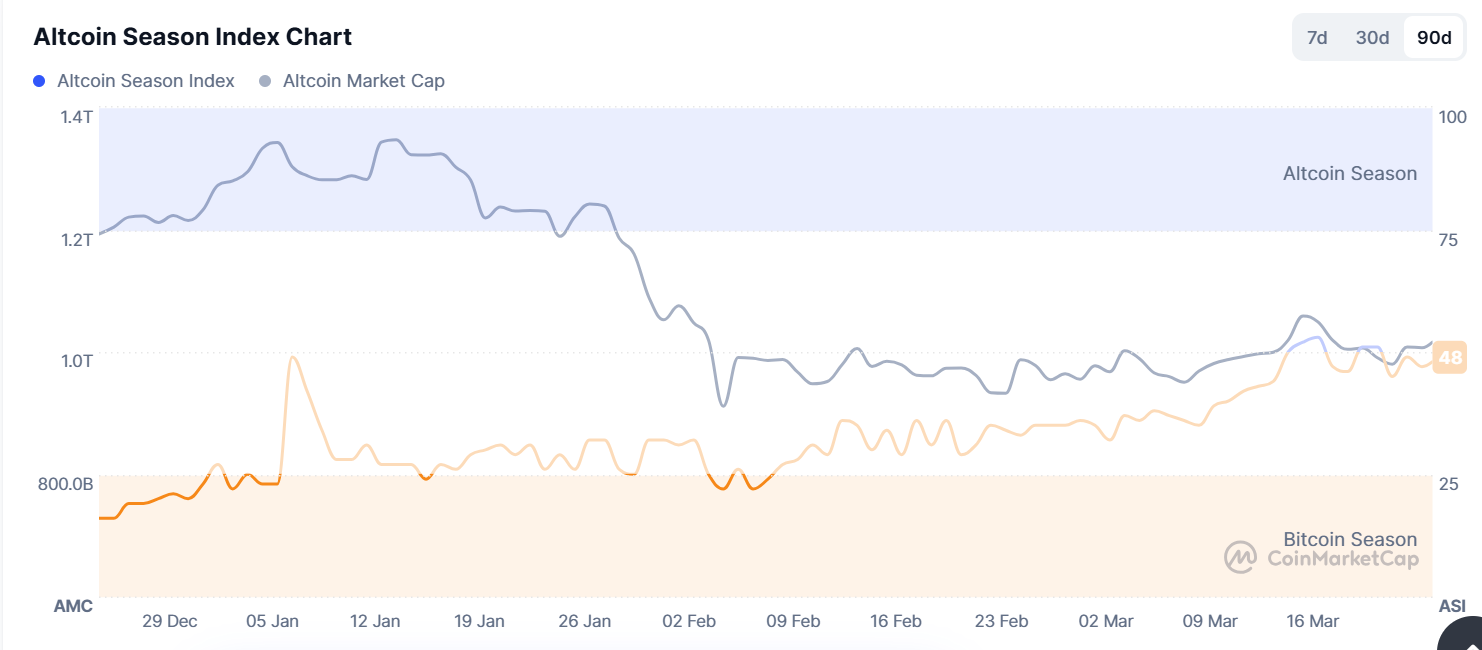
The Altcoin Season Index sits at around 48 on CoinMarketCap, still below the 75 threshold needed to confirm a genuine altcoin season. The altcoin market cap has recovered slightly from February lows near $950 billion.
Besides, it remains well below January highs around $1.3 trillion.
What Experts Say Investors Should Do
Woo offered a cautious but clear takeaway.
He noted that many projects with tokens appearing locked on paper have actually already been sold off-chain. That could reduce expected sell pressure in future cycles. Still, he stopped short of recommending altcoins. His advice was straightforward: just buy Bitcoin.
Investor and FTX creditor Simon Dixon echoed that sentiment on X.
Dixon described FTX’s Chapter 11 process as a wealth transfer benefiting a select group within the financial system, while lawyers drained value meant for creditors.
He shared that some creditors lost everything, including retirement savings and homes. Dixon urged crypto holders to keep Bitcoin in self-custody, avoiding corporate or intermediary layers entirely.
The financial-industrial complex loved the FTX Chapter 11.
I followed every stage of it, and what I saw was clear: Chapter 11 is another wealth transfer to a small club within the FIC, one that profits while lawyers drain the creditors.
I spent two years inside one of these… https://t.co/ReOEFVuFrl
— Simon Dixon (@SimonDixonTwitt) March 25, 2026
Both analysts pointed toward the same conclusion. The 2023–2025 cycle rewarded insiders who understood the mechanics of locked token deals.
For everyone else, Bitcoin remained the clearest path forward.