

Bitcoin momentum slows as investors cut risk, with ETF outflows and weak liquidity shaping market conditions.
Market sentiment is turning cautious as funds begin to leave both crypto and stocks. Bitcoin is slipping alongside major indices, while oil prices continue to climb. At the same time, investors appear to be shifting toward areas seen as more stable amid growing uncertainty across global markets.
Oil Surge Signals Capital Flight From Bitcoin and Global Markets
Bitcoin has dropped nearly 5%, moving in line with declines in the S&P 500, Dow Jones, Nasdaq, and gold. According to The Kobeissi Letter, combined outflows from the S&P 500 ETF and Nasdaq 100 ETF reached $64 billion over the past three months.
This marks the largest outflow on record. It also represents a sharp reversal from the $50 billion in inflows recorded in November. However, crude oil is now up about 50% since the US and Israel–Iran war began on Feb. 28. This divergence reflects a clear rotation away from risk assets into energy markets.
BREAKING: The S&P 500 ETF, $SPY, and the Nasdaq 100 ETF, $QQQ, have seen combined outflows of -$64 billion over the last 3 months, the most on record.
This marks a sharp reversal from +$50 billion in 3-month inflows posted in November.
This is also almost DOUBLE the previous… pic.twitter.com/Rj4XVLR1Gd
— The Kobeissi Letter (@KobeissiLetter) March 20, 2026
Capital flows further confirm this shift. In particular, rising outflows from major equity exchange-traded funds signal reduced risk appetite. As a result, investors appear to be cutting exposure to both equities and crypto.
Recent outflows are nearly double the previous decade high set in 2018. Even during the 2020 pandemic and the March–April 2025 sell-off, flows did not reach current levels. As a share of assets under management, outflows have climbed to 5%, the highest since the first quarter of 2023.
Bitcoin Faces Liquidity Strain as Market Absorption Weakens
Bitcoin ETFs are showing similar weakness, as the spot Bitcoin ETFs recorded $253 million in outflows over the past two days. Although monthly flows remain positive at $1.43 billion, underlying trends suggest fragility. Between November and February, cumulative outflows totaled $6.3 billion, suggesting inconsistent demand.
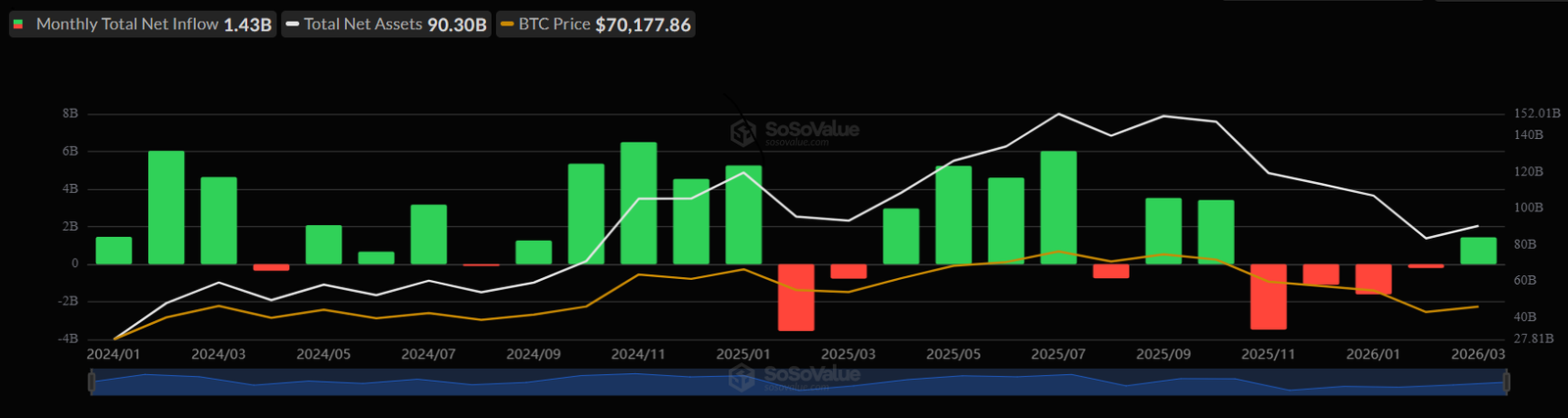
Image Source: SoSoValue
Market data shows that many investors started taking profits quickly. According to Glassnode, net realized profit-taking briefly accelerated to $17 million per hour on a 24-hour average. But that selling slowed down soon after, and Bitcoin’s price dropped below $70,000. This means the market isn’t strong enough right now to handle heavy selling.
Market participants are also comparing the current situation to past events, like the Russia-Ukraine war in 2022. Back then, Bitcoin first dropped, then bounced briefly. But the recovery didn’t last, leading to a prolonged downturn later in the year.
Meanwhile, Bitcoin’s recent price movement follows a pattern similar to earlier ones. The asset rallied nearly 10% earlier in the current conflict but is now losing strength. Analysts attribute the slowdown to tighter liquidity and rising energy costs.
In addition, forced selling during periods of stress is also weighing on demand. Crypto analyst Finish believes Bitcoin may need to fall further, possibly near $55,000, before finding a bottom. They also think prices may struggle to rise until the conflict ends, since markets are currently in a risk-off mode and investors are being more cautious.