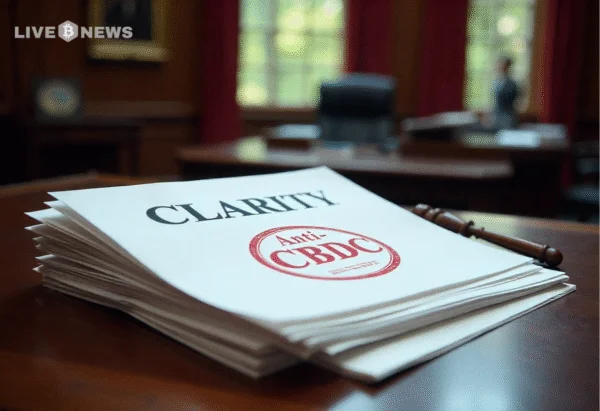

Gnosis co-founder Dr. Friederike Ernst warns the CLARITY Act could hand crypto control to large financial institutions, undermining user ownership and DeFi rails.
The US Digital Asset Market Structure Clarity Act has a problem. According to Cointelegraph on X (@Cointelegraph), Gnosis blockchain protocol co-founder Dr. Friederike Ernst says the bill could push crypto into the hands of a few large financial institutions. That is not a minor concern.
Ernst told Cointelegraph that the bill’s regulatory provisions assume all activity must pass through centralized intermediaries. That assumption, she said, risks consolidating crypto rails with entrenched players who already dominate traditional finance.
Must Read: Wall Street Banks Raise Alarm Over OCC Crypto Licensing Framework
Ownership Model Under Threat
Blockchain’s real breakthrough, Ernst argued, was never just about new financial infrastructure. Users becoming owners of the networks they rely on — that was the shift. The CLARITY Act, as currently drafted, puts that at risk.
“If activity is pushed back through institutional intermediaries, users risk becoming customers renting access to financial technology once again rather than stakeholders in it,” she said, as reported by Cointelegraph.
The failure to protect open, permissionless blockchain rails and DeFi protocols is the core issue she raised. Bring legacy finance’s points of failure into crypto, and you have not reformed the system. You have just rebuilt it.
You Might Also Like: Ethereum Records $263M in DeFi App Fees as Adoption Grows in 2026
Where the Bill Still Gets It Right
Ernst did not dismiss the CLARITY Act entirely. It does clarify regulatory jurisdiction between the SEC and the CFTC. It also protects peer-to-peer transactions and self-custody — two things the crypto community has fought hard to preserve.
But those wins do not fix the deeper problem. Regulatory clarity that unintentionally destroys the ownership model it claims to protect is not clarity. It is a trade-off few DeFi advocates are willing to accept.
Also Read: Galaxy Research Head Flags $9B Crypto Fraud, Proposes DeFi Hold Law
Stalled in Congress. Banks Are Winning the Argument.
The bill remains stuck. A standoff between the crypto industry and banking sector over stablecoin yield has it pinned down. The disagreement centers on whether stablecoin issuers can share interest with holders — banks say no.
Coinbase pulled its support in January. CEO Brian Armstrong was direct about it: “We’d rather have no bill than a bad bill,” he said after reviewing a draft. The provisions targeting DeFi, blocking stablecoin yield, and restricting tokenized real-world asset growth were too much.
Senator Bernie Moreno said he expects the bill to pass by April and reach President Trump’s desk. But Alex Thorn, head of firmwide research at Galaxy, is less confident. Speaking in a post on X, Thorn said if the bill does not pass by April 2026, odds of it becoming law this year are “extremely low.”
Thorn also pointed to deeper problems ahead. “It’s very possible that rewards are not the ‘final’ hurdle but instead just the current hill the bill is dying on,” he posted on X, flagging DeFi protections, developer safeguards, and regulatory authority as potential flash points.
You Might Also Like: Congress Targets ‘Wild West’ Prediction Markets With New Death Bets Ban
The Bigger Question Nobody Is Asking
What happens if the bill passes in its current form. Crypto may gain regulatory clarity. But the permissionless, user-owned infrastructure that made blockchain worth regulating in the first place — that could be quietly hollowed out.
Ernst’s warning is not about killing the bill. It is about what gets quietly lost if the fine print favors institutional access over open rails. The challenge, as she put it, is ensuring clarity does not unintentionally undermine the ownership model.