

Poland’s president has just rejected a strict crypto bill and has triggered a national debate between pro and anti-crypto supporters.
Poland’s president has vetoed a strict crypto bill that aimed to completely change the country’s digital asset rules.
The move generated celebrations from crypto supporters, amid criticism from parts of the government.
Why Poland’s crypto bill faced a veto
President Karol Nawrocki rejected the Crypto-Asset Market Act after months of public debate. His office said the bill threatened the rights of Polish citizens and created a heavy regulatory structure.
One of the strongest concerns came from a rule that allowed the government to block websites in the crypto market without a clear and open process. His team said this could restrict free expression and invite misuse of power.
Tomasz Mentzen, a known supporter of crypto and a Polish politician expected the veto.
Prezydent RP @NawrockiKn odmówił podpisania ustawy o rynku kryptoaktywów.
‼️ Zdaniem Prezydenta, zawetowane przepisy realnie zagrażają wolnościom Polaków, ich majątkowi i stabilności państwa. https://t.co/ZBXaZg5uQI pic.twitter.com/27n7gpAayF
— Kancelaria Prezydenta RP (@prezydentpl) December 1, 2025
He argued that the bill’s long list of rules would raise costs for startups and send them to nearby countries that take a lighter approach. He mentioned the Czech Republic and Malta as examples.
The president also pointed to high supervisory fees in the proposal. He said these charges would block local startups and give an advantage to large foreign firms. He saw this as a mistake that could slow the growth of local companies.
Government officials warn about the risks
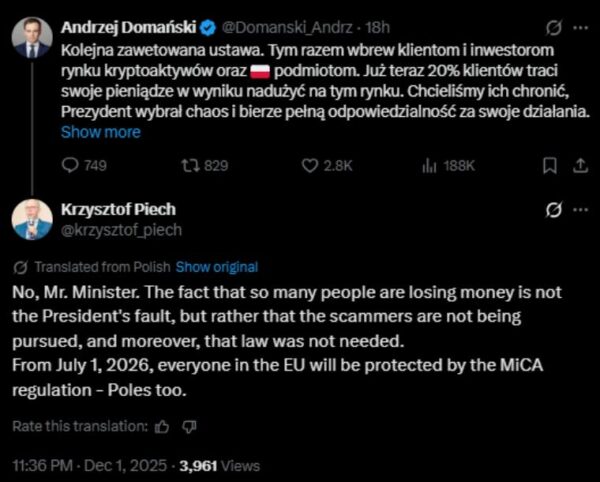
Government officials reacted strongly to the president’s decision. Finance Minister Andrzej Domański said many people have already lost money because of abuse in the crypto market.
He said the president had chosen disorder and should be held responsible if things get worse.
Deputy Prime Minister and Foreign Affairs Minister Radosław Sikorski shared a similar view. He argued that the bill would have brought structure to such a fast-changing sector.
Kolejna zawetowana ustawa. Tym razem wbrew klientom i inwestorom rynku kryptoaktywów oraz 🇵🇱 podmiotom. Już teraz 20% klientów traci swoje pieniądze w wyniku nadużyć na tym rynku. Chcieliśmy ich chronić, Prezydent wybrał chaos i bierze pełną odpowiedzialność za swoje działania.…
— Andrzej Domański (@Domanski_Andrz) December 1, 2025
He warned that if the market collapses and people lose their savings, they will know whom to blame.
Government leaders said the crypto bill was not perfect, but they believed it would have offered stronger oversight where people often face scams. They stressed that the public needs clear rules, especially as more Poles join the crypto space.
How the crypto community responded
Crypto supporters reacted quickly and welcomed the veto. Economist Krzysztof Piech argued that the president cannot be blamed for police failures in catching scammers.
Piech said the veto does not remove the need for oversight, but he believes better systems already exist at the European level.
He pointed to the EU’s upcoming MiCA rules, which will start in July. These rules will cover all EU members and set clear standards for consumer protection, company licensing and stablecoin activity.
Many supporters say Poland should avoid creating a heavy local system when a unified one is already on the way.
They also say innovation will suffer if Poland builds rules that are harder to follow than those in nearby countries. They argue that companies prefer stable and simple systems and will leave if they face too many restrictions.
Related Reading: Poland Passes Crypto Asset Market Act, Moves to Senate
What comes next for Poland
The debate over the crypto bill is not finished just yet. Parliament can try to bring the bill back or write a new version that removes the concerns around website blocking and high fees.
Lawmakers may also wait for MiCA to take effect and choose a lighter national model.
For now, the Polish crypto sector sits between two sides. One side argues that strict controls will slow innovation and drive companies away.
The other side says a fast-moving market without enough oversight puts people at risk. In all, the veto shows ths struggle in Poland (and other parts of the world), to find rules that protect users but do not shut down new ideas.