

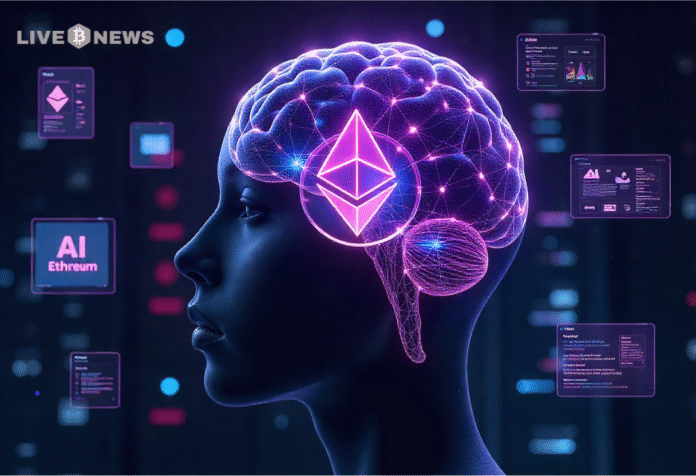

Ethereum launches dAI Team to build decentralized AI infrastructure, finalize ERC-8004 standard, and unite blockchain with trusted, open AI systems.
In a major step toward merging blockchain and artificial intelligence, the Ethereum Foundation has launched a new initiative called the dAI (decentralized AI) Team. This team, led by Ethereum core developer Davide Crapis, hopes to make Ethereum the core of the emerging AI economy and future software development.
Ethereum Lays Groundwork for Decentralized AI Stack
To begin with, the dAI Team has clearly defined goals. In the short term, it will focus on the finalization and creation of the ERC-8004 standard, which is expected to be launched. This new standard aims to enable AI agents to complete transactions smoothly and securely. Notably, this is an innovation that is set to be unveiled at Devconnect in November 2025.
However, the long-term vision is much further-reaching. According to Crapis, the mission is to create a genuinely decentralized AI infrastructure. This would enable AI systems to exist without being dependent on a handful of big, centralized companies. Instead, Ethereum will act as a neutral and open platform of coordination and trust.
Related Reading: Ethereum Foundation Launches ‘Trillion Dollar Security’ Initiative | Live Bitcoin News
In a post on his X (formerly Twitter) account, Crapis elaborated on the two areas of primary focus. First, the team will focus on making an AI economy work on Ethereum. This means developing systems in which AI agents and robots can be paid by others, abide by rules and cooperate – the whole time without middlemen. Second, the team will assist in building a Decentralized AI Stack, which means that AI development is open, transparent, and censorship-resistant.
Furthermore, Crapis highlighted the necessity for joining two communities together: blockchain developers and AI researchers. In the past, these groups have often worked separately. Now, together with the dAI Team, there will be close collaboration with both Ethereum’s Protocol and Ecosystem teams. This will help the future upgrades of Ethereum to align with the needs of AI developers.
Ethereum to Power Verified, Trusted AI Identities
On top of that, Ethereum can help to improve the trust and verification of AI systems. For example, ERC-8004 will help users to know who an AI agent is and whether it can be trusted. This is needed as AI agents start to interact more directly with people and other systems.
Importantly, Crapis pointed out that Ethereum provides a neutral base layer for reputation and value. As AI agents become smarter and more independent, they will need a secure way to prove their identity and exchange value. Ethereum is well-suited to take this role because it is open, global, and decentralized.
Inspired by the d/acc philosophy (decentralized acceleration), and Ethereum’s original ideology, the dAI Team is looking to support public goods and new research to strengthen this ecosystem. They hope to build a future in which humans remain in control and AI benefits the greater good.
In conclusion, the introduction of the dAI Team is a bold step by the Ethereum Foundation. By bringing the strengths of blockchain and the promise of AI together and by combining them into a new approach, they hope to create a fairer, safer digital future. The journey is just starting and the team is actively seeking more talent to join them.


