
JPMorgan Expands JPM Coin to Ethereum for Institutional Payments

Latest in Ethereum
JPMorgan Expands JPM Coin to Ethereum for Institutional Payments
Standard Chartered Opens Bitcoin and Ethereum Trading to UAE Clients
Bitcoin, Ethereum and XRP Flash Buy Signals After Major Sell-Off
Bitmine’s ETH Buying Spree Nears End With Holdings at 4.9% of Supply
Ethereum Price Faces Key $2.8K Test as Bulls Target $4,800
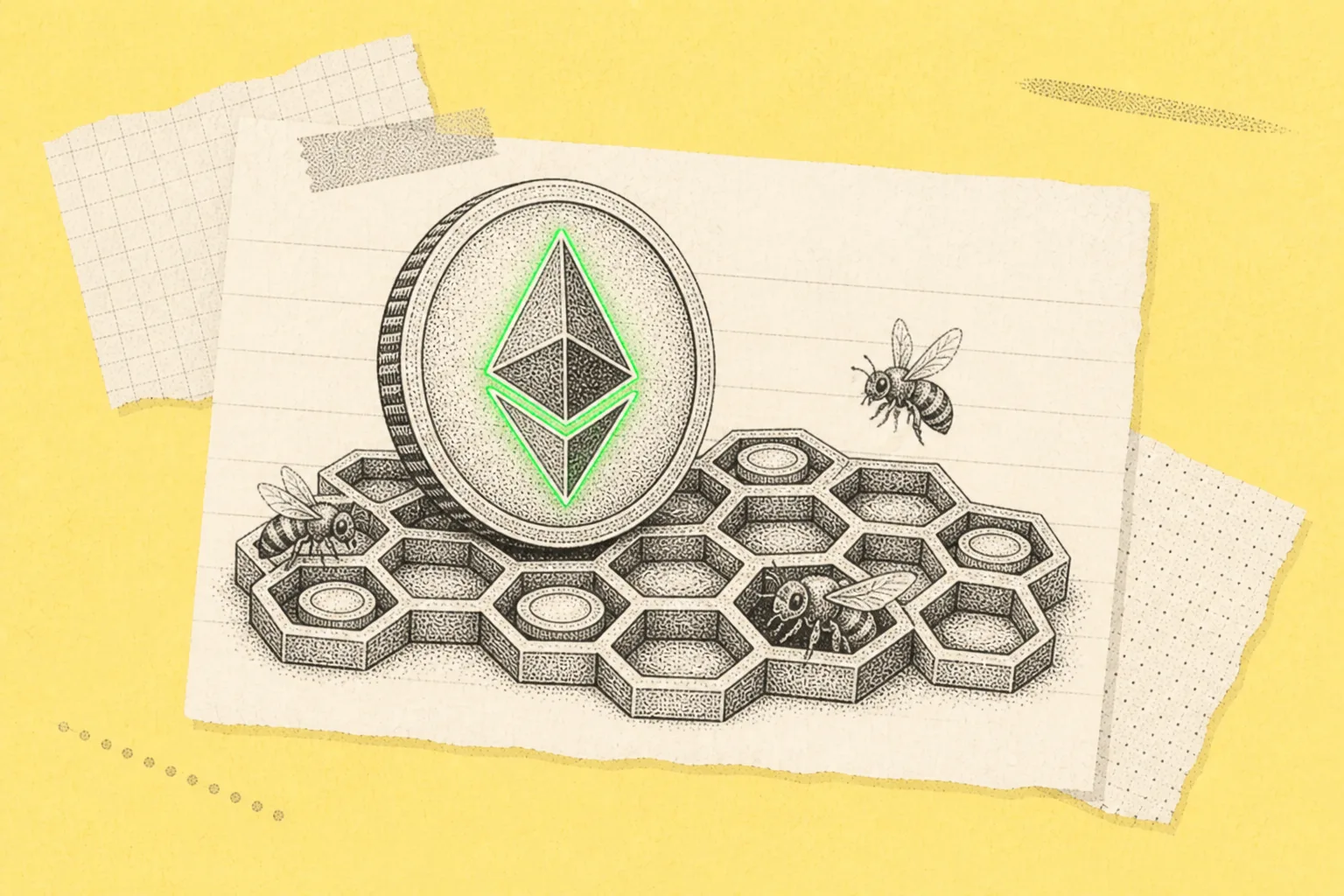
Ethereum is a decentralized blockchain network. Related: Korea continues fuel demand ethereum xrp. It’s also a development platform, and it operates on its own currency, ether or ETH, in short. Many people use the two names, Ethereum and ETH, as if they mean the same thing. That doesn’t usually cause confusion in normal speech. But in reality, they refer to different things, and knowing that distinction makes the rest of this guide easier to follow.
Ethereum matters beyond just its price, since it’s the backbone of decentralized finance, or DeFi, to a large extent. It’s the network where most NFTs live, the settlement layer beneath a growing number of Layer 2 networks, and, more recently, the asset held inside regulated financial products used by institutions. None of this happened by chance, and none of it happened all at once.
Whether you’ve never used a cryptocurrency exchange, already follow the industry closely, or are weighing Ethereum as a long-term investment, this guide aims to offer a clear, complete answer. It starts with the fundamentals, moves into an overview of how the network works, and then covers its token economics as they stand today.
Later sections describe what people are actually building on Ethereum, where the network is headed, how the risks and arguments look from an investor’s standpoint, and how to take the first safe steps toward using it. Also covered: 900b gone silvers flash crash makes ethereum look small. Meanwhile, if you are already aware of Ethereum and interested in keeping yourself updated about the latest developments in the Ethereum ecosystem, follow the for the latest news.
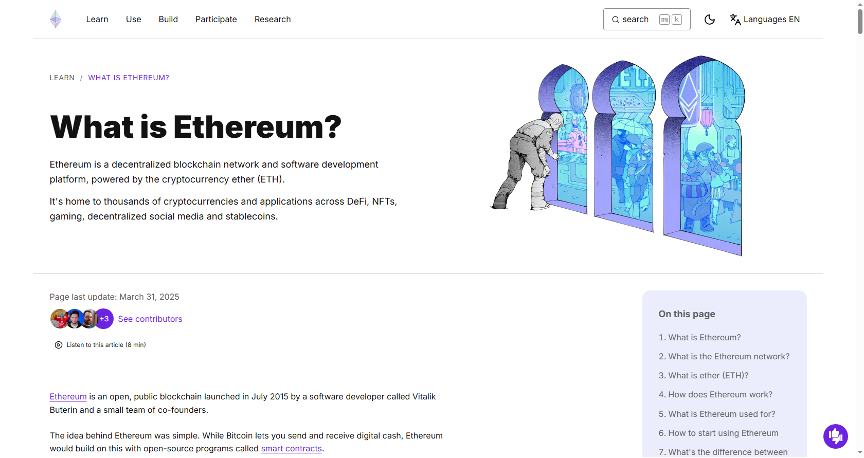
Ethereum.org’s own plain-language explainer page, the Ethereum Foundation’s answer to the exact question this section covers. Source: ethereum.org
Ethereum operates as a decentralized “World Computer”. Also covered: Mike mcglone ethereum will soon eclipse btc. Related: Ethereums pectra upgrade skyrockets max stake to 2048 eth. There’s no single central server to switch off and halt Ethereum, and no single company owns or runs it. Instead, thousands of independently operated computers, called nodes, each hold an identical copy of the same record of transactions. These nodes agree on the contents of that record by following a shared set of rules built into the software itself.
What actually separates Ethereum from an ordinary digital ledger is that it also runs code. Developers can deploy small programs called smart contracts onto the network, and those programs execute exactly as written; nobody can modify them afterward. That single feature lets applications operate without a company sitting in the middle, and it’s generally what people mean when they call a system decentralized.
Ether (ETH) is the asset that powers the network. It pays for computation, secures the chain through staking, and trades as an independent asset on nearly every major exchange. Ethereum is the network; ETH is the asset that runs on it. In everyday conversation, the two terms are interchangeable without much issue, though the distinction starts to matter once staking, gas fees, or tokenomics enter the discussion.
A programmer named Vitalik Buterin published the Ethereum whitepaper in November 2013. See also: Vitalik buterin donates 533k from memecoins to animal welfare charity. His central argument was that Bitcoin’s scripting language was too restrictive, and that a blockchain could instead be built to run arbitrary programs rather than simply move funds from one address to another. A small group of co-founders joined soon afterward, and by the summer of 2014 the team ran a public token sale that raised around 31,000 BTC, worth about 18 million dollars at the time, to fund development.
The network itself went live on July 30, 2015, in a phase known as Frontier. This was the genesis block, the first moment Ethereum’s blockchain existed, and the first time a smart contract could be deployed on a live network rather than a test environment.
That no single company owns Ethereum today was the intention from the start, not an accident of circumstance. Independent client teams coordinate development, researchers contribute alongside them, and the nonprofit Ethereum Foundation funds research and distributes grants without holding any authority to control the protocol by decree. Proposed changes move through a public review process that can take months, sometimes years, before anything is finalized. It’s a slower, less centralized way of building software than a typical company follows, and that same structure is the reason no single party can shut the network down.
Bitcoin and Ethereum are frequently discussed together, and the two do share meaningful similarities: both are decentralized, both run on public blockchains, and both rely on cryptographic proof rather than a central authority for security. Beyond that shared foundation, the two were built for different roles.
Bitcoin was designed primarily as digital money, a way to send value directly between two people without a bank acting as an intermediary, and its scripting language is intentionally limited to support that single purpose. Ethereum took a different path: a general-purpose platform with a scripting environment flexible enough to support entire applications. That one design choice explains why DeFi, NFTs, DAOs, and thousands of independent tokens exist on Ethereum rather than on Bitcoin’s base layer, which was never built to support them.
| Bitcoin | Ethereum | |
| Primary purpose | Digital money/store of value | Programmable platform for applications |
| Core capability | Peer-to-peer value transfer | Smart contracts and dApps |
| What’s built on top | Mostly payments and custody | DeFi, NFTs, tokens, DAOs, L2s |
Underneath the technical terminology, Ethereum functions as a system that enables consensus between participants who have no reason to trust one another without the need for a central authority acting as a referee. The sections below explain, piece by piece, the components that make this possible.
A blockchain is a sequential arrangement of blocks of information. Each block contains a bundle of recent transactions that are cryptographically linked to the block before it. If someone tries to alter the contents of an old block, every block created after it visibly changes too. That’s why blockchain history is described as tamper-evident rather than simply tamper-proof, closer to a shared spreadsheet everyone can watch being updated in real time than a sealed vault.
Relying on thousands of independent nodes instead of one central server comes down to a question of trust. A single company controlling the ledger could freeze accounts, alter balances, or shut down entirely, at its own discretion. When many independent operators each verify the same information instead, no single party can quietly rewrite history, because every other copy of the record would immediately disagree.
A smart contract is a piece of code deployed to the blockchain that runs exactly as written, with no customer service department to appeal to if the outcome isn’t what you expected. A useful comparison is a vending machine: the correct input produces a fixed result, and the machine can’t be made to behave differently. No manager exists who can override the outcome afterward.
That rigidity cuts both ways. The rules can’t be quietly changed after deployment, and because the code is publicly visible, anyone can review it before trusting it with real funds. Errors in the code, however, are just as permanent as its intended features, a lesson Ethereum learned early in its history, at considerable cost, described later in this guide.
Most developers write smart contracts in a programming language called Solidity. Further reading: Overview ethereums smart contracts. Deploying a contract requires paying a fee, denominated in gas, to have the code placed onto the network. Once a contract is deployed, anyone can interact with it, and the same rules apply to every user without exception.
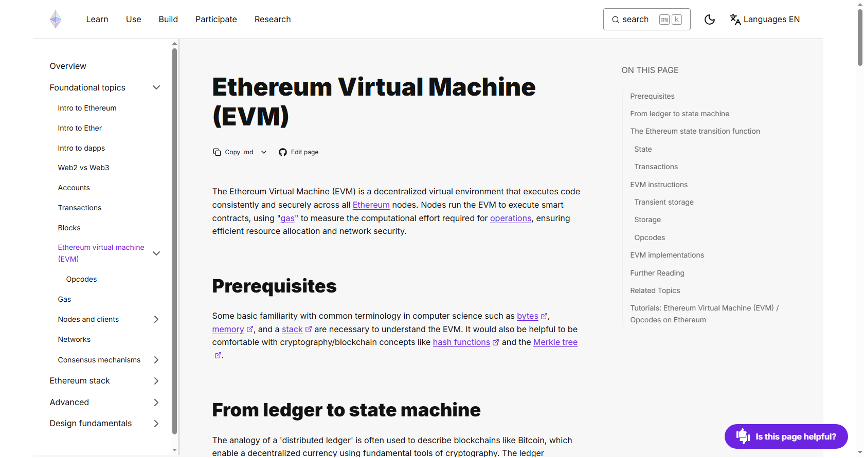
The Ethereum Virtual Machine documentation page, describing the runtime environment every Ethereum node executes in parallel. Source: ethereum.org
The Ethereum Virtual Machine, commonly abbreviated as the EVM, is the software environment that actually executes smart contract code. Every node on the network runs its own copy of the EVM and processes identical instructions, which is how thousands of separate computers consistently reach the same result.
EVM compatibility has grown into something bigger than Ethereum itself. Because the execution environment is well documented and thoroughly tested, many other blockchains and Layer 2 networks adopted it instead of building an equivalent from scratch, which is why code written for Ethereum often runs with little or no modification on networks such as Arbitrum, Base, or Polygon.
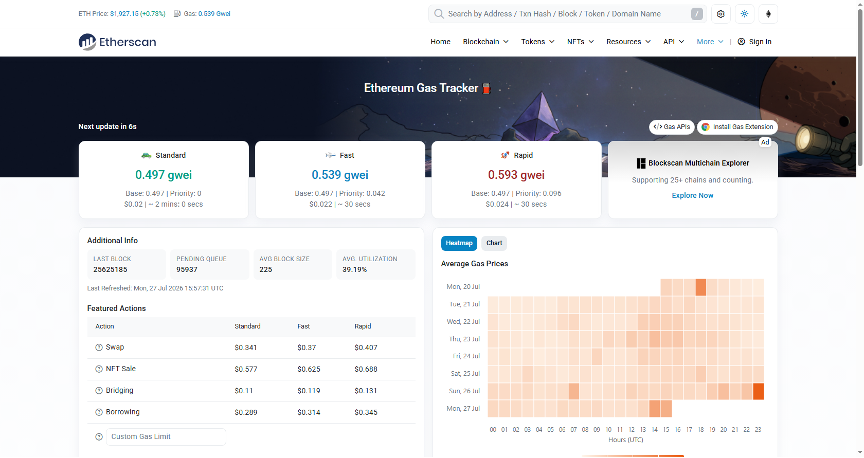
Ethereum mainnet gas prices sitting near 0.5 Gwei at the time of writing, a fraction of the double-digit Gwei spikes seen during 2021’s congestion. Source: Etherscan Gas Tracker
Gas is the fee paid to have a transaction processed and included in a block, and it exists for a practical reason. Without any charge attached to using the network, it would be easy to flood the system with pointless transactions and slow it to a halt. Charging for computation, and directing that fee to the validators who secure the network, keeps the incentives of every participant reasonably aligned.
Two figures determine what a transaction actually costs. Gas price is the amount a user is willing to pay per unit of computation, typically measured in a small denomination called Gwei. Gas limit sets the maximum amount of computation a user is willing to fund, a safeguard that prevents a flawed transaction from draining a wallet by running indefinitely. Multiplying the two figures gives the approximate fee.
Fees rise when many users compete for block space at the same time, not unlike toll roads getting more expensive during rush hour. That congestion is the main reason much of the activity has shifted to Layer 2 rollups, which batch thousands of transactions together and settle them back to Ethereum at once, spreading the cost across every participant.
Programmable money carries real advantages and real risks at the same time. The same immutability that makes a smart contract trustworthy also means a coding error can be exploited once and drained just as permanently as any legitimate transaction. Ethereum’s history includes a founding-era security incident, described in more detail shortly, that forced the community to choose between its code and its stated principles, and similar exploits have continued since. Earlier this year, an attacker exploited a flaw in a cross-chain bridge protocol and drained approximately $450,000 across Ethereum, Base, Arbitrum, and BNB Chain. The risk hasn’t disappeared over time; it has simply moved, from the base layer of the network to the applications built on top of it.
None of this cancels out the benefits of an open system. The same transparency that lets attackers study smart contract code also lets independent auditors, researchers, and competing developers study it just as closely, and security practices around Ethereum have improved considerably since 2016. The tension between permissionless innovation and permissionless exploitation is a structural feature of the model itself, not an oversight that was later corrected.
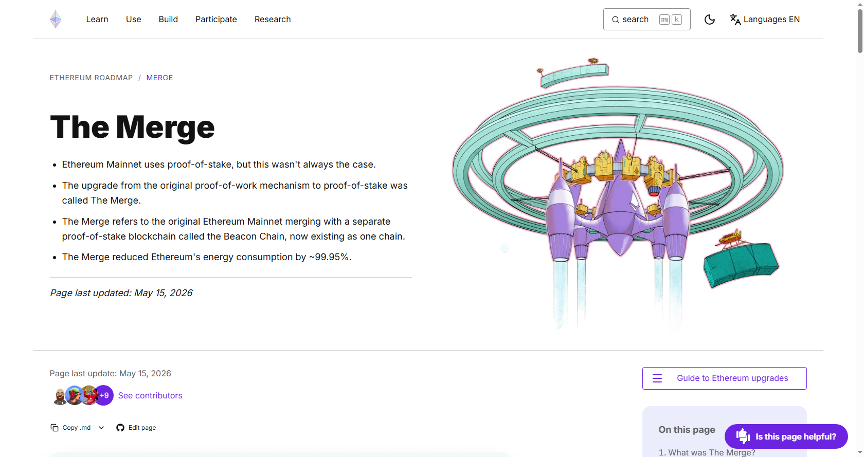
Ethereum.org’s official page documenting the Merge, the September 2022 event that retired proof-of-work mining in favor of proof-of-stake validation. Source: ethereum.org
For years, miners competed against one another solving computational puzzles to earn a block reward, a process that consumed enormous amounts of electricity. That changed on September 15, 2022, when Ethereum completed an upgrade known as the Merge, permanently retiring proof-of-work mining in favor of proof-of-stake validation. Validators now lock up ETH as collateral and are selected to propose and confirm blocks, with dishonest behavior punished by the loss of part of that collateral.
Technically, the Merge combined Ethereum’s original execution layer with the Beacon Chain, a parallel proof-of-stake system that had been running quietly since 2020, purely as a testing environment. The two were joined into a single live network, and the transition required no action at all from ordinary users.
The figure most often cited from the Merge is a reduction of roughly 99.95 percent in the network’s energy consumption, since mining hardware is no longer needed to compete for blocks. A less widely discussed, though equally significant, effect is that proof-of-stake also changed Ethereum’s issuance model completely, which is exactly where the discussion of tokenomics picks up below.
Tokenomics refers to the set of rules governing how a cryptocurrency is created, distributed, used, and, in some cases, removed from circulation. It covers supply schedules, incentive design, and anything else that affects how scarce or abundant a token becomes over time. For Ethereum, this framework changed twice in significant ways: once with the Merge, and once a year earlier, through a fee-burning mechanism that turned out to matter a great deal.
Under the earlier proof-of-work system, new ETH entered circulation as block rewards paid to miners, at a rate that pushed total supply upward steadily year after year, similar in principle to how Bitcoin’s own mining rewards work. Ethereum has no hard supply cap written into its protocol the way Bitcoin does, though issuance was still governed by a fixed schedule.
Proof-of-stake replaced miners with validators, and issuance now scales with the total amount of ETH actively staked rather than a flat mining reward. A larger amount of ETH staked results in more total issuance paid to validators overall, yet the reward rate for each individual validator falls as the pool of stakers grows. That’s exactly the pattern reflected in the current data below.
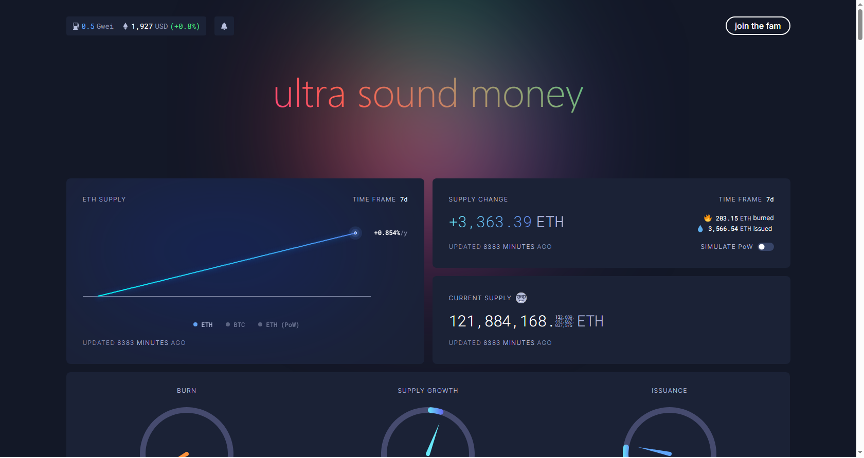
A live snapshot from ultrasound.money showing Ethereum’s current supply near 121.88 million ETH, with issuance temporarily outpacing burn during a quiet, low-fee week. Source: ultrasound.money
In August 2021, an update to the Ethereum network, named the London Upgrade, introduced Ethereum Improvement Proposal -1599 (EIP-1599) to change how transaction fees are calculated. Instead of a pure auction where the highest bidder wins block space, every transaction now pays a base fee that adjusts automatically with network demand, in addition to an optional tip for the validator. The base fee itself is paid to nobody; it’s permanently removed from circulation, a process commonly described as burning.
This burn mechanism made Ethereum’s total supply dynamic rather than continuously rising. When network activity is high, more ETH gets burned than is issued to validators, and total supply can shrink. During quieter periods, issuance outpaces burning and supply rises again. Roughly 4.6 million ETH has been burned in total since EIP-1559 took effect, worth more than 9 billion dollars at current prices, though a slower burn rate over the past two years means the network has actually been net inflationary more often than not since the Merge.
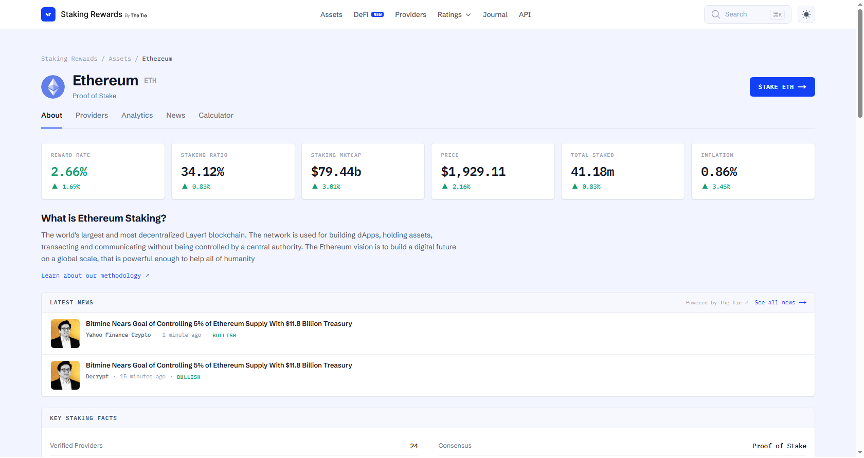
Live Ethereum staking metrics: a 2.66% reward rate, 34.12% of all ETH staked, and roughly $79 billion in total staking market cap. Source: Staking Rewards
Proof of stake asks validators to commit ETH as collateral rather than spend electricity on mining hardware. Running an independent validator requires staking 32 ETH to propose and confirm blocks; dishonest behavior or extended downtime results in a portion of that stake being destroyed as a penalty through a process called Slashing.
For anyone without 32 ETH on hand, staking pools and liquid staking platforms let smaller holders combine funds and split rewards proportionally, without running validator hardware themselves. More than 41 million ETH, close to a third of the entire circulating supply, is currently staked through these methods, earning a reward rate of roughly 2.66 percent annually. That figure keeps shifting: staking recently hit a record 34% of supply while rewards fell to their lowest level on record, a direct result of more participants competing for the same pool of issuance.
Ethereum doesn’t run on a fixed inflation rate the way many cryptocurrencies do. Its supply moves in either direction depending on two things happening at once. One is the amount of new ETH issued to stakers; another is the amount of ETH burned through EIP-1559 during the same period. Heavy network usage tends to push the balance toward deflationary; quieter periods push it back toward inflationary.
That dynamic is exactly what a large wave of ETH moving into staking has done to the numbers recently, locking up supply while simultaneously boosting issuance, since issuance scales with the total staked. A record 3 million ETH moving into staking pushed the circulating supply available on exchanges down to multi-year lows, even as total supply kept climbing at the same time. Those two figures moved in opposite directions at once, a nuance a single inflation number could never fully capture.
Token utility describes what a token is genuinely required for, apart from any speculative value assigned to it. A token with no real use inside its own network depends entirely on people wanting to hold it for its own sake, a considerably weaker foundation for long-term value.
ETH’s utility works on several levels at once. It pays every gas fee on the network, it’s the asset validators stake to secure the chain, and it also serves as the primary collateral used throughout DeFi, backing loans, supplying liquidity, and settling trades. That combination, a currency the protocol itself requires in order to function, accounts for a substantial part of ETH’s value beyond ordinary supply and demand.
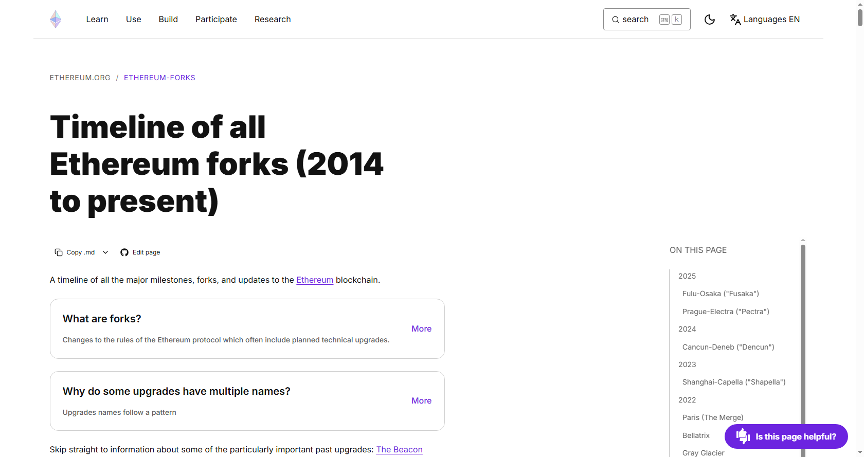
Ethereum.org’s own maintained timeline of every network fork from 2014 to the present, the clearest primary record of the network’s upgrade history. Source: ethereum.org
Ethereum’s history doesn’t follow a single straight line. It unfolds more like a series of overlapping developments: a founding idea, a security crisis that nearly split the project apart for good, several stretches of intense speculation, and a slow, ongoing effort to rebuild the network’s technical foundations that continues even today.
2014: The whitepaper was published in November 2013, and a crowdsale funded development through the summer of 2014. Frontier, the first live mainnet, launched on July 30, 2015. Within a year, developers were already deploying real smart contracts and decentralized applications on a network still in its early stages.
2016: Then, in 2016, came The DAO, a large, community-governed investment fund built as a smart contract on Ethereum. Related: Ethereum foundation formalizes defi strategy with new protocol support unit. It raised roughly 150 million dollars worth of ETH from thousands of participants, an enormous sum for the time. An attacker found a reentrancy flaw in its code and used it to withdraw more than 3.6 million ETH, worth around 60 million dollars at the time, before the exploit could be stopped.
The response proved just as controversial as the hack itself. Ethereum’s developers proposed a hard fork that would effectively reverse the chain’s history and return the stolen funds, overriding what the original code had technically permitted. Most of the community backed the fork, and that version became the Ethereum in use today, while a minority disagreed on principle, arguing that code should be treated as final regardless of outcome, and kept running the original, unforked chain under the name Ethereum Classic. That split still exists. It remains one of the clearest real-world examples of tension between a blockchain’s technical rules and the human judgment of the people operating it, and it shaped how carefully the network has approached security and governance ever since.
2017: The year 2017 brought the ICO boom. Thousands of new tokens launched on Ethereum using the ERC-20 standard, a template that made issuing a new asset remarkably easy. Genuine innovation existed alongside outright scams, speculation increased sharply, and rising activity made network congestion a visible, everyday problem for the first time.
2018 & 2019: The market then cooled sharply through 2018 and into 2019, a period widely called crypto winter, marked by falling prices and many ICO-era projects quietly shutting down. Beneath that downturn, development continued anyway. The Metropolis upgrades, delivered across the Byzantium (2017) and Constantinople (2019) hard forks, improved security, privacy, and efficiency at a time when few people outside the industry were paying attention.
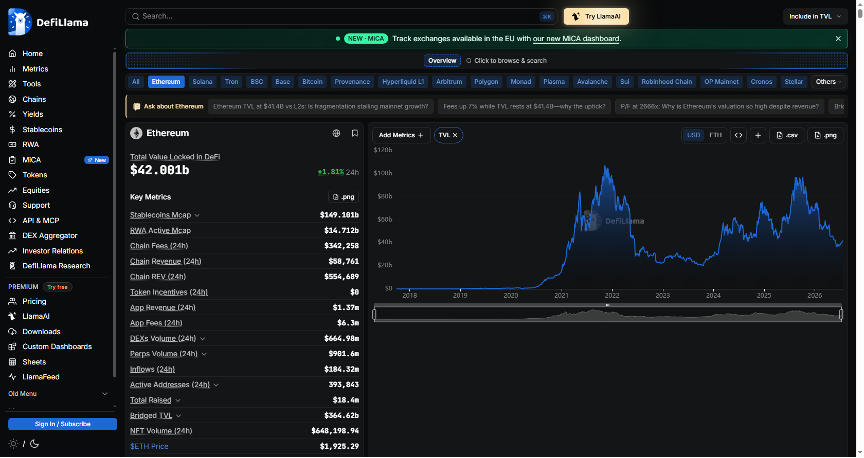
Ethereum DeFi’s total value locked across its full history on DefiLlama, showing the 2020 DeFi Summer ramp, the 2021 peak, and today’s roughly $42 billion in locked value. Source: DefiLlama
2020: The year 2020 brought what the industry now calls DeFi Summer. Lending protocol Compound launched a governance token, COMP, distributed to anyone who borrowed or lent through the platform, and the rush to earn those rewards set off a chain reaction across the sector. Total value locked in DeFi rose from under a billion dollars at the start of the year to roughly 15 billion dollars by its end, with Ethereum hosting about 95 percent of that total.
2021: Attention shifted toward NFTs. Digital artist Beeple sold a single piece, titled “Everydays: The First 5000 Days”, for 69 million dollars at a major auction house, while collections such as CryptoPunks and the newly launched Bored Ape Yacht Club turned profile-picture NFTs into a genuine cultural phenomenon that drew interest from celebrities too. NFT trading volume for the year reportedly reached $ 13 billion, almost all of it flowing through Ethereum.
2022: In September 2022, the Merge took place, moving the entire network onto proof-of-stake and cutting energy use by roughly 99.95 percent, closing out one of the most significant three-year stretches in the network’s history.
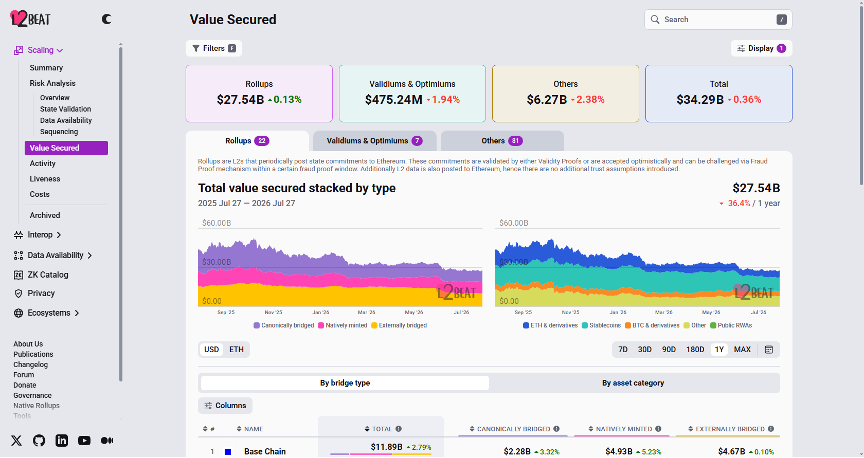
L2Beat’s Layer 2 value-secured dashboard, showing roughly $34 billion currently secured across Ethereum’s Layer 2 networks, led by Base. Source: L2Beat
The years following the Merge have been defined mostly by scaling and legitimacy rather than single dramatic events. Layer 2 rollups, chiefly Arbitrum, Optimism, and Base, absorbed a substantial share of everyday transaction volume, cutting fees for ordinary users by batching activity and settling it back to Ethereum’s mainnet. These networks now secure tens of billions of dollars in value collectively, with Base alone holding close to $ 12 billion.
Regulation eventually caught up too. In May 2024, the SEC approved spot Ethereum ETFs for listing in the United States, with trading beginning that July. That decision opened a regulated channel for institutional capital that hadn’t existed a few years earlier, and flows into these products have since become one of the most closely watched indicators of institutional sentiment toward ETH, a subject discussed further in the investor section below.
On the protocol side, upgrades continued at a steady pace: Shapella enabled staking withdrawals in 2023, Dencun reduced Layer 2 costs further in 2024, and Pectra and Fusaka improved scalability and validator flexibility through 2025. 2026 continues that momentum, with the Glamsterdam and Heze-Bogota upgrades scheduled, laying the groundwork for the more ambitious roadmap described later in this guide.
Bitcoin showed that a blockchain could move money without a bank involved. Ethereum showed that a blockchain could do considerably more than that, turning a public ledger into a platform capable of hosting financial markets, ownership records, and entire organizations with no central office. The categories below describe what’s actually built on Ethereum in practice.
DeFi refers to the collection of financial applications, including lending, borrowing, trading, and yield-generating strategies, that operate without a bank, broker, or clearinghouse involved. Instead of an institution approving a loan, a smart contract holds the collateral and enforces the terms automatically, for any user, at any time. DeFi remains Ethereum’s flagship use case, and with roughly 42 billion dollars currently locked in DeFi protocols on the network, it stands as clear evidence that the model works at meaningful scale, not only in theory.
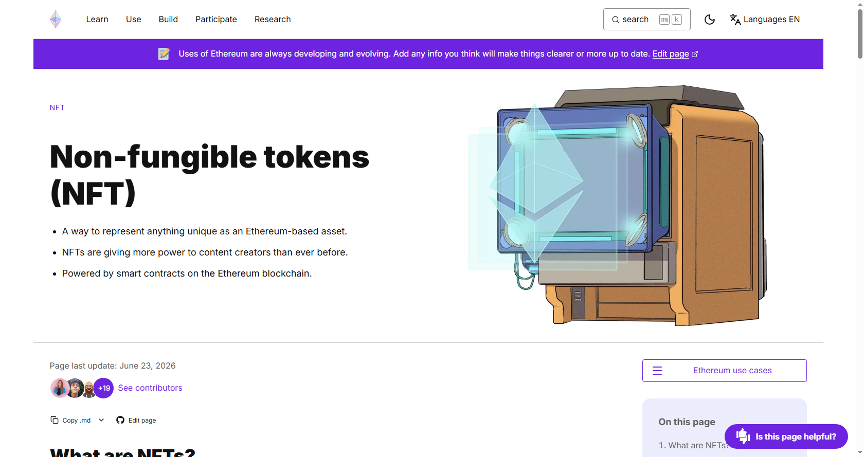
Ethereum.org’s overview of non-fungible tokens, explaining how the standard gives digital art, collectibles, and other unique assets verifiable, on-chain ownership. Source: ethereum.org
An NFT, short for non-fungible token, represents verifiable ownership of something unique: digital art, a collectible, an event ticket, or, in some newer cases, a form of identity or membership. Non-fungible simply means it can’t be exchanged on a one-to-one basis the way one unit of currency can be swapped for another, since each NFT is distinct and individually tracked. Ethereum’s role is to make that ownership verifiable and its history traceable, letting anyone confirm who owns a given item and where it originated, without relying on a private company’s database as the source of truth.
The ERC-20 standard makes it straightforward for a project or community to issue its own token, which explains how thousands of distinct assets came to exist on Ethereum in the first place. DAOs, or decentralized autonomous organizations, extend this idea further, letting communities pool funds into a shared treasury and vote on how to use them directly on the blockchain, without a board of directors. It’s a genuinely new way for groups of unrelated people to coordinate around shared goals, shared funding, and shared rules, all enforced by code rather than a legal entity.

US spot Ethereum ETFs currently hold about $10.17 billion in net assets, roughly 4.5% of Ethereum’s entire market cap, after $11.18 billion in cumulative inflows since launch. Source: SoSoValue
Tokenized real-world assets and stablecoins, digital tokens pegged to currencies such as the US dollar, have quietly become one of Ethereum’s largest use cases by dollar value, with well over one hundred billion dollars in stablecoin market capitalization on the network alone. Institutional interest has followed a similar trajectory: regulated spot ETH ETFs now hold billions of dollars in assets, and U.S. spot Bitcoin and Ethereum ETFs recently recorded 310 million dollars in net outflows within a single day, a reminder that institutional capital moves in both directions and reacts to the same shifts in sentiment as any other market participant, only at a much larger scale.
Institutional exposure to Ethereum takes several forms beyond a single ETF ticker. Spot ETH ETFs, large asset-manager balance sheets, public-company treasuries, whale-sized staking or OTC accumulation, and country-level access programs all let meaningfully sized capital enter the network without every participant running a validator or managing a self-custody wallet. Because institutions can rotate freely between BTC and ETH, any single day’s buy or sell print reads as flow news rather than a lasting regime change. Concentrated wrapper demand and large holders reshape ETH’s ownership structure, but neither one functions as a permanent floor under its price. A deeper look at ETF product mechanics lives in the Ethereum ETF guide, while price-specific frameworks are covered separately in the Ethereum price analysis guide.
Headlines comparing Ethereum’s transaction counts or volatility directly against Bitcoin’s describe where each network sits in its own cycle, not a verdict that one has replaced the other. Activity on one chain can run ahead of the other’s even while each still carries a distinct price-risk profile. Those comparisons work best as context for usage trends and risk tone, with the deeper protocol and product mechanics better left to each network’s own dedicated guide.
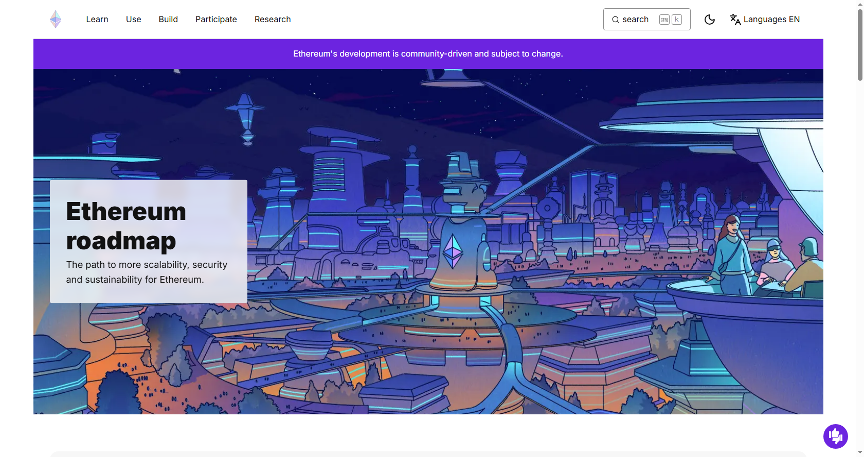
Ethereum.org’s official roadmap page, mapping planned upgrades against four long-term pillars: scalability, security, sustainability, and usability. Source: ethereum.org
Where Ethereum is headed matters to long-term holders just as much as its past, since a protocol still being actively rebuilt carries a different risk profile, and different potential upside, than one that has largely finished evolving. The upgrades below build directly on the DAO fork, the Merge, and EIP-1559 covered earlier, extending that history rather than replacing it.
Ethereum’s official roadmap is organized around four priorities: scalability, security, sustainability, and usability. In practice, this means upgrades meant to make the network faster and less expensive for ordinary users, more resistant to technical attacks and centralization, and less intimidating for newcomers encountering it for the first time.
Individual changes move through a formal process called an Ethereum Improvement Proposal, or EIP, the same mechanism behind EIP-1559’s fee burn. Anyone can draft a proposal, though each one requires extensive technical review and broad community agreement before being folded into an actual network upgrade. That process, more than anything else, is why Ethereum’s changes tend to arrive slowly, following extensive public debate.
In July 2026, Vitalik Buterin outlined an updated long-term vision known as Lean Ethereum, describing a plan to simplify the protocol’s core architecture across roughly seven sequential hard forks. The stated priorities include quantum resistance, meaning cryptography designed to stay secure even against future quantum computers; built-in privacy at the protocol level; and scaling toward roughly 10,000 transactions per second on the base layer alone, with Layer 2 networks pushing aggregate throughput considerably higher. Ethereum’s official page on post-quantum cryptography explains the underlying reasoning in greater technical depth.
Full post-quantum infrastructure is targeted for around 2029. Nearer-term upgrades, including one called Glamsterdam scheduled for later in 2026, deliver parts of that broader vision gradually rather than all at once. As with any multi-year technical roadmap, specific dates and even specific upgrade names may shift as research progresses, and the timeline is best understood as a general direction rather than a fixed schedule.
For someone using Ethereum regularly, this roadmap should translate into a steadily improving experience over time: lower fees, faster confirmations, and fewer technical details required just to send a transaction with confidence.
For long-term holders, a research-driven roadmap with clearly stated priorities is generally a stronger signal than a network that has stopped evolving, since it suggests the protocol is still actively defending its relevance against newer competitors. Still, a roadmap represents a stated intention rather than a guarantee. Timelines can slip, priorities can be reordered, and research sometimes shows that an approach doesn’t hold up in practice the way it did on paper. None of this is unique to Ethereum, but it’s worth remembering before treating any roadmap as a promise.
This section is educational and reflects publicly available information at the time of writing. It’s not financial advice, and nothing here should be treated as a recommendation to buy, sell, or hold ETH or any related product.
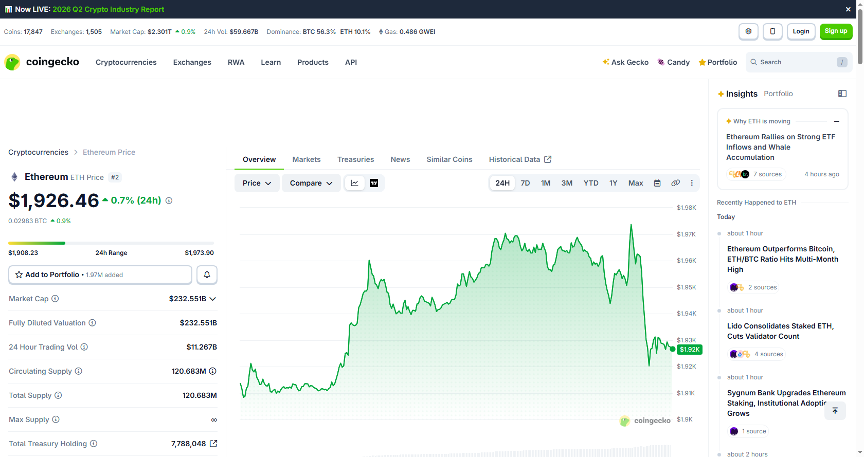
Ethereum’s live market snapshot: price near $1,926, a market cap around $232.5 billion, and roughly 120.68 million ETH in circulating supply. Source: CoinGecko
The case investors make for Ethereum usually starts with scale: the network has the largest base of developers and deployed applications of any smart contract platform, by a considerable margin. See also: Canadas goldmoney offers investors access bitcoin ethereum. A second argument centers on upgrades aimed directly at scalability and efficiency, on the reasoning that a cheaper, faster network keeps that developer base from drifting toward competitors. A third argument involves regulated access, since ETH ETFs now let traditional investors gain exposure through an ordinary brokerage account, without touching a cryptocurrency exchange or managing a self-custodied wallet.
Ethereum’s price history reflects a pattern of sharp cycles rather than steady growth. The 2017 ICO boom produced a strong rally followed by a prolonged, severe decline. 2020 and 2021 brought a second, larger cycle driven by demand from DeFi and NFTs, followed in 2022 by a bear market compounded by unfavorable macroeconomic conditions and a broader decline across risk assets generally. This history doesn’t predict what happens next, though it does show that ETH has never moved in one direction for an extended stretch of time.
Supporters of Ethereum generally point to network effects as the central argument: the deepest pool of developers of any smart contract chain, the largest number of deployed applications, and the deepest existing liquidity. That advantage is genuinely hard for a newer competitor to overcome quickly. Supporters also point to ETH’s built-in demand, since gas fees require it, staking collateral requires it, and most DeFi collateral requires it too, making it the resource the network depends on to operate at all. Ongoing scalability upgrades form a further argument, resting on the expectation that a faster, less expensive network keeps usage growing rather than shifting toward competitors.
The risks tied to Ethereum are just as real as the potential upside and deserve equally serious consideration. Also covered: Ethereum holds firm against bitcoin as analyst eyes next major. Price volatility remains extreme by the standards of traditional financial markets, with routine double-digit percentage swings within short periods. Smart contract risk hasn’t diminished either: the DAO hack and this year’s cross-chain bridge exploits represent different eras of the same underlying problem, where code containing a flaw eventually gets discovered and exploited. Regulatory treatment continues to vary widely by jurisdiction and remains subject to change, and competition from other smart contract platforms, some faster or less expensive on paper, remains a constant pressure rather than a settled question.
The most direct approach is buying and holding ETH through a regulated exchange. Regulated products, such as the spot ETH ETFs discussed earlier, offer exposure through an ordinary brokerage account instead, without requiring a cryptocurrency wallet. Staking ETH, either independently or through a pooled provider, adds a yield component on top of price exposure, though it carries its own lockup and slashing risks. Some investors instead choose indirect exposure through companies or funds that hold ETH on their own balance sheet. Each approach carries a different mix of custody risk, complexity, and cost, and none of them changes the underlying volatility of the asset itself.
Every step below starts from the same place: caution first, speed second. Ethereum’s history includes enough phishing scams and drained wallets that safety habits matter more here than in almost any other part of this guide.

MetaMask, the most widely used browser and mobile wallet for interacting with Ethereum and EVM-compatible networks. Source: MetaMask
A wallet holds the keys that control access to ETH, not the coins themselves, which always exist on the blockchain regardless of any device. Browser extension and mobile wallets such as MetaMask are the most common starting point, convenient for everyday use and free to set up within a few minutes. Hardware wallets, discussed next, store the same keys on a physical device disconnected from the internet, trading some convenience for meaningfully stronger security.
Whichever type is chosen, the seed phrase, a sequence of twelve or twenty-four words generated when the wallet is created, is the single most important thing to protect. Anyone who obtains that phrase gains complete and permanent control of the wallet, and no password reset is available. It should be written down on paper, stored offline, and never typed into a website, no matter how official that website looks. Phishing sites that imitate real wallet interfaces remain the most common way people lose funds, far more often than any sophisticated technical attack.
The screens below follow MetaMask’s own walkthrough for that installation, since the exact button layout shifts between browser and mobile builds and is worth checking against the current interface rather than a remembered one.

The first onboarding screen after installing the extension, offering a choice between a new wallet and an existing one. Source: MetaMask
Selecting “Create a New Wallet” leads to a choice between two setup paths. The traditional route generates a Secret Recovery Phrase that only the user holds. The newer alternative links a Google, Apple, or Telegram account instead, pairing that login with a password rather than a written phrase; MetaMask still generates an SRP behind the scenes either way, splitting it into encrypted shares that MetaMask itself cannot reassemble.
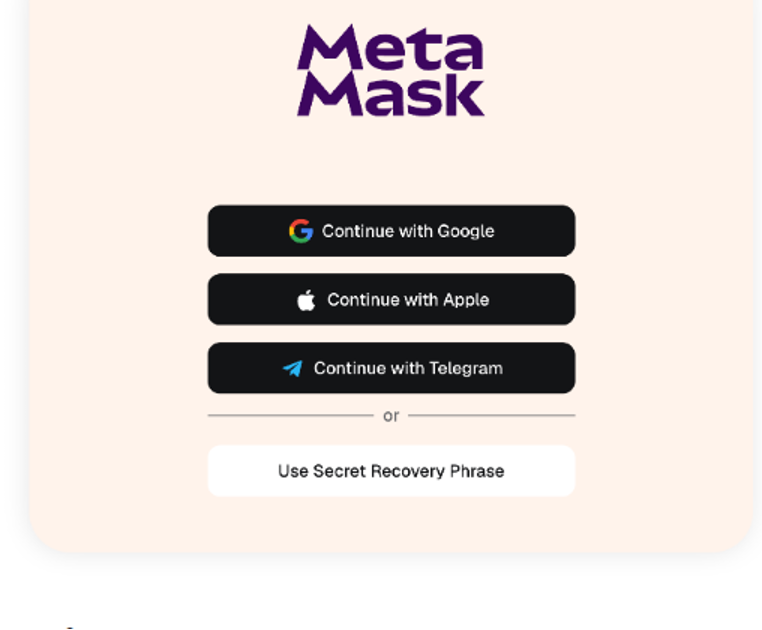
MetaMask’s setup screen for choosing between a Secret Recovery Phrase and a linked social account instead. Source: MetaMask
Choosing the Secret Recovery Phrase path displays twelve words, shown once, that must be copied down in the exact order given. MetaMask’s own interface warns against screenshotting or copying that screen directly, a deliberate nudge toward paper rather than another device.
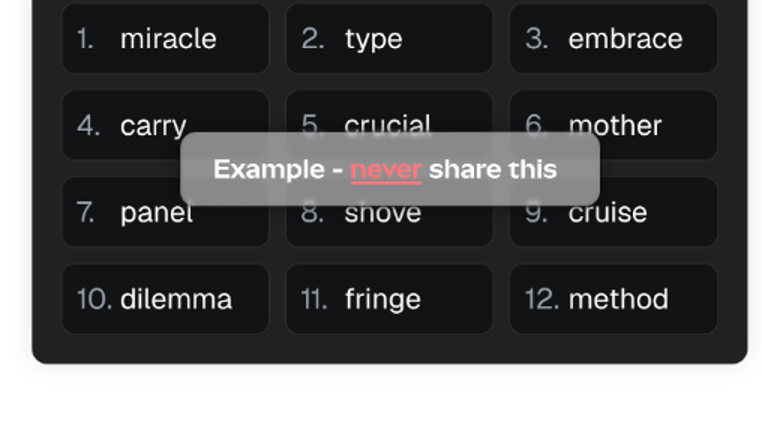
A sample Secret Recovery Phrase screen. MetaMask overlays a warning directly on top of the words: never share this. Source: MetaMask
The wallet finishes setup once that phrase, or the linked social login and password, is confirmed a second time. From there, the extension icon sits in the browser toolbar, ready to connect to any Ethereum application.
Most people buy their first ETH through a regulated exchange, verifying identity, depositing funds, and completing the purchase in a process similar to any other online brokerage. Where available, ETFs offer an alternative route through a standard brokerage account. Either way, starting with a small amount while learning how fees, confirmation times, and withdrawals work costs a lot less than learning those same lessons on a large position, and using platforms with an established regulatory record meaningfully cuts down counterparty risk.
Using a decentralized application starts with connecting a wallet to that application’s website, which grants permission to request transactions but not to move funds without explicit approval each time. From there, common first moves include swapping one token for another on a decentralized exchange, supplying assets to a lending protocol, or browsing an NFT marketplace.
The most important habit to build early is confirming the actual website address before connecting a wallet to anything at all. Fraudulent sites that copy a legitimate application’s design in precise detail are common, and once a wallet approves a malicious contract, funds can be drained without any further action from the user. Bookmarking verified sites directly is safer than relying on search results or links shared on social media.

Ledger, one of the most established hardware wallet manufacturers, keeping private keys offline on a dedicated physical device. Source: Ledger
MetaMask remains the most widely used software wallet for Ethereum, largely because most decentralized applications are built and tested against it first, which keeps its compatibility close to universal. For anyone holding a meaningful amount of ETH, a hardware wallet such as Ledger keeps private keys stored offline on a physical device, protecting funds even if the connected computer picks up malware. Further reading: Monty mumford dont store a private key on your computer. Coinbase Wallet offers a more familiar entry point for users already used to a centralized exchange, while Rainbow has built a following around its cleaner design, mainly for NFTs and DeFi. None of these options is objectively better than the rest; the right choice depends on how much value is being held and how confident the user is managing their own security.
A closer look at five widely used wallets, spanning both categories, shows how differently that trade-off plays out in practice.
Trezor, Ledger’s main open source hardware wallet competitor, citing over two million users worldwide. Source: Trezor
Trezor, made by the Czech company SatoshiLabs, positions itself as the open source alternative to Ledger’s closed firmware. Its current lineup spans three models: the Safe 3 lists around 47 dollars, the Safe 5 around 103 dollars, and the flagship Safe 7 around 224 dollars, though Trezor runs periodic discounts off those figures. All three connect to Ethereum applications through WalletConnect, covering more than 70,000 decentralized apps, and pair with more than 30 third party wallet interfaces, MetaMask included.
Owning a hardware wallet does not remove risk entirely, a point the industry was reminded of directly at the end of July 2026. A firmware bug in Coldcard’s Mk3 device, present in versions released from March 2021 onward, weakened the random number generation used to create new wallets, cutting the effective entropy behind some seed phrases from 128 bits down toward roughly 40. Attackers exploited that weakness to brute force private keys, draining close to 594 BTC, worth an estimated 38 to 40 million dollars, from roughly 500 wallets before Coinkite, Coldcard’s maker, published a fix and urged every affected user to migrate funds to a freshly generated wallet.
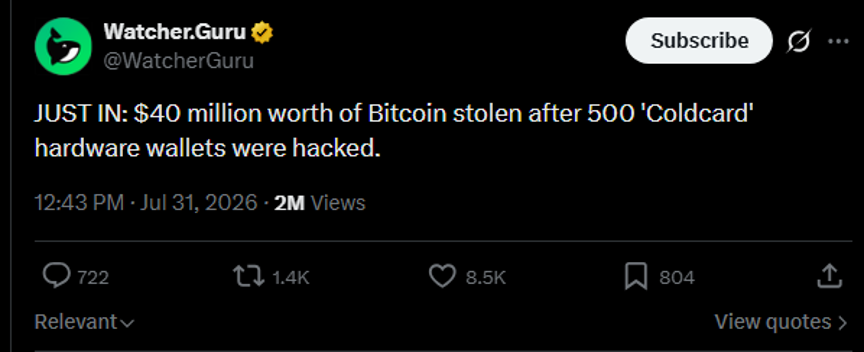
Watcher.Guru’s initial report on the theft, posted as the story broke. Source: Watcher.Guru
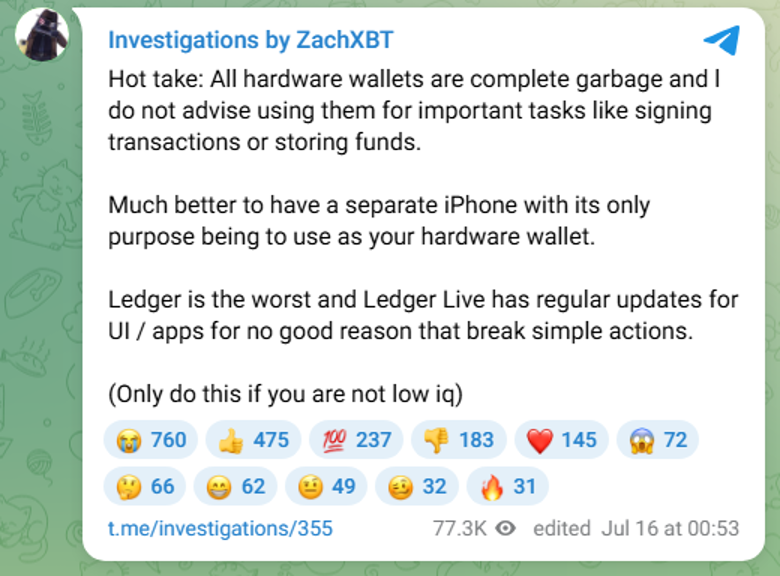
ZachXBT’s post on his Investigations channel. Source: Telegram
On-chain investigator ZachXBT went further than most commentators reacting to the incident, arguing on his Telegram channel, arguing that hardware wallets generally should not be trusted for signing transactions or storing funds at all, and singling out Ledger specifically because Ledger Live pushes frequent UI and app updates that, in his account, regularly break simple actions. His alternative, a separate phone kept offline and used for nothing else, is a more extreme stance than most security researchers take, though it reflects a real and growing skepticism toward hardware wallets as a default recommendation rather than one option among
Ledger moved quickly to draw a line between itself and the incident. “Ledger is not affected by the recently published Coldcard Mk3 advisory,” the company wrote on X, pointing to a certified True Random Number Generator built directly into its Secure Element chip, one that generates the full 256 bits of entropy behind every 24-word Secret Recovery Phrase it produces. The distinction matters: the Coldcard failure was specific to Coinkite’s own firmware implementation, not a flaw shared across hardware wallets generally, though it landed at a moment when confidence in the category was already being tested in public.
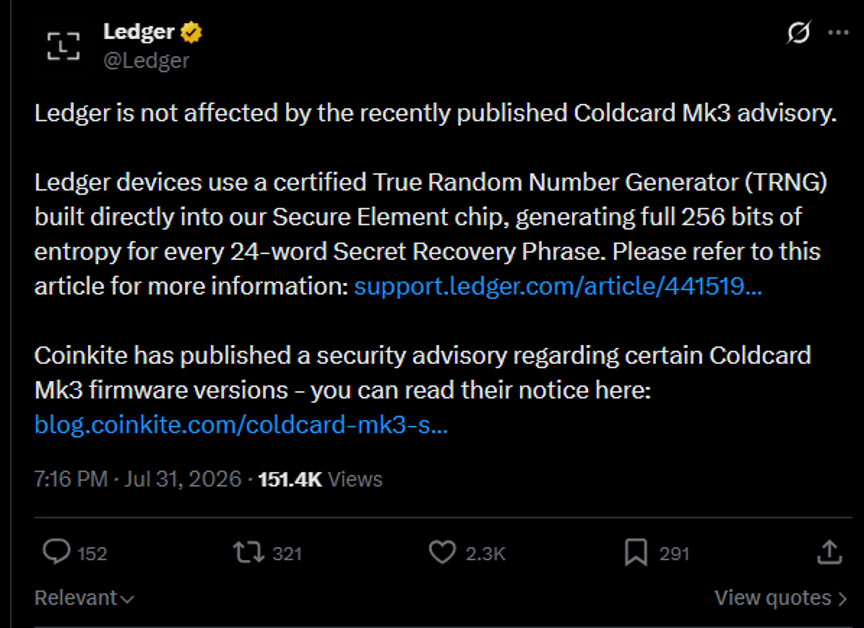
Ledger’s official response, posted the same day the advisory spread. Source: Ledger
The losses were not abstract for the people who held them. Verified author Jonathan Goodman said that roughly 1.6 million dollars in Bitcoin was drained from his account on July 29, and that a police report he filed online was rejected because the amount involved was too large, with instructions to file in person at a station instead. It illustrates a gap that exists well outside crypto specifically: the systems meant to respond to theft were not built with losses of that size, or that speed, in mind.
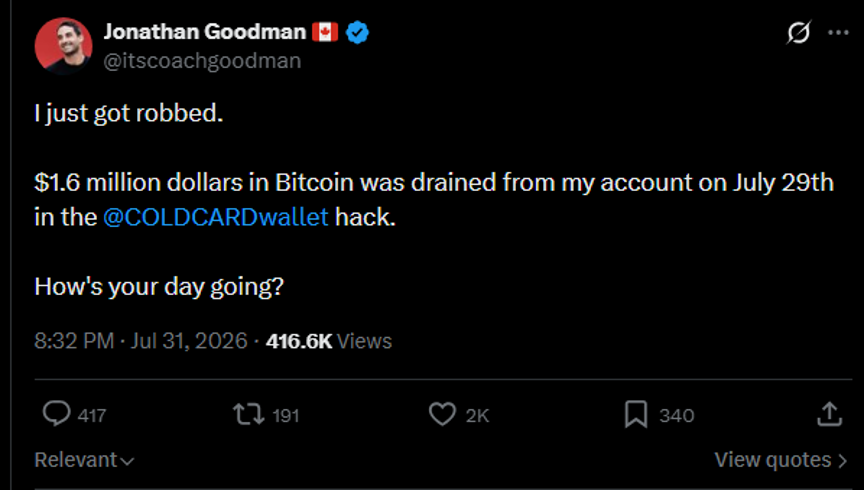
Jonathan Goodman’s account of the theft, posted the day after the funds moved. Source: X
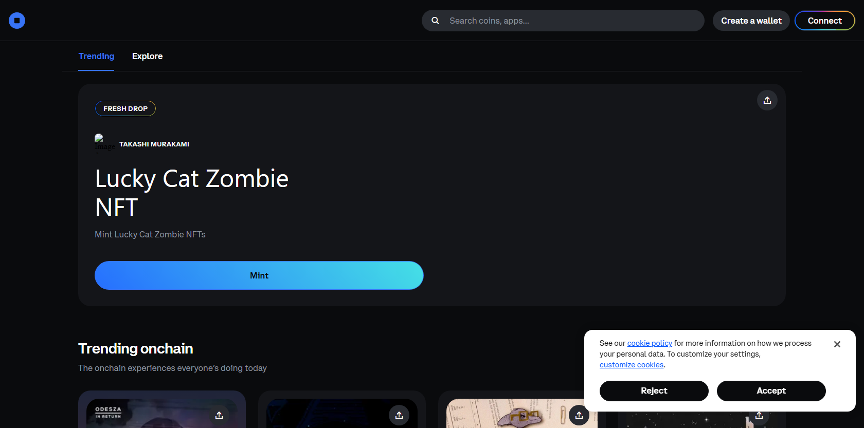
Coinbase Wallet’s own in-app browser, shown here surfacing trending onchain NFT drops. Source: Coinbase Wallet
Coinbase Wallet is easy to confuse with a standard Coinbase exchange account, though the two work differently. The exchange holds custody of user funds, the same model as any centralized platform. Coinbase Wallet, by contrast, is self-custodial software; once created, Coinbase itself never holds the private keys. It supports the same dApp browsing, token swapping, and NFT functionality as MetaMask, aimed at users who already trust the Coinbase brand but want to hold their own keys instead of leaving funds on the exchange.
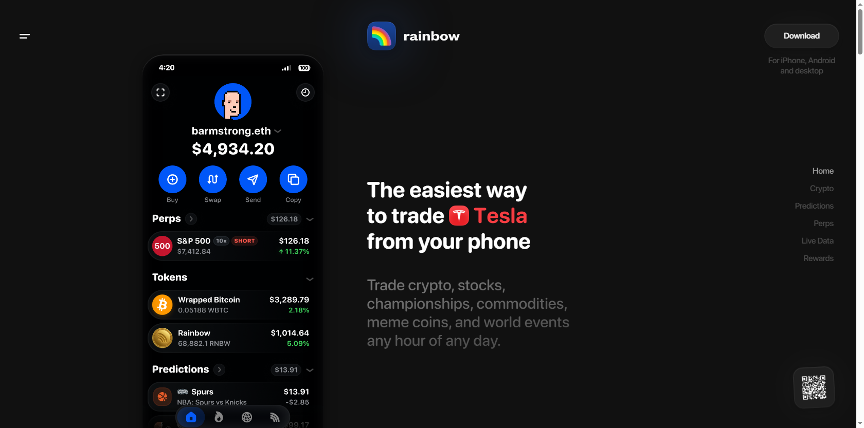
Rainbow’s current homepage, now positioned around trading crypto, predictions, and leveraged perpetuals rather than only NFTs. Source: Rainbow
Rainbow built its early reputation as a design-forward Ethereum wallet aimed at NFT collectors. The product has since broadened considerably, now marketing itself as a single app for trading crypto, prediction markets, and leveraged perpetual contracts on top of the original self-custodial wallet, worth knowing for anyone choosing it purely as a simple NFT wallet based on its earlier reputation.
Ethereum.org remains the most reliable single source for deeper technical and educational material, maintained by the Ethereum Foundation rather than any commercial interest. Following the developers and researchers who actually build the protocol tends to be far more useful over time than following price-focused commentary, since the former explains why the network works, while the latter is mostly speculation about what happens next.
Ethereum keeps changing shape through a steady mix of client upgrades, Ethereum Improvement Proposals, and ongoing research into consensus design and data availability. Every step in that pipeline gets debated in public before it reaches mainnet, a process ethereum.org’s own roadmap organizes around four long-term goals: scalability, security, sustainability, and usability.
Extra capacity rarely arrives without a cost somewhere else in the system. Faster confirmations and cheaper block space can shift where centralization risk sits, and validator participation has shown it can wobble even during a carefully tested rollout.
The Fusaka upgrade activated on December 4, 2025, and within minutes a flaw in the Prysm consensus client began forcing affected nodes to recompute old chain states, a resource drain that left them unable to answer validator requests on time. Network participation fell as low as 75 percent across 42 epochs, with 248 blocks missed and roughly 382 ETH in attestation rewards lost before developers shipped a fix, according to Prysm’s own incident report. Ethereum kept finalizing blocks throughout the episode only because other client teams were unaffected, a reminder that client diversity works as a real centralization safeguard, not just a talking point.
Leadership inside the Ethereum Foundation has also started framing the roadmap around a goal that sits above raw throughput. The Foundation’s March 2026 mandate describes Ethereum as a form of sanctuary technology, aiming to give users a shelter from outside pressure where privacy and self-sovereignty function as default settings rather than optional add-ons. Vitalik Buterin has framed 2026 specifically as a year meant to recover ground the network lost on privacy and trustlessness, a shift in emphasis worth watching rather than a promise tied to any single shipped feature.
That same emphasis on substance over branding cuts against a separate pattern worth naming directly. Projects and products regularly describe themselves as “Ethereum-connected” or “built on Ethereum” while offering little of the audited contracts, public repositories, or verifiable on-chain footprint that phrase implies. Readers evaluating a claim like that should look for a real contract address or an audit before treating the label as evidence of anything on its own.
Ethereum’s transaction-ordering design creates its own exposure, and enforcement has already followed it. In 2024, the U.S. Department of Justice charged two brothers with wire fraud after they allegedly exploited the Flashbots MEV-Boost system to extract roughly 25 million dollars in about 12 seconds, the first case of its kind brought by federal prosecutors. The case shows that maximal extractable value now sits inside real legal exposure, not only inside a technical argument about fairness.
None of this makes roadmap headlines a reliable trading signal. A shipped upgrade, a new EIP, or a Foundation mandate changes how the network works and who carries which risk. It says nothing on its own about where ETH’s price goes next, and treating engineering milestones as automatic catalysts has a poor track record.
A decentralized blockchain network built to run code, not just move money. Thousands of independent computers, called nodes, hold identical copies of the same transaction record and reach agreement on any change to it through a proof-of-stake mechanism, meaning no single company or server can be switched off to stop the network.
The two get used interchangeably, though they are not identical. Ethereum is the network itself, its software and the global set of nodes running it. ETH is the asset native to that network, the thing paid out in gas fees and staked as collateral by validators. Losing sight of that distinction rarely matters in casual conversation, but it matters once staking mechanics or tokenomics enter the picture.
Four things dominate, in practice. Decentralized finance covers lending, trading, and borrowing without a bank in the middle. NFTs provide a way to prove ownership of a specific digital item. Independent projects issue their own tokens on top of Ethereum rather than building a blockchain from scratch. DAOs let a community pool funds and vote on how to spend them, without a board of directors. A newer fifth category, tokenized real-world assets and regulated products such as spot ETH ETFs, has grown large enough that it now belongs on this list too.
Bitcoin’s scripting language was deliberately kept narrow, built for one job: moving value from one address to another as securely as possible. Vitalik Buterin’s original argument, laid out in the 2013 whitepaper, was that this restriction was too limiting, and that a blockchain could instead run arbitrary programs. That single design choice is the reason DeFi, NFTs, and DAOs exist on Ethereum and were never built directly on Bitcoin’s base layer.
The answer depends on which layer is being asked about. Ethereum’s core consensus layer has run continuously since the Merge with no successful attack on it. Individual smart contracts, wallets, and applications sitting on top of that base layer are a separate matter; coding errors and phishing sites remain the most common way people actually lose funds, not a failure of the underlying network.
Building on the network, trading ETH outright, staking for a yield, and supplying liquidity to DeFi protocols are the main routes people take. None of them come with a guaranteed return. Plenty of people who assumed a rally would keep extending have watched price volatility erase unrealized gains within weeks.
A regulated exchange purchase is the most direct route. A spot ETH ETF through an ordinary brokerage account works for anyone who would rather avoid a wallet entirely. Staking ETH, either solo or through a pooled provider, adds a yield on top of price exposure but introduces lockup and slashing risk that a straightforward purchase does not carry. None of the above is financial advice, and each route mixes custody, regulatory, and market risk differently, worth understanding before any capital moves.
Explore more