Ether aims at 3,400 as the liquidation of 2B approaches 3,000. Vitalik Buterin certifies the sharding milestone by way of PeerDAS implementation in the Fusaka upgrade.
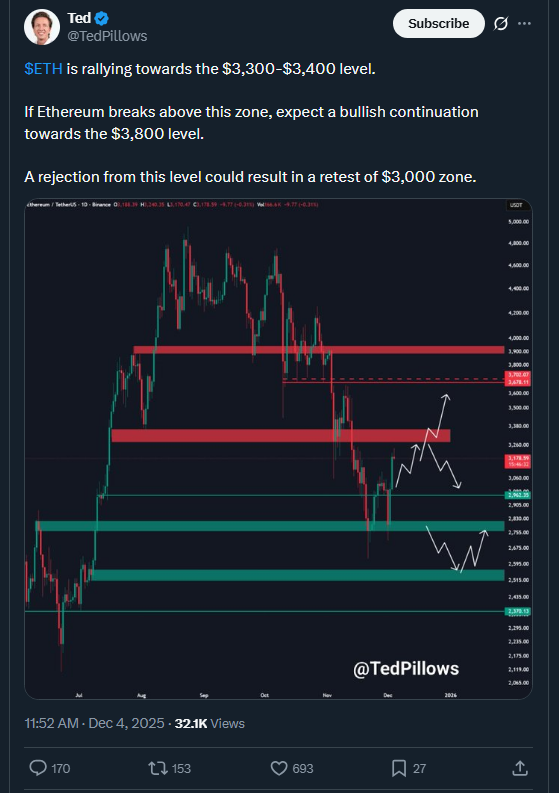
Ether is trading in a critical price area. The second-largest cryptocurrency in terms of market cap aims at the $3,300-3,400 resistance point. Breakouts will lead to powerful moves in the market.
Ted Pillows on X says that ETH is heading toward this critical range. The trader indicated that a breakout would result in bullish continuation. The subsequent target is at 3,800 in case the momentum prevails.
Source:Ted Pillows on X
Massive Liquidation Zone Threatens Market Stability
The stakes involved are unusually high for leveraged traders. On X, Ted Pillows disclosed that positions to the amount of $2 billion are being liquidated at $3,000. At $3,300, an extra 700 million would be erased.

Source: On X, Ted Pillows
These clusters of liquidation bring about volatile conditions. Either way, price action would be followed by cascading liquidations. These are the key levels that traders are following closely.
Any rejection of the $3,300-3,400 zone will take ETH back to $3,000. This retest would trigger the bigger liquidation event. The market players are getting ready to be more volatile.
You might also like: Ethereum News: Ethereum Whale Wakes: $120M Staked After 10 Years
Ethereum Achieves Decade-Long Sharding Dream
Vitalik Buterin made a radical announcement on X. The co-founder of Ethereum affirmed that PeerDAS in Fusaka is a real sharding implementation. This is the fulfilment of a dream that was set in 2015.
PeerDAS in Fusaka is notable in the sense that it is literally sharding, but Buterin said on X. Ethereum has achieved consensus on blocks without having individual nodes process whole datasets. Client-side probabilistic verification makes the system resistant against 51% attacks.
The data availability sampling process has been under development since 2017. A technology is eventually brought to the manufacturing stage after several years of research. This breakthrough was a fundamental blockchain design made by Ethereum researchers and core developers.
You might also like: Ethereum Sheds $6.4B in Leverage as Whales Buy Big
Three Gaps Remain in Sharding Implementation
Buterin described unfinished details of the existing sharding solution. The Ethereum L1 is currently not capable of executing O(c 2) transactions as Layer 2 solutions can. Mature ZK-EVMs are also required to implement scaling benefits to the base layer.
The proposer-builder bottleneck remains as a constraint. Builders now need to handle entire datasets and build complete blocks. This centralisation issue would be solved through distributed block building.
Ether has no sharded mempool yet. This aspect is still on the development pathway. The following two years will be devoted to the development of PeerDAS mechanisms.
Buterin further highlighted the importance regardless of such constraints. The system will grow gradually but in a stable manner. The upgrade will be an instant benefit to Layer 2 solutions. The technology will increase Ethereum L1 gas capacity when ZK-EVMs grow up.
The meeting of price action and technical accomplishments forms an intriguing point. Ether is threatened with short-term liquidation but is providing long-term scale-up. Both developments are being monitored by the market participants as the ecosystem transforms.