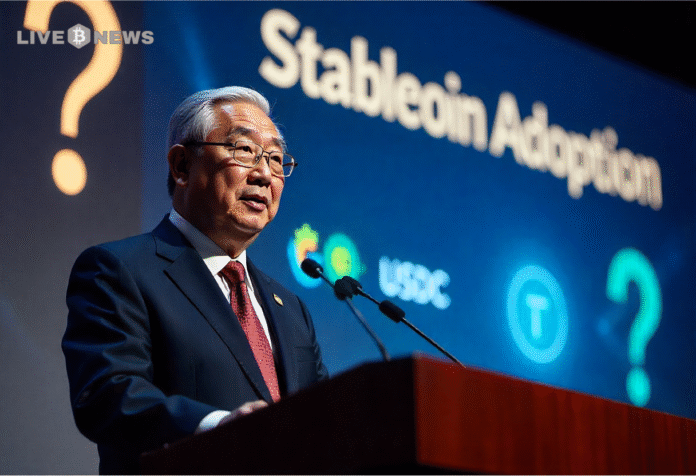

Former central bank head of China, Zhou Xiaochuan, cautions against risks of stablecoins. Calls for multi-angle scrutiny.
Stablecoin acceptance is being questioned by Zhou Xiaochuan, the former governor of the Chinese central bank. According to him, the hype of stablecoins does not take into account serious risks and ignores different points of view. The recent in-depth analysis by Zhou is a multi-dimensional perspective of stablecoins.
Zhou cautions that issuers of stablecoins are usually not knowledgeable enough about monetary policy. Over-issuance without due reserves exposes them.
This may cause financial instability. He emphasized that the stability of stablecoin is not an easy statement to make, but needs robust supervision.
Backdoor Benefit of Stablecoin Spills.
Zhou points to two major dangers: over-issuance and high leverage. Stablecoin issuers can issue above 100% reserves. In addition, loans and trade can multiply. The danger of redemption exceeds the support.
He attacked the ambiguous custody of the reserves. For illustration, regulators questioned whether Facebook’s Libra intended to enable self-custody. Zhou demands that central banks control or support custodians. Otherwise, trust and stability weaken.
Zhou compares stablecoins to Hong Kong banknotes. Banks deposit US cash to support Hong Kong dollars. Reserves alone are not enough to stop bank runs even at the time.
The Reality Behind Decentralization Hype
Nevertheless, Zhou is uncertain of the actual demand in decentralized finance. A large proportion of financial services cannot be entirely decentralized.
Asia, such as China, has established an effective account-based payment infrastructure. There are systems that are based on established infrastructure and not tokens of blockchain.
The Bank of International Settlements promotes centralized tokenization. This is more feasible according to Zhou. Not everything can be fully tokenized or decentralized. It takes a sober, case-by-case analysis.
Compliance and Market Manipulation Warnings
Zhou points out that payment risks cannot be solved with technology alone. Stablecoins continue to encounter enormous compliance barriers. KYC, AML, and identity verification are also necessary. The wallets of blockchain do not overlook such regulations.
One of the important issues is the manipulation of stablecoin markets. Zhou explains that the use of mixed currencies in exchanges paves way to fraud.
Volatile crypto in combination with stablecoins gives free reign to speculation. This increases the exposure of unqualified investors such as minor investors.
Zhou cautions that speculative intentions motivate most of the stablecoin issuers. Others are interested in rapid returns rather than the stability of the systems. This can spur fraud and upset financial markets.
He challenges the assertions that stablecoins significantly lower the costs of cross-border trade. Regulation and foreign exchange controls are causing many fees, rather than inefficiencies.