
Record Iran strike bets drive $469M volume on Polymarket, raising insider wallet and market integrity concerns.
Rising tensions in the Middle East triggered record activity on prediction markets. Polymarket posted its highest single-day volume as traders rushed to price in the Iran strikes. At the same time, several wallets captured large profits before official confirmation.
Polymarket Hits $469M Record as Iran Strike Bets Deliver Outsized Profits
Dune data shows Polymarket reached $469 million in single-day notional volume. That figure marks an all-time high for the platform. Last week, political contracts alone accounted for $350 million.
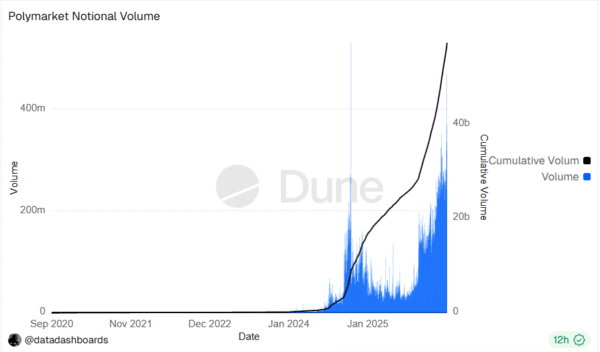 Image Source: Dune
However, trading patterns showed that traders appeared to bet on the strikes before they were confirmed. According to Bubblemaps, at least six connected wallets made about $1.2 million in profit. They placed large bets before the market adjusted the odds.
Once the strikes were announced, prices changed fast, and their positions gained value. Another trader, known as “flydartball,” placed over $170,000 betting that the U.S. would launch missile strikes on Iranian cities. After the strikes were confirmed, the value of that bet rose to nearly $500,000.
Roughly a year ago, the same trader reportedly earned more than $250,000. The profit came from betting on a previous U.S. operation against Iran known as “Midnight Hammer.” The account is wagered on Iran’s Supreme Leader, Ali Khamenei, stepping down soon. That position is already showing an unrealized gain of about $56,000.
Another striking example involves a wallet named “Roeyha2026.” According to Lookonchain data, the account was created just 11 hours before the strike confirmation. The wallet placed $50,000 on the U.S. launching strikes on Iran by March 1, 2026. After the announcement, the bet’s value rose to around $96,800, representing a 93% return within hours.
Insider Trading Fears Surface After Timely Geopolitical Bets
When several wallets record large gains around the same geopolitical event, attention follows. Prediction markets are transparent, and wallet activity is publicly visible on-chain. Still, concentrated profits ahead of public confirmation can lead to questions about timing and access to information.
Some market observers are now debating whether access to non-public or classified information played a role. If any trader acted on privileged military intelligence, that would create an unfair advantage over the broader market. Even without proof of misconduct, precise timing from suspected insider wallets fuels suspicion and weakens confidence.
At the same time, regulatory conditions have shifted. Over the past year, the Trump administration has taken a more supportive stance toward crypto-related businesses. That environment has allowed platforms such as Polymarket to expand participation and liquidity.
As political betting grows, calls for closer oversight may follow. Debate now centers on fairness, transparency, and whether additional safeguards are needed if event-driven markets continue to attract large speculative capital.