

Institutions reduced BTC exposure in Q4, signaling caution but not panic across ETFs and futures markets.
Institutional investors reduced their Bitcoin ETF holdings sharply in the fourth quarter of last year. As contained in a new 13F filing, large investors, led by hedge funds, reduced their positions as the OG coin’s price dropped. However, market data suggests that this move was part of a broad market cooling phase.
Advisors and Hedge Funds Cut Bitcoin ETF Exposure, 13F Data Shows
Bloomberg Intelligence data shows 13F filers sold shares equivalent to roughly 25,098 BTC during Q4. Investment advisors reduced exposure by about 21,831 BTC. Hedge fund managers cut approximately 7,694 BTC. Together, those groups accounted for most of the quarterly decline.
What did 13F filers do with the Bitcoin ETFs in Q4??
In what should not be much of a surprise — they were sellers. Advisors and Hedge Funds (the two largest holder categories) were the biggest sellers. Overall 13F Filers sold ETF shares equivalent to ~25,000 Bitcoin in 4Q 2025. pic.twitter.com/0MEbzXVDb1
— James Seyffart (@JSeyff) February 24, 2026
Despite selling, institutions still hold around 311,697 BTC in ETF products. Holdings are valued near $27.3 billion. Figures suggest trimming activity rather than full liquidation. Allocations remain sizable even after reductions.
Monthly spot Bitcoin ETF flows support the trend, with steady net outflows seen late last year. Recent data shows BTC-linked funds recorded about $939 million in net withdrawals. As a result, total assets under management fell from earlier highs to around $81.3 billion.
Moreover, CME futures positioning data shows that annualized premiums stayed high during 2023 and much of 2025. And this trend was especially in longer-dated contracts. Usually, high basis signals strong leveraged demand and active carry trades.
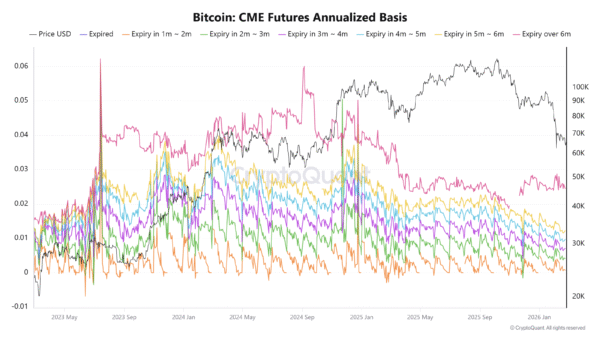
Image Source: CryptoQuant
However, conditions changed in recent months as premiums fell sharply across all contracts. Front-month futures traded with very small premiums, while longer-dated contracts also flattened.
Negative Coinbase Premium Signals Continued Caution Among U.S. Investors
Coinbase Premium Gap often stayed negative in late 2025 and early 2026. A negative premium usually means stronger selling from U.S.-based traders. At the same time, strong positive spikes, which are often linked to institutional dip buying, did not appear.
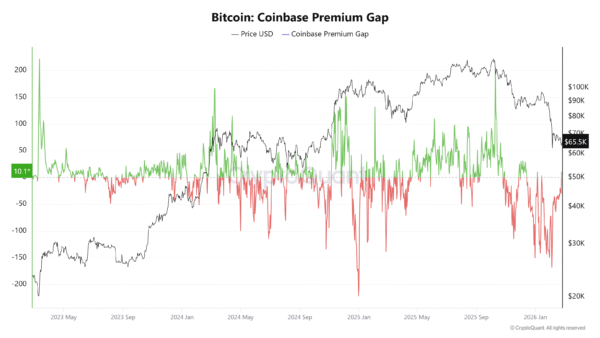
Image Source: CryptoQuant
Looking at the Bitcoin price chart, the firstborn coin sits below its 50, 100, and 200 moving averages. More so, the technical indicators are aligned in a bearish order. Meanwhile, the RSI is flashing weak momentum. However, it is yet to drop into oversold levels.
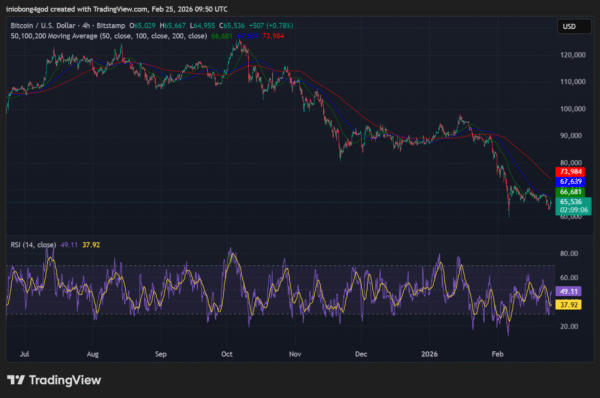
Image Source: TradingView
Interestingly, Bitcoin’s decline does not resemble the sharp selloffs seen in past cycles. Instead, market behavior points to steady risk reduction rather than forced liquidations.
Essentially, these market metrics point to cooling institutional appetite. And the sell-offs appear measured and strategic.
A shift in sentiment would require clear signals across several metrics. Until those signals appear, data suggests institutional capital remains in wait-and-see mode.