
A victim loses $180K after falling prey to a phishing attack and authorizing a fraudulent transaction. ScamSniffer warns about the steep increase in similar scams in August 2025.
The victim unknowingly signed an Approve phishing transaction, and the attackers stole a staggering amount of money, $180,390, out of a crypto wallet.
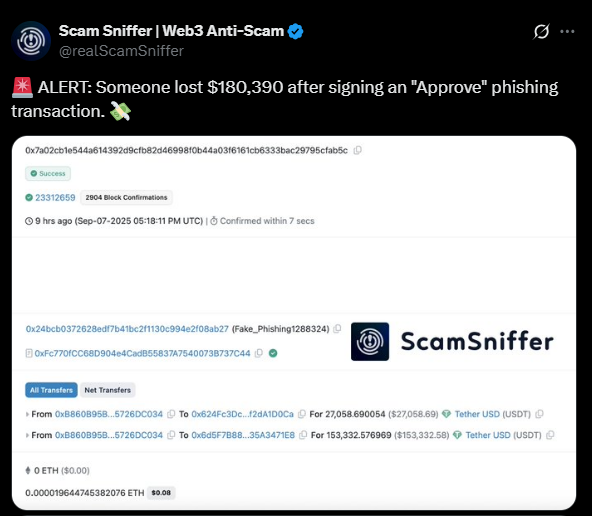
Source – X
This case drew the notice of ScamSniffer, one of the most popular Web3 anti-scam services, which disclosed a greater spike in phishing losses by August 2025.
An August report on the platform revealed phishing attacks led to losses amounting to 12.17 million dollars. More than 15,000 victims, a 72 percent rise in losses compared to July, and a 67 percent rise in victims.
A New Wave of Deceptive “Approve” Scams
The phishing attempt is a trend that is increasing in relation to the Ethereum EIP-7702 upgrade. This permits batch operation by permitting outside accounts to impersonate smart contracts in the short term.
Fraudsters use this aspect to masquerade fraudulent agreements as valid DeFi swap operations. The wallets of unsuspecting users who go ahead and accept such transactions are now at the mercy of the perpetrator to drain the asset of the wallet within a short time.
Other victims lost up to $1.54 million in related scams besides the 180K loss suffered in the same time.
These batch-signature scams are noted by ScamSniffer in its August report as one of the leading ways to commit phishing and inflict enormous financial losses.
These attacks were of high magnitude and sophistication. That same report identified three big incidents that contributed almost half of the total losses of $12.17 million.
Explosive Phishing Surge in Crypto Scene
Scams related to phishing are growing fast in terms of occurrence and costs. In August alone, data provided by ScamSniffer showed 15,230 crypto users had been scammed. The highest in 2025 history, and had incurred greater losses than any month in 2025.
Such a sudden increase is an indication that phishing criminals are taking advantage of the new Ethereum functionality. Taking advantage of advanced attack methods to defraud users.
Security gurus caution that these batch transactions, though technically novel, introduce new vulnerabilities. They can be used by scammers to carry out concealed transactions following the approval of what appears to be the normal operations by users.
These risks are not of much awareness to the victims, and hence education and guarding are necessary.
Industry Perspective on EIP-7702 Exploits
In the Pectra upgrade, Ethereum added EIP-7702, which provided support to batch transactions to improve the user experience.
Phishing actors have, however, weaponized this functionality. The bad actors develop counterfeit DeFi platform interfaces that exactly resemble the trusted services, such as Uniswap.
As soon as victims confirm by a mere click, their wallets are emptied within seconds.
The reports of ScamSniffer underline the fact that scammers are taking advantage of the new features of Ethereum transactions and the limited knowledge of users.
Regulators and crypto platforms still have some issues with the need to keep pace with quickly changing attack techniques. These involve smart contract mimicry and batch transaction abuses.