
Standard Chartered Opens Bitcoin and Ethereum Trading to UAE Clients

Latest in Bitcoin ETF
Standard Chartered Opens Bitcoin and Ethereum Trading to UAE Clients
Bitcoin ETF Outflows Hit $679M as Wintermute Warns Crypto Has “Nothing Underneath”
Bitcoin Bond Market: Why Treasury Yields Could Matter More Than the Fed
Bitcoin (BTC) Defies October Trend as ETFs Pull In $241M
Bitcoin Leads All Major Assets Since August 2020 Outperforming All Competitors

Bitcoin may have fallen lower over the past few weeks, but institutional interest never slowed down. Investors have continued to invest in spot Bitcoin ETFs, businesses are adding Bitcoin to their balance sheets, and governments are still holding onto their Bitcoin. Additionally, several companies are taking steps to strengthen their treasury strategies, pay down debt, and improve their financial positions. These actions reinforce that many institutions remain optimistic about the future of Bitcoin, even when times get tough.
This roundup covers the most recent U.S. spot Bitcoin ETF flows and Bitcoin purchases by individual companies. It also includes updated rankings of the largest public companies, private companies, governments, and ETFs with Bitcoin holdings. The focus of this article is not price action but the continued building of Bitcoin positions and capital management by many institutional investors. Also covered: Bitcoin price unlikely to crash 70 without saylor selling cryptoquant.
Institutional interest in Bitcoin remained resilient despite continued market caution, as fresh demand for BlackRock’s spot Bitcoin ETF offset selling across several competing funds. Although weekly flows stayed negative, steady monthly inflows suggest long-term investor appetite has yet to fade, even as Bitcoin trades below recent highs and market sentiment remains subdued.
U.S. spot Bitcoin ETF recorded a net flow of $32.11 million on July 29, up from $21.19 million on its first day of trading. The iShares Bitcoin Trust (IBIT) continued to be the largest inflow provider, bringing in $89.83 million in new money. Meanwhile, Fidelity’s Wise Origin Bitcoin Fund (FBTC) had $43.08 million in outflows and ARK 21Shares Bitcoin ETF (ARKB) saw $14.64 million in outflows.
There were no net flows in Grayscale’s GBTC and BTC tokens, or Bitwise’s BITB token, on the day. Net flows over the course of the week were also negative, at $29.29 million, as investors moved money around across spot ETFs. Monthly net flows were positive, at $204.7 million, and cumulative net flows have reached $51.36 billion since spot Bitcoin ETFs launched in the United States.
At the time of publication, Bitcoin stood at $63,990, down 0.2% over the prior day and down 2.5% during the past week. Likewise, confidence in the market remained shallow, with the Crypto Fear & Greed Index at 28, keeping the market in the “Fear” zone. Even so, this is much farther from the “Extreme Fear” levels it reached over a month ago, indicating that sentiment is slowly improving.
Even as ETFs build cautious positions, the corporate buyer base has been accumulating BTC over July. New corporate Bitcoin balances show steady accumulation, indicating that many in this space are looking at the long term rather than the short term.
Spot Bitcoin ETFs give investors a simpler way to gain exposure to Bitcoin’s price through a regular brokerage account, without dealing with wallets, private keys, or self-custody. That structure has also made Bitcoin more accessible to investors who prefer traditional financial products.
Competition between ETF issuers can shape which funds attract the most assets. Fees, custody arrangements, liquidity, and product structure can all influence investor choices. A fund with lower fees may have an advantage, but cost is not the only factor investors consider. Brand reach, trading depth, and fit inside adviser model portfolios can pull more creations toward a small set of tickers even when many funds offer the same underlying exposure.
Daily creations and redemptions also provide a useful look at short-term demand for ETF exposure. However, these flows should not be treated as a permanent signal for Bitcoin’s price. Inflows can support demand at certain points, while outflows can reflect changing investor preferences, but neither automatically determines where BTC trades next. Secondary-market share trading can be heavy without changing how much Bitcoin the trust holds; primary-market creations and redemptions are what expand or shrink the fund’s BTC claim.
Cumulative flow ledgers underline a durable access pattern: one issuer can account for more than the category’s retained net inflows when other spot Bitcoin ETFs, especially legacy products with sustained redemptions, post combined net outflows since the January 2024 U.S. launch. That is concentration in a distribution rail, not a mandate to buy on every drawdown. Creations grow the trust only when authorized participants create shares; redemptions reverse the same pipe.
Filing and listing stages are another important part of the process. A new filing can attract attention and raise expectations, but it does not guarantee that a product will launch successfully or maintain significant assets under management over time.
Though recent price weakness has caused concerns among Bitcoin-obsessed investors, companies buying Bitcoin continue to expand their treasury reserves. In the first Bitcoin purchase announced this month, Japanese investment firm Metaplanet Inc. purchased 2,823 Bitcoin on July 2 as part of its Bitcoin Treasury Operations.
*Metaplanet Acquires Additional 2,823 Bitcoin, Total Holdings Reach 43,000 BTC* pic.twitter.com/j3j4mvjiOr
— Metaplanet Inc. (@Metaplanet) July 2, 2026
The firm used the proceeds from the sale of Bitcoin options to buy the coins at an average price of 12,712,055 yen per Bitcoin, totaling about 35.89 billion yen. Metaplanet’s BTC purchases bring their holdings to 43,000 BTC, continuing the growth of the largest publicly traded corporate Bitcoin holder in Asia.
Also, Bitcoin mining company CleanSpark Inc. increased its holdings this month by adding 454 BTC to its treasury on July 7. This increased its total holdings by 3.37% to 13,924 BTC. While many Bitcoin miners routinely sell newly mined Bitcoin to fund their operations, CleanSpark continues to hold onto a sizable portion of its mined coins.
So far this month, American Bitcoin Corp. (ABTC) disclosed that it now holds more than 8,000 BTC in its treasury on July 6th. The company said that its Bitcoin holdings have more than tripled since its Nasdaq debut, along with a nearly three-fold increase in its Satoshis per share.
Institutional Bitcoin ownership continues to expand as public companies strengthen their balance sheets with the digital asset. Recent data from BitcoinTreasuries.net shows that Bitcoin is increasingly viewed as a strategic treasury reserve rather than a speculative investment, with a growing number of firms accumulating long-term positions.
Strategy remains the clear market leader, holding 843,775 BTC, which is more than 19 times the Bitcoin reserves of its nearest competitor. Also covered: Michael saylor signals more btc buys using 2022 bear market. The company’s continued accumulation has set the benchmark for corporate Bitcoin adoption and reinforces its long-term conviction in the asset.
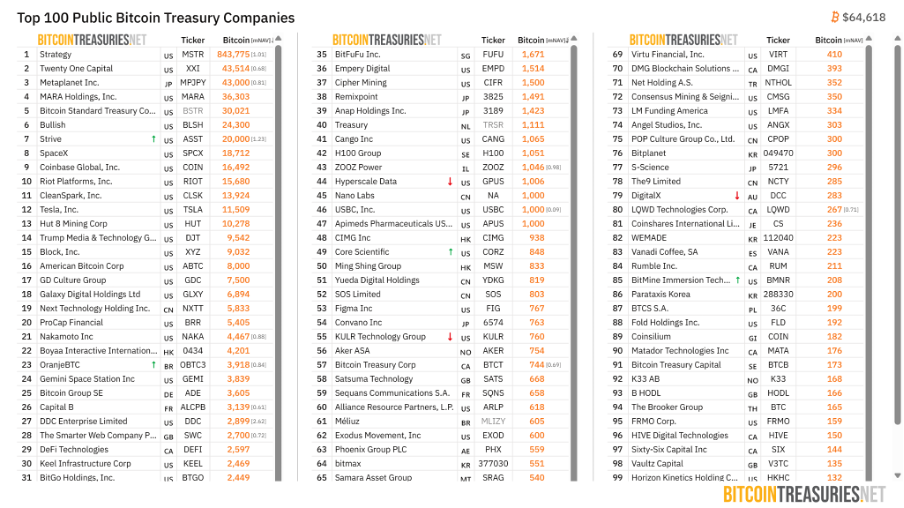
Behind the industry leader, other firms are running a closely contested race for custody of the OG coin. Investment firm Twenty One Capital ranks second with 43,514 BTC, narrowly ahead of Japan’s Metaplanet Inc., which holds 43,000 BTC and remains Asia’s largest publicly listed corporate Bitcoin holder. The slim difference between the two companies highlights how aggressively firms continue expanding their Bitcoin treasuries.
Bitcoin mining companies are also holding a large share among the largest holders. MARA Holdings leads with 36,303 BTC, reflecting its long-term strategy of retaining a large portion of the Bitcoin it mines rather than selling its production into the market. Also covered: Blackrocks bitcoin etf could trigger a 52b sell off heres.
Meanwhile, mining companies are not the only institutional holders that are expanding. See also: Saylor says short term holders block bitcoin 150k target. Bitcoin Standard Treasury Company is fast rising, with 30,021 BTC, while cryptocurrency exchange operator Bullish possesses 24,300 BTC. Furthermore, asset management firm Strive is also becoming prominent with 20,000 BTC as Bitcoin adoption reaches beyond crypto-native businesses.
Major corporations outside the financial and mining sectors continue to maintain meaningful Bitcoin exposure as well. Private aerospace company SpaceX ranks eighth with 18,712 BTC, illustrating that interest in Bitcoin as a treasury asset extends across multiple industries.
Public companies currently hold a combined 1,262,211 BTC, with 198 publicly listed firms now owning Bitcoin. The continued growth in corporate holdings suggests institutional adoption remains one of the strongest long-term drivers of Bitcoin demand, as companies across diverse sectors steadily increase their exposure to the digital asset.
Private firms are adding Bitcoin to their balance sheets, with 72 firms now holding a commanding 284,453 BTC worth about $18.35 billion. New rankings show a small group of companies controls most of those reserves, proving that Bitcoin attracts steady corporate interest as a long-term treasury asset. Related: Mstr could control 7 5 of bitcoin what that means.
Block.one is the largest Bitcoin holding among private corporate holdings, with 164,000 BTC. This position places the firm well ahead of all other private companies in the latest rankings. Stablecoin issuer Tether Holdings Limited follows with 97,141 BTC, making BTC one of the bigger components of its increasing reserve portfolio.
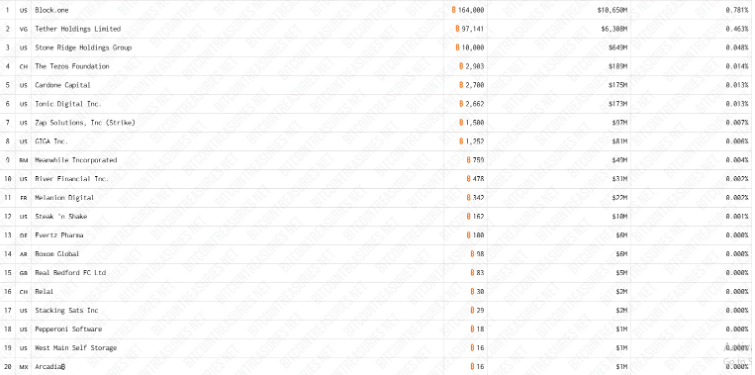
Furthermore, investment firm Stone Ridge Holdings Group ranks third with 10,000 BTC, demonstrating a consistent commitment to the asset over many years. Tezos Foundation takes the fourth corporate spot with its 2,903 BTC.
Cardone Capital completes the top five by holding 2,700 BTC in its corporate treasury, while Digital Infrastructure Company Ionic Digital Inc. follows up with 2,662 BTC. Bitcoin payments company Zap Solutions, Inc., better known as Strike, reports 1,500 BTC on its balance sheet. GIGA Inc. holds 1,252 BTC, ranking eighth among private corporate holders.
Governments around the world are increasingly storing Bitcoin, just as many private investors and corporations have done in the past few years. While some countries have accumulated their holdings through seizures and asset forfeitures, others have adopted Bitcoin as part of broader national strategies, ranging from state-backed mining to sovereign reserve management. Collectively, these holdings highlight Bitcoin’s expanding role in public-sector balance sheets.
According to BitcoinTreasuries.net, governments collectively own 649,976 BTC, valued at approximately $41.92 billion. The 13 sovereign holders acquired their Bitcoin through different channels, including asset seizures, public disclosures, mining operations, and treasury reserves.
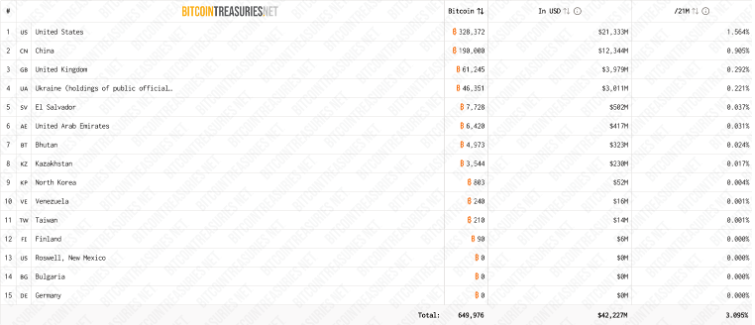
The United States remains the world’s largest sovereign holder of Bitcoin, amassing 328,372 BTC, worth $21.18 billion. Most of its holdings stem from criminal investigations and asset forfeiture cases conducted over several years. China follows with 190,000 BTC, worth $12.25 billion, mainly obtained from confiscations from law enforcement operations. These two sovereign holdings have amassed more than three-quarters of the world’s government-owned Bitcoin and show how enforcement has become a new source for sovereign Bitcoin ownership.
Britain stands third on the list with 61,245 BTC, while Ukraine comes fourth with 46,351 BTC. However, Ukraine’s holdings are not from a centralized treasury or state-owned venture, as with the other sovereign holders.
El Salvador remains the most deliberate government in accumulating Bitcoin. The country holds 7,728 BTC, with all additions coming through purchases since adopting Bitcoin as legal tender. Meanwhile, the United Arab Emirates owns 6,420 BTC, while Bhutan has accumulated 4,973 BTC through state-owned renewable energy mining projects. Growing government participation shows that Bitcoin acquisition strategies are expanding beyond asset seizures and confiscations.
The remaining sovereign holders of BTC include Kazakhstan with 3,544 BTC, North Korea with 803 BTC, Venezuela with 240 BTC, Taiwan with 210 BTC, and Finland with 90 BTC. Despite holding smaller amounts, they show that Bitcoin is gaining ground in more places.
Institutional demand for Bitcoin continues to be led by exchange-traded funds, with BlackRock maintaining a commanding lead over every other investment product. See also: 13t blackrock ceo says crypto is the next wave for. The latest holdings show that a small group of ETFs and custodians controls a significant share of institutional Bitcoin, reflecting where investors continue to concentrate their capital.
BlackRock’s iShares Bitcoin Trust (IBIT) remains the largest Bitcoin ETF, holding 811,291 BTC valued at approximately $52.31 billion. Further reading: Blackrock moves to turn bitcoin volatility into income with new. The fund’s lead over competitors underscores its position as the preferred vehicle for institutional investors seeking Bitcoin exposure through traditional financial markets.
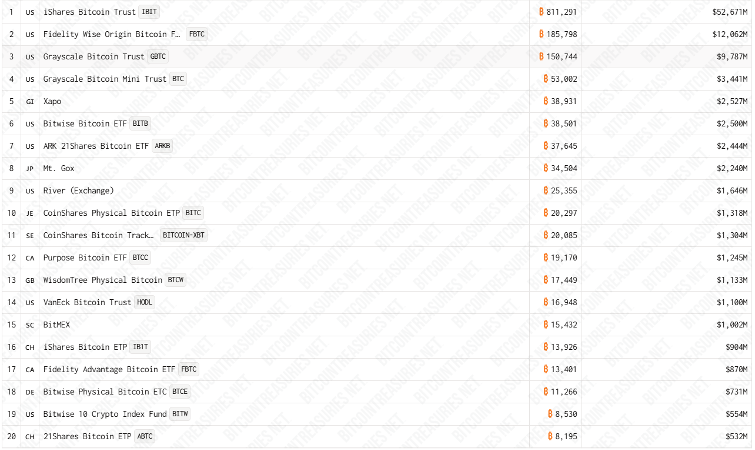
Fidelity Wise Origin Bitcoin Fund (FBTC) ranks second with 185,798 BTC, worth about $11.98 billion. It comes after Grayscale Bitcoin Trust (GBTC) with 150,744 BTC worth about $9.72 billion. Though GBTC has attracted investor outflows since becoming an ETF, it still remains one of the largest Bitcoin funds in the world.
Among the three largest funds, institutional holders still seem concentrated among a handful of established products and custodians. Grayscale Bitcoin Mini Trust holds 53,002 BTC, while digital asset custodian Xapo holds about 38,931 BTC in custody. The Bitwise Bitcoin ETF closely tracks, with 38501 BTC in its custody. The ARK 21Shares Bitcoin ETFs also aggregate 37,645 BTC, illustrating the increasing competition amongst spot Bitcoin ETF issuers for institutional capital.
Outside of active investment products, the estate of the collapsed Mt. Gox exchange still controls 34,504 BTC. Although these holdings are not part of an investment strategy, they remain among the world’s largest institutional Bitcoin reserves while awaiting distribution to creditors.
Public companies can hold Bitcoin as a treasury reserve and treat it as a capital-allocation choice alongside cash and bonds. When BTC rises on the balance sheet, it can improve reported financial strength even if operating results are weak; that is accounting and treasury mechanics, not proof every firm should copy the strategy. Corporate BTC buying remains a balance-sheet channel distinct from spot ETF creations, even when both appear in the same news cycle. Read them as separate access and demand rails when explaining institutional Bitcoin.
Public-company treasury programs keep buying through drawdowns, analyst price targets, and missed index inclusions. That is still a balance-sheet channel, not an ETF creation. A regional bitcoin beta product is another brokerage wrapper; read it as access, not as proof the corporate treasury trade changed.
Corporate Bitcoin treasury strategies continued evolving this week as companies focused not only on accumulating Bitcoin but also on strengthening their balance sheets and improving capital efficiency. Recent developments from B Treasury Capital AB and Strategy illustrate how firms are refining their financial structures while maintaining long-term conviction in Bitcoin.
B Treasury Capital AB (BTC AB) strengthened its financial position after repaying its remaining EUR 270,000 loan, equivalent to approximately SEK 3.0 million. The repayment was funded through proceeds from the preference share issue completed ahead of BTC PREF’s July 20 listing on the Spotlight Stock Market. As a result, the company no longer carries any interest-bearing debt.
Chief Executive Officer Christoffer De Geer said becoming debt-free gives BTC AB a cleaner capital structure and full control over its Bitcoin holdings. Removing borrowing obligations allows the company to manage its treasury without interest costs while maintaining complete ownership of its Bitcoin reserve. The move reflects a growing trend among Bitcoin treasury companies to strengthen their balance sheets alongside expanding digital asset exposure. Related: Saylor microstrategy and the shifting bitcoin treasury model.
While BTC AB focused on reducing leverage, Strategy concentrated on capital allocation rather than increasing its Bitcoin holdings. A Form 8-K filed on July 27 showed the company neither bought nor sold Bitcoin during the reporting week, leaving its treasury unchanged at 843,775 BTC acquired at an average purchase price of $75,476 per coin.
Even without adding to its Bitcoin reserves, Strategy remained active in the capital markets. Related: Microstrategy adds 835m in bitcoin amid market dip. During the week, the company sold approximately 5.43 million MSTR shares through its at-the-market offering, generating about $544.5 million in net proceeds. Further reading: Mstr meltdown saylors bitcoin bet erases 90b as shares crash. It also repurchased 288,930 shares of its Variable Rate Series A Perpetual Stretch Preferred Stock (STRC) for $25 million under its $1 billion Digital Credit Securities Repurchase Program, leaving roughly $975 million available for future buybacks.
These transactions further strengthened Strategy’s financial position. Cash reserves increased from $3.225 billion to $3.75 billion, a level the company said could fund preferred dividend payments for approximately 2.1 years even if Bitcoin’s value fell to zero. See also: Saylors shocking dividend secret bitcoin needs just 1 25 growth. According to market analyst Adam Livingston’s CEBE framework, senior claims declined during the week while the amount of residual
Bitcoin attributable to common shareholders increased, despite no additional Bitcoin purchases. Gross Bitcoin per share declined because of the new share issuance, but lower senior claims helped improve residual Bitcoin ownership for common shareholders under the framework.
Institutional confidence in Strategy also remained evident. Further reading: Michael saylor credits bitcoin for beating mag 7 stocks in. Vanguard, one of the world’s largest asset managers, increased its exposure through the Vanguard Total Stock Market Index Fund (VTSAX), purchasing approximately $50 million worth of Strategy shares. The latest investment brought Vanguard’s total position in the company to roughly $993.5 million, underscoring continued institutional interest in firms using Bitcoin as a long-term treasury asset.
Bitcoin ETF Outflows Hit $679M as Wintermute Warns Crypto Has "Nothing Underneath"
Explore more