
 Samuel·September 17, 2026

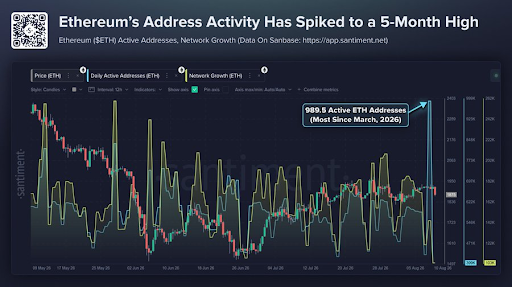
Ethereum logged 989,500 active addresses in 24 hours, its highest count since early March. The rapid growth in active addresses shows that daily usage of the settlement layer is increasing rapidly in the Ethereum network.
Hence, analysts in the crypto market are keenly watching for the effects of this liquidity injection on the broader market today.
Santiment indicates that Ethereum has seen a surge in wallet activity as the ETH price has been steady around $1,870. On-chain metrics gauge active network participation by counting the number of wallet interactions on the chain for a given time period. In addition, it is important to consider the daily transactions on the primary execution ledger as a glimpse of basic protocol functionality.
When major global cryptocurrency spot markets become more active, it is generally a precursor to the volatility traders anticipate in the market. Active wallet addresses are separate cryptographic accounts which transact on the mainnet every day.
Ethereum active addresses therefore serve as a great way for institutional investors to gauge the actual organic adoption volume rather than speculative trading volume.
Past trends suggest that when network metrics are high, there is a positive trend in capital inflows over time in decentralized financial markets.
Active wallet counts are used in addition to tracking transfers to get a sense of the health of the blockchain’s underlying structure. Ethereum, in general, is a decentralized, open-source smart contract-based execution environment. Unlike simple payment networks, it is a virtual machine that processes complex instructions globally, without any intermediary.
Consequently, every token swap, lending deposit, or NFT mint requires base layer validation and gas fees. When unique wallet interactions climb sharply, execution demand scales across thousands of decentralized applications simultaneously.
Robinhood Chain activity boosts Ethereum gas use and app traffic across markets worldwide. In particular, millions of retail investors are engaging with secondary rollups and base layer interfaces on a daily basis.
Moreover, lower transaction execution fees make it easier for traders to invest in decentralized protocols and make more frequent investments.
Activity resumes on the Ethereum network with stablecoins, RWAs and tokenized assets. Furthermore, continuous smart contract execution and native state transitions on-chain are needed for institutional-grade settlement systems. Consequently, overall network throughput is better than many months on the market.
As a result, user retention is much higher on the leading lending applications for decentralized application developers.
Institutional investors also consider how layer-one blockchain networks ensure the basic security guarantees to understand this momentum. Ethereum uses a proof-of-stake consensus mechanism that is supported by more than one million validators around the world. Validators lock up native ETH to suggest blocks, validate state changes and bring billions of dollars of value.
Moreover, layer-two scaling solutions return execution proofs as chained proofs directly to the secure layer-one framework. This structure allows off-chain application scalability without compromising the mainnet’s security, decentralization, and global consensus integrity.
A significant contributing factor to the increase is the resurgence of interest in US spot Ethereum ETFs.
In the first week of August, net inflows into these products reached about $245 million, continuing a run of five weeks in a row.
In addition, institutional asset managers use regulated investment vehicles to gain access to native staking yields. Expanding institutional capital allocation, therefore, has a direct positive impact on the overall growth of organic participation across the ecosystem.
As a result, there is consistent demand for native gas tokens in the ETH market across various markets.
Also, the core developers are working on further enhancements to the protocol scalability solutions, which can handle increased volume of continuous transactions.
However, traditional financial institutions are developing their primary asset tokenization frameworks on the public ledger rails.
Overall, analyzing Ethereum active addresses is one of the basic strategies for assessing the long-term growth of the Web3 network.
Related News
Explore more