
Hedera (HBAR): News, Price, and the Enterprise Hashgraph Network
Hedera runs on hashgraph, not a blockchain in the traditional sense, and it was built from day one for enterprises rather than degens. HBAR is the token that pays for all of it. People who follow this one closely have a running line: Hedera isn’t a degen chain, it’s an enterprise coin, and the Council […]

Hedera runs on hashgraph, not a blockchain in the traditional sense, and it was built from day one for enterprises rather than degens. HBAR is the token that pays for all of it.
People who follow this one closely have a running line: Hedera isn’t a degen chain, it’s an enterprise coin, and the Council behind it reads more like a corporate board than a crypto community. That reputation just got a regulatory upgrade.
This page covers how hashgraph actually works, why US regulators now treat HBAR as a commodity, how McLaren Racing and Repsol ended up with Council seats, three separate regulated routes into HBAR that didn’t exist a year ago, what actually moves the price, and the honest read on a recent rank slip. Read on for whichever part brought you here.
HBAR Wrapper Filings, Council Moves, and Cross-Chain Transfer News
Three threads are worth tracking on Hedera right now, and they all point in the same direction: institutions getting more comfortable holding and using HBAR.
Regulatory and Institutional Recognition
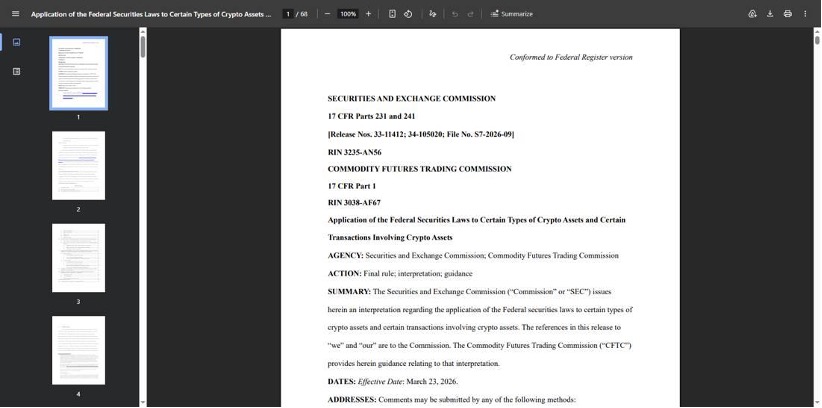
US regulators drew a hard line in March 2026. The SEC and CFTC jointly published Interpretive Release No. 33-11412, a formal taxonomy that sorts crypto assets into five categories, and HBAR landed squarely in the digital commodity bucket alongside 15 other assets. That matters more than it sounds. It takes HBAR out from under the shadow of securities registration and puts it under CFTC oversight instead, which is the same treatment Bitcoin gets.
ETF, Index, and Wrapper Access
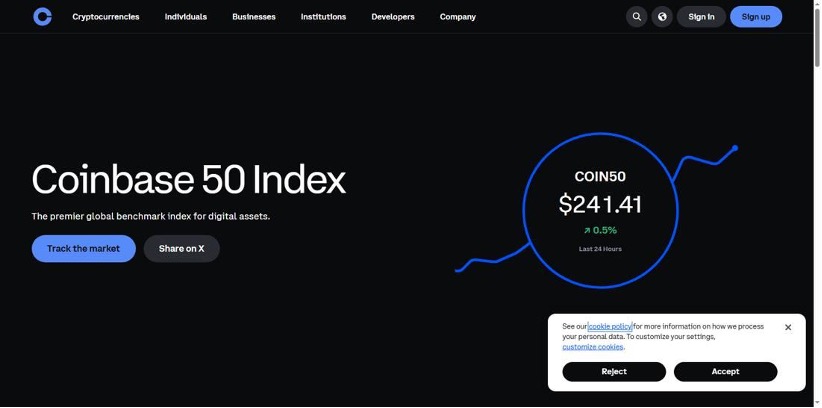
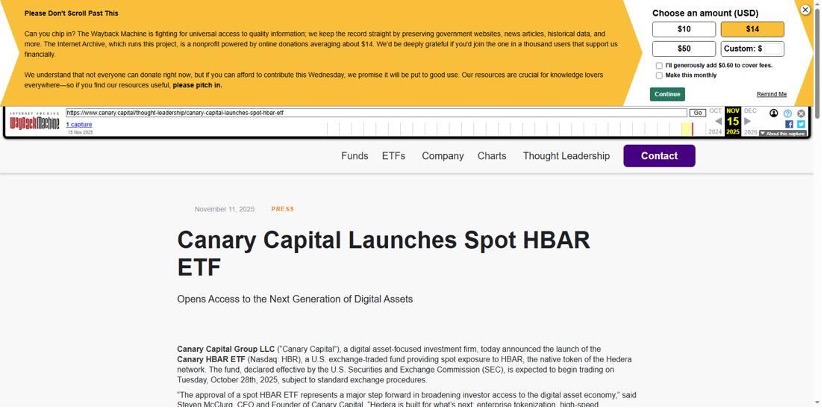
Grayscale filed an S-1 with the SEC for a Hedera Trust ETF back in September 2025, but Canary Capital got there faster, launching a spot HBAR ETF on Nasdaq under the ticker HBR from October 28, 2025, while Grayscale’s filing was still working through the SEC. HBAR also fought its way back into the Coinbase 50 Index, a re-entry after its 2024 removal that automatically pulls HBAR into products like the KraneShares Coinbase 50 ETF.
Cross-Chain Transfer Rails
Axelar plugged Hedera into more than 60 other blockchain networks through a single integration, and SaucerSwap became the first Hedera exchange to build that bridge directly into its own interface. That gives HBAR and Hedera-based tokens a real path to liquidity outside the network, not just inside it.
What Is Hedera (HBAR) and How Hashgraph Works
Hedera calls itself an enterprise-oriented public network, and that label actually fits, unlike many self-descriptions in this space. Instead of the block-by-block chain most cryptocurrencies run on, it uses hashgraph, a directed acyclic graph consensus method, with HBAR sitting underneath all of it to pay network fees and fund whatever gets built on top.
Governance is the other piece that sets this one apart, and it is a deliberate bet, not an accident. A Council of large enterprises holds equal votes here. No anonymous validators, no single foundation calling the shots, just big companies with reputations to protect, which tends to make for steadier governance than an open validator set. It also means the Council roster reads like a corporate directory more than a crypto community.
Council Launch to Regulated Wrappers: Hedera’s Institutional Access Arc
Dates below come straight from Hedera’s own posts and public filings. Worth checking against the primary link if anything here needs updating.
2018: Hashgraph Launches With a Governing Council Model
2018 was when Hedera Hashgraph launched, built from the start around a Governing Council of enterprises rather than anonymous validator staking, and that governance bet still defines the network today.
2018-2024: Council Membership Expands Across Industries
Enterprise members spanning technology, finance, and telecom, historically including names like Google, IBM, and Boeing, joined the Council with equal voting rights over several years. That slow-and-steady membership growth is what built Hedera’s institutional reputation long before the regulatory wins that followed.
September 2025: Wyoming’s Frontier Stable Token Adopts Hedera
Wyoming picked Hedera as a candidate blockchain for its Frontier Stable Token, the first US state-issued stable token, adding a public-sector settlement use case to the network’s resume.
September-November 2025: ETF Filing, Policy Network, and Axelar Integration
Grayscale filed its ETF paperwork. Hedera joined the Digital Chamber’s State Network alongside Strategy, IOG, TRON, and Crypto.com to work on state-level crypto policy. The Axelar integration went live, opening transfers across 60-plus chains. HBAR rejoined the Coinbase 50 Index. Four separate wins landed inside a two-month stretch, which is unusually fast for this network.
Q4 2025: Canary Capital Launches a Spot HBAR ETF
Canary Capital beat Grayscale to market by launching a spot HBAR ETF in the United States, giving HBAR one of its first regulated fund wrappers.
February 2026: Hedera Joins OMFIF’s Digital Monetary Institute
Hedera deepened its policy presence by engaging with OMFIF’s Digital Monetary Institute, sitting alongside blockchain infrastructure peers like Ripple, R3, and ConsenSys in conversations with central banks on CBDC and digital-money policy.
March 2026: Commodity Classification and New Council Members
US regulators classified HBAR as a commodity rather than a security through the SEC-CFTC taxonomy above, and in the same window McLaren Racing and Repsol both joined the Hedera Council. A regulatory win and two enterprise-adoption wins landed in the same month, which is not a coincidence so much as evidence institutions had been waiting for exactly this kind of clarity.
Enterprise Adoption via the Hedera Council
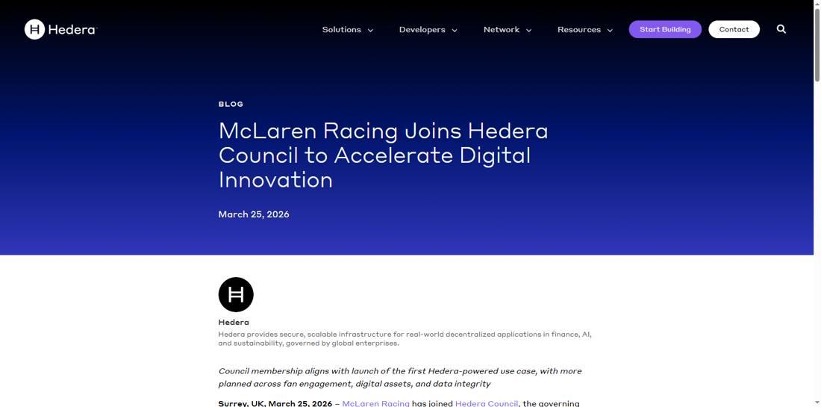
McLaren Racing’s Council seat grew out of a multi-year partnership covering both the McLaren Formula 1 team and the Arrow McLaren IndyCar team, branding and free-to-claim digital collectibles included. Repsol’s seat is aimed squarely at decentralized digital identity: interoperable identity, wallet-to-wallet KYC and KYB, and tamper-proof credentials built with an eye on the EU’s eIDAS2 and GDPR rules.
HashSphere, built by Hashgraph on Hedera’s technology, gives regulated enterprises a permissioned private-blockchain option that still stays interoperable with Hedera’s public network. Wyoming’s Frontier Stable Token, mentioned above, is the clearest public-sector example of that same idea, a state government choosing Hedera for payments and disbursements rather than building something from scratch. HashPack wallet and Hedera’s throughput claims round out the day-to-day context around all of this, though that is its own topic and not the focus here.
What Moves HBAR Price: Flows, Wrappers, and Rank Noise
ETF filings, index inclusion, and the commodity classification have all coincided with real price reactions, which makes sense since each one removes a piece of institutional hesitation. The useful framing is to separate genuine institutional flow signals from short-term rank and volume noise. A coin can drop out of the top 20 purely on thin volume during a quiet week, with nothing about the underlying network changing.
None of this supports a guaranteed price target, for HBAR or anything else. Check LBN’s live Altcoin News for dated price analysis instead of treating anything here as a forecast.
Council, Wrapper, and Rank-Swing Headlines Around HBAR
Hedera headlines sort cleanly into three buckets. Enterprise and Council news covers new members like McLaren and Repsol. Regulatory and ETF news covers filings, approvals, and the commodity classification. Price and market news covers the day-to-day chart moves, including rank swings that usually say more about volume than fundamentals.
A new Council member, a new ETF or index filing, a new regulatory development, a new integration: those are the four recurring shapes a real Hedera headline takes.
Regulatory Recognition Strengthens Hedera’s Institutional Case
US regulators have classified Hedera as a digital commodity rather than a security, aligning its treatment with assets like Bitcoin and removing a legal ambiguity that previously limited institutional participation. Hedera has reinforced that positioning by joining policy-focused bodies rather than staying purely commercial.
It sits within OMFIF’s Digital Monetary Institute alongside a small group of blockchain infrastructure providers, such as Ripple, R3, and ConsenSys, and engages directly with central banks and regulators on CBDC and digital-money frameworks used across the UK, EU, Singapore, and UAE. Separately, Hedera joined the Digital Chamber’s State Network with peers including Cardano and Crypto.com to advocate for coordinated, pro-crypto policy at the US state and local level. Together, these moves show a network building regulatory credibility as deliberately as it builds technology, which matters more to institutions than any single price catalyst.
What “Commodity, Not Security” Means for HBAR
In practice, it means institutions can hold and transact in HBAR without worrying that it might retroactively count as an unregistered securities offering. That single change removes a legal risk that had kept some regulated players on the sidelines, and it is a big part of why the ETF and index news above landed when it did.
ETF and Index Wrappers Extend Regulated HBAR Access
Regulated wrapper products provide institutions with a way to gain exposure to HBAR without managing private keys or direct custody. Grayscale’s S-1 filing for a Hedera ETF, along with parallel filings for Litecoin and Bitcoin Cash, does not seek a standalone rule change. Instead, it waits on the SEC’s broader Generic Listing Standards, a single regulatory path that could allow several crypto ETFs to list on NYSE Arca at once, rather than fighting for separate approvals asset by asset. Index inclusion works similarly. HBAR’s re-entry into the Coinbase 50 Index means it now feeds into financial products such as the KraneShares Coinbase 50 ETF and a COIN50 perpetual futures contract, providing passive index exposure to HBAR alongside the market’s other largest, most liquid assets.
Both routes matter because they turn HBAR from a self-custodied token into a line item institutions can hold inside existing compliance frameworks.
Cross-Chain Transfers via Axelar Add a Third Access Lever
Beyond funds and indexes, Hedera added a direct-transfer access route by integrating with Axelar, which connects Hedera to more than 60 other blockchains without a manual bridging process. Axelar’s delegated proof-of-stake validator network verifies each cross-chain transfer, and ecosystem projects such as SaucerSwap have already built the integration into their interfaces. The result is a third way to reach HBAR liquidity and Hedera dApps, not through a regulated wrapper, but through direct interoperability that expands where the asset and its applications can actually be used.
FAQ
What is Hedera (HBAR)?
Hedera is an enterprise-oriented public network that uses hashgraph consensus instead of a traditional blockchain, governed by a Council of large enterprises, with HBAR as its native token for fees and services.
How is hashgraph different from a blockchain?
Hashgraph uses a directed acyclic graph structure rather than a linear chain of blocks, which Hedera argues lets it process transactions with different throughput and finality tradeoffs than block-based chains.
What is the Hedera Council?
A governing body of large enterprises, including recent additions McLaren Racing and Repsol, each holding equal voting rights over Hedera’s software and services rather than ceding control to anonymous validators or a single foundation.
Is Hedera a security or a commodity?
As of March 2026, US regulators classify HBAR as a digital commodity under the SEC-CFTC joint taxonomy, not a security.
What ETF and index products offer exposure to HBAR?
Canary Capital’s spot HBAR ETF (HBR) trades on Nasdaq, Grayscale has filed its own Hedera Trust ETF with the SEC, and HBAR sits inside the Coinbase 50 Index, feeding products like the KraneShares Coinbase 50 ETF.
How can I buy Hedera (HBAR)?
Most major exchanges list HBAR directly, and investors who prefer a regulated fund wrapper instead of self-custody can use Canary Capital’s HBR ETF or index products that include HBAR.
Will HBAR reach $10?
No page can responsibly promise a specific price target. Treat any dollar figure as one scenario to weigh against real flow and adoption data, not a guarantee.
What drives HBAR price?
Institutional flow signals like ETF and index news tend to matter more than short-term rank or volume swings, which often reflect noise rather than a change in the network itself.
Why did HBAR drop out of the crypto top 20?
Short-term rank swings usually track price and volume shifts across the whole market rather than anything specific breaking inside Hedera’s network or governance.
Where can I read about other altcoins?
The Altcoins hub covers the broader market, while Cardano, Pi Network, Dogecoin, and Solana each cover their respective coins.
Key Takeaways
- Hedera runs on Hashgraph, a directed acyclic graph consensus method, governed by a Council of large enterprises with equal votes.
- US commodity classification, OMFIF Digital Monetary Institute engagement, and Digital Chamber policy work reduced institutional friction in 2025-2026.
- Grayscale’s ETF filing, Canary Capital’s spot ETF, and Coinbase 50 Index inclusion give three separate regulated-access routes to HBAR.
- McLaren Racing and Repsol joining the Council show enterprise adoption moving from finance and tech into motorsport and energy identity products.
- Short-term rank swings, like briefly falling out of the crypto top 20, reflect price and volume flow, not network fundamentals.
- The Axelar integration adds a direct interoperability route to HBAR liquidity beyond funds and indexes.
- Sibling hubs (ADA, Pi, DOGE, SOL, SHIB) and the Altcoins pillar cover their own coins. This page stays focused on Hedera.