XRP Whale Accumulation Hits $2.2 Billion as Price Eyes These Next Targets

Latest in XRP
Ripple and XRP are two well-known names in the cryptocurrency industry. Many people think they are the same thing. They are closely related, but they play different roles in the digital asset landscape.
Ripple is a technology firm that builds payment systems for banks, businesses, and financial firms. XRP is the native cryptocurrency of the XRP Ledger (XRPL). Ripple offers some payment products that use XRP, but Ripple does not own or control the XRP Ledger.
Introduction: Ripple (XRP) Explained
What Is Ripple? What Is XRP?
How XRP Works
Consensus Instead of Mining
XRP Tokenomics
Major Milestones in XRP’s History
What XRP Is Used For
Acquire, Hold, and Secure XRP
Ripple XRP Price Drivers and News Catalysts
XRP vs Bitcoin vs Ethereum
Risks and Criticisms
Why XRP Matters
Frequently Asked Questions (FAQ)
This guide is a simple explanation of Ripple and XRP, including cto. It covers the XRP Ledger, XRP tokenomics, real-world uses, legal history, market relevance, and the key events that shaped XRP. It also explains why XRP is one of the world’s biggest digital assets.
The XRP Ledger (XRPL) is the open-source, decentralized blockchain that powers XRP. It is open for anyone to use, extend, or build on. The XRPL was designed for fast, cheap transfers of funds.
Unlike Bitcoin, the XRP Ledger has no mining. It uses a consensus mechanism called the XRP Ledger Consensus Protocol instead, where trusted validators verify transactions. Most transactions on XRPL settle in 3–5 seconds, and fees stay very low.
Beyond payments, the XRPL includes a built-in decentralized exchange (DEX) and supports stablecoins, custom tokens, and central bank digital currencies (CBDCs). These features benefit businesses and developers building on the network.
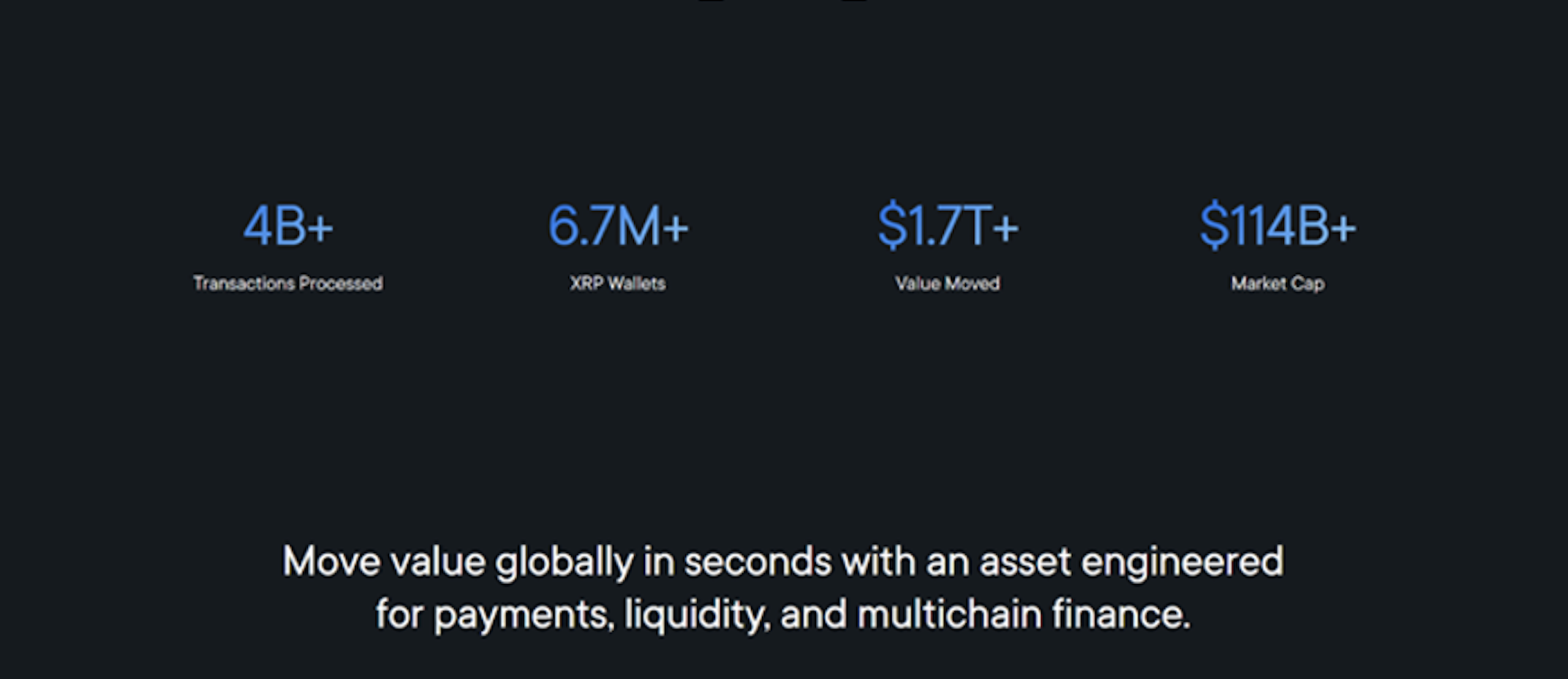
XRP’s goal is to make cross-border money transfers faster and cheaper by moving value from one currency to another. To date, the XRP Ledger has processed over 4 billion transactions, supported over 6.7 million wallets, and moved more than $1.7 trillion in value.
XRP’s story includes several turning points. David Schwartz, Jed McCaleb, and Arthur Britto began building the XRP Ledger in 2011, and the network launched in 2012. Chris Larsen soon joined the project, and together they formed the company that would become Ripple. See also: Ripple co founder chris larsen moves 26 million in xrp.
The founders allocated 80 billion XRP to Ripple to help grow the ecosystem. Ripple later placed most of these tokens into escrow — a system that releases XRP gradually and keeps the supply predictable.
XRP became one of the world’s biggest cryptocurrencies during the 2017 bull market. In 2020, the U.S. Securities and Exchange Commission (SEC) sued Ripple over its XRP sales — a case that shaped market sentiment for years.
The lawsuit was resolved in 2025, bringing greater legal clarity. Spot XRP ETFs launched in the U.S. that same year, and in March 2026 the SEC and CFTC jointly classified XRP as a digital commodity. Together, these technology, legal, and market developments have shaped XRP’s position in the crypto landscape today.
A common misconception among newcomers is that Ripple and XRP are the same thing. They aren’t! Understanding the difference makes the rest of the Ripple ecosystem much easier to follow. Below, you’ll find what Ripple is, what XRP is, what the XRP Ledger (XRPL) does, and why XRP was created.
Ripple is a financial technology company. It builds payment software and digital asset infrastructure for banks, businesses, and payment providers, aiming to make cross-border money transfers faster, cheaper, and more secure.
Traditional international payments often pass through multiple banks, which can take several days and rack up high fees. Ripple’s blockchain technology cuts those delays and costs, giving financial institutions a modern alternative to legacy systems such as SWIFT.
XRP, on the other hand, is not the company — it’s the native cryptocurrency of the XRP Ledger (XRPL). It is a digital asset independent of any central authority, and anyone can buy, sell, or trade it. Ripple builds some payment products that use XRP, but XRP works independently of Ripple.
The simplest way to remember the difference: Ripple builds the payment technology, and XRP is the digital asset that moves value across the XRP Ledger. They are closely related, but not identical.
The XRP Ledger, or XRPL, is an open-source, decentralized blockchain designed to move money fast and at minimal cost. The network is open for anyone to use, build applications on, or help maintain.
Instead of mining, the XRPL uses a consensus mechanism in which independent validators verify transactions. That keeps the network far less energy-intensive than proof-of-work blockchains while ensuring security and reliability.
The XRPL does more than just support payments. It also includes a built-in decentralized exchange (DEX) and supports stablecoins, tokenized real-world assets (RWAs), and non-fungible tokens (NFTs) — capabilities that benefit developers, businesses, and financial institutions alike.
The XRPL is central to the Ripple ecosystem but is not a Ripple product itself. Ripple builds on top of the ledger, while a global community of developers, businesses, and independent validators maintains the open-source blockchain.
XRP exists to make global payments faster, cheaper, and more efficient. It is a practical digital currency built for moving funds between currencies, and much more.
A conventional international bank transfer can take 3–5 days. Meanwhile, an XRP transaction typically completes in 3–5 seconds, letting businesses and payment providers move funds internationally at a fraction of the time.
XRP also reduces how much money banks need to hold in foreign accounts, known as nostro accounts, by acting as a bridge currency that provides liquidity as money moves between currencies.
Its fixed supply is another core feature. The network minted all 100 billion XRP at launch, and no new XRP can ever be created. A very small amount is destroyed with every transaction, which helps prevent network spam.
To understand XRP, it helps to see how the network operates behind the scenes. The XRP Ledger was built to move value quickly without making the technology hard to follow. This section covers how XRP processes transactions, why it’s fast and cheap, and how it works as a bridge between currencies.
Bitcoin isn’t the only cryptocurrency that relies on mining — an electricity- and CPU-intensive process to validate transactions. While there are plenty of other cryptocurrencies that rely on mining, the XRP Ledger takes a different approach. It uses the Ripple Protocol Consensus Algorithm (RPCA) to achieve consensus.
Instead of mining, independent validator computers work together to confirm transactions, typically reaching consensus in 3–5 seconds. Because there’s no mining involved, the network uses significantly less energy than traditional proof-of-work blockchains.
No single validator controls the network; a worldwide community maintains it, which keeps the ledger secure, reliable, and accessible at all times.
XRP’s biggest advantage is speed. Most transactions on the XRP Ledger settle in 3 to 5 seconds, regardless of where the sender and receiver are located, and fees typically run a tiny fraction of a cent, which makes the network practical for both small and large transfers.
This matters most for international payments. A traditional bank transfer can take several days and pass through multiple intermediaries, and each step adds cost and delay. The XRP Ledger lets value move nearly instantaneously instead, which helps businesses improve cash flow and cut wait times for clients and partners. The same low fees also make XRP efficient for liquidity routing, since institutions can move money without paying high costs per transfer.
XRP is often called a bridge currency as it enables the movement of funds between two different currencies quickly and without hassle.
For example, imagine a business needs to pay someone in Japanese yen but only holds U.S. dollars. Instead of routing the payment through multiple banks and waiting days for settlement, the dollars can be converted to XRP, sent across the XRP Ledger, and converted into yen — all in seconds.
This removes the need for financial institutions to keep large nostro accounts of foreign currency sitting idle. Funds can move only when needed instead of being tied up across multiple countries.
This bridge function is the core utility XRP was built for. While many digital assets serve various purposes, XRP’s central use case has stayed the same for over a decade: fast, low-cost value transfer and payment settlement within the global financial system.
XRP’s tokenomics provides information on how its supply is created, controlled and distributed. Learning how its supply is created, controlled, and distributed helps explain why XRP remains such a prominent topic in crypto.
Unlike Bitcoin, XRP isn’t mined. The network created all 100 billion XRP tokens when the XRP Ledger launched in 2012, and no new XRP can ever be added to the supply.
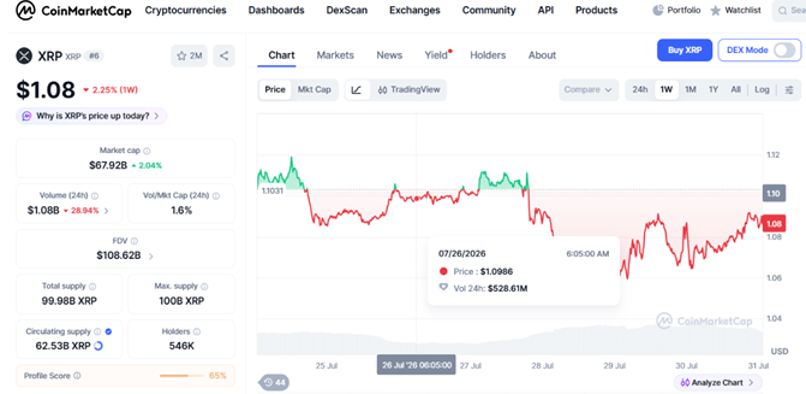
According to CoinMarketCap, XRP’s total supply sits at 100 billion tokens. Supporters see this fixed cap as a built-in scarcity mechanism over time.
A small amount of XRP is also destroyed, or “burned,” with every transaction. Each burn is tiny, but it gradually reduces the overall supply — a detail investors often weigh when considering XRP’s long-term value and price drivers.
When XRP launched, its founders kept 20 billion XRP and allocated 80 billion XRP to Ripple to help fund the ecosystem’s growth.
As Ripple’s holdings drew concern from parts of the market, the company launched an escrow system in 2017 to add predictability. Escrow works like a locked vault: XRP sits inside it and can only be released according to rules programmed into the XRP Ledger.
Ripple placed 55 billion XRP into escrow, with releases capped at 1 billion XRP per month — though Ripple typically returns much of the unused amount back into escrow. This public, rules-based schedule gives the market transparency, since Ripple can’t dump large amounts of XRP without warning. Escrow releases remain a factor many XRP watchers track closely, since they can influence supply and sentiment.
XRP’s token distribution has sparked debate for years. Critics argue that Ripple’s large XRP reserves give the company outsized influence over the ecosystem. Supporters counter that the escrow system adds transparency and that the XRP Ledger itself is open-source and run by independent validators worldwide.
These differing views split opinion on XRP: some see it as a payment-focused utility token, while others remain wary of its distribution structure. Either way, tokenomics is central to understanding XRP, since it shapes perceptions of scarcity, adoption, and long-term value.
Ripple’s dollar stablecoin RLUSD is positioned for banks and enterprises that need 1:1 USD reserves, audits, and redemption, not for speculative trading. Staged approvals in Dubai’s DIFC (approval in principle, DFSA payments license, then RLUSD token recognition) show how regulated blockchain payments are expanding within a major trade hub.
In the UK, an FCA EMI license plus cryptoasset registration lets Ripple Markets UK issue e-money and institutional payments rails that can carry RLUSD. Pairing Ripple Payments with regulated fiat platforms enables enterprises to mint or burn RLUSD while keeping EUR and GBP cash legs in a single stack. The durable lesson for the pillar: licensing and stablecoin settlement are how Ripple sells trust to institutions.
Acquiring a multi-asset prime broker expands Ripple beyond payments into clearing, funding, and institutional trading services across FX, digital assets, derivatives, and fixed income. RLUSD can act as collateral that bridges crypto funding and traditional markets, while migrating post-trade work onto the XRP Ledger aims to cut operational costs.
XRPL roadmap upgrades add ledger-native lending through pooled vaults, plus privacy tools that prove compliance without exposing wallet data. Programmability is arriving through an EVM-compatible sidechain for Solidity apps, while mainnet smart contracts remain a longer research path. Operator hygiene still matters: urgent rippled patches fix edge-case crashes, so validators need timely upgrades for network reliability.
The Ripple (XRP) story spans more than a decade of technological change, market surges, and legal developments. These milestones explain why XRP remains one of the most discussed digital assets in crypto.
David Schwartz, Jed McCaleb, and Arthur Britto began developing a new kind of blockchain in 2011, aiming to build something faster and more efficient than Bitcoin.
The XRP Ledger (XRPL) officially launched in June 2012. Unlike Bitcoin, it wasn’t mined — it was built for payments and value transfer from the start.
Chris Larsen joined the project later that year, and the team formed a company called NewCoin, which became OpenCoin and finally Ripple. From the outset, Ripple’s strategy was to build payment technology around XRP that could make cross-border transfers faster and cheaper for banks and businesses.
XRP grew steadily for several years as Ripple signed partnerships and expanded its payment business, but it entered the spotlight during the 2017 crypto bull market.
As millions of new investors entered the crypto market that year, XRP’s market cap rose to become one of the largest in crypto, briefly surging past $3.00. Ripple’s partnerships with financial institutions fueled investor excitement, and many hoped XRP could help modernize international transactions and challenge legacy systems like SWIFT.
Growing social media buzz, news coverage, and exchange support all reinforced XRP’s rise, making it one of the most recognized digital assets worldwide.
One of the biggest events in XRP’s history began in December 2020, when the SEC sued Ripple for selling XRP as an unregistered security.
The lawsuit rattled the crypto industry. Several exchanges halted or delisted XRP trading, and investors closely tracked every case update for years.
A pivotal shift came in July 2023, when Judge Analisa Torres ruled that XRP itself was not a security when traded on public exchanges — though the court found that certain institutional sales had violated securities law.
The case continued through appeals and penalty discussions in 2024 and 2025. According to Reuters, in August 2025, Ripple and the SEC reached a settlement and dropped their remaining appeals, closing one of the longest-running legal battles in crypto history.
Resolving the lawsuit reshaped how people viewed Ripple and XRP. After more than four years of legal uncertainty, attention shifted to XRP’s real-world use and growth potential.
Market confidence improved first. Exchanges that had delisted or restricted XRP during the lawsuit began restoring it after key rulings, making XRP easier to access and boosting trading volumes.
Legal clarity also opened the door to institutional interest. Companies that had been waiting on the sidelines began exploring the XRP Ledger for payments, tokenized assets, and other blockchain use cases.
XRP news coverage shifted too — from court proceedings to partnerships, payment technology, and adoption. That shift has helped redefine XRP’s public image from a legal case to a utility-driven digital asset.
New developments reinforced this progress. The first U.S. spot XRP ETFs began trading in 2025, and Ripple launched its own U.S. dollar-backed stablecoin, RLUSD, on the XRP Ledger — both expanding the ecosystem’s reach.
Legal clarity alone doesn’t guarantee higher prices, though. Like any major cryptocurrency, XRP’s price still depends on market demand, adoption, investor confidence, and overall crypto market conditions. It continues to compete with stablecoins and other blockchain networks for growth. The central question today isn’t about the lawsuit anymore. It’s about how widely banks, payment companies, and financial institutions will adopt the XRP Ledger going forward.
XRP is a digital asset built for fast payments, liquidity, and financial services. Also covered: Gtreasury launches ripple treasury to transform global cash and liquidity. It powers the XRP Ledger (XRPL) and moves money worldwide in seconds. Today, it’s used for cross-border payments, settlement, liquidity, tokenized assets, and a growing set of institutional applications.
The numbers reflect that growth: the XRP ecosystem has processed 4B+ transactions, supports 6.7M+ wallets, has moved $1.7T+ in value, and carries a market capitalization above $114B.
XRP’s core design job is bridge liquidity: move value across borders without locking large multi-currency nostro balances at every destination bank. Ripple’s On-Demand Liquidity model uses XRP to source local currency at settlement time, which is why the company competes for mindshare against SWIFT-style correspondent banking rather than against meme-coin narratives. Cross-border standard setters describe what a third-party settlement asset needs in practice: messaging interoperability (including ISO 20022-style payment messages), deep enough liquidity to clear transfers, and the ability to work across jurisdictions. That checklist is literacy for “bridge currency” claims, not a price forecast. Operators outside crypto, such as mobility and travel firms, can also hold XRP reserves to settle payouts and refunds when traditional rails are slow or expensive. Banks may adopt Ripple payment technology, including Interledger-style rails for real-time transfers, while still lagging on native XRP settlement, so product adoption and token usage can diverge. The strategic framing from Ripple leadership is network scale: become the dominant remittance and bank-liquidity layer that monetizes fast, large-value transfers.
Regulated venues can also list smaller-notional XRP futures so traders get price exposure with sized margin and clearer product rules. Those contracts are brokerage access tools. They do not replace XRP’s payment-bridge design job, and a futures listing is not the same event as bank settlement volume.
Ripple continues to expand the XRP Ledger beyond payments into a broader set of financial services, including cross-border payments, foreign exchange (FX), digital asset transfers, and institutional applications.
Ripple Payments gives businesses a managed solution for international transfers, letting them send and receive fiat currencies, RLUSD, USDC, USDT, and other supported stablecoins without rebuilding their existing payment systems.
Stablecoins play a growing role in the XRP ecosystem, letting businesses transact across different digital currencies while XRP serves as the liquidity bridge between assets. The XRP Ledger can also tokenize real-world assets (RWAs) such as money market funds, bonds, and investment funds, allowing them to settle faster and transfer more safely on-chain.
New XRPL features — including Multi-Purpose Tokens (MPTs), Permissioned Domains, Permissioned DEX, Token Escrow, Batch Transactions, and an upcoming Lending Protocol — are aimed squarely at regulated financial institutions looking to use XRP for liquidity, settlement, and tokenization.
Buying and holding XRP is straightforward if you follow the right steps: choose a reputable exchange, move long-term holdings to a secure wallet, and follow basic security practices to protect your funds from scams and hackers.
An XRP wallet is an application that lets you send, receive, store, and manage XRP on the XRP Ledger (XRPL). Rather than holding your coins directly, it stores the private keys that give you access to them.
There are two main types: custodial wallets and self-custody wallets. A custodial wallet is controlled by an exchange or company that holds your private keys. It is convenient if you forget your password, but it means you don’t have full control of your assets. A self-custody wallet puts your private keys and recovery phrase in your own hands, giving you complete control, but your funds can’t be recovered if that phrase is lost.
Wallets also come in hot and cold varieties. Hot wallets stay connected to the internet and work well for daily payments or trading — popular options include Xaman Wallet (formerly Xumm) and Trust Wallet. Cold wallets, like the Ledger Nano or Trezor Safe, are hardware devices that keep your keys offline, offering stronger protection for long-term storage.
When choosing a wallet, weigh security features, reputation, and user reviews. Beginners tend to favor hot wallets for ease of use, while long-term investors typically prefer the added security of hardware wallets.
Picking the right exchange matters just as much as picking a wallet. A trusted exchange makes buying, selling, and storing XRP far safer.
Look for strong security practices — two-factor authentication (2FA), cold storage for customer funds, and a solid security track record — along with good liquidity, which tends to mean more stable prices and smoother trades.
Compare trading, deposit, and withdrawal fees before opening an account, and confirm the platform supports your preferred payment method, whether that’s a bank transfer or debit card. It’s also worth checking that the exchange follows local regulations and requires identity verification (KYC). Coinbase, Kraken, and Binance are all well-established options.
XRP can also be bought through decentralized exchanges (DEXs) such as the XRPL DEX and Sologenic DEX, though these generally suit more advanced users, since you’ll need a crypto wallet and another cryptocurrency to trade for XRP.
Once your exchange account is set up and funded, you can buy XRP on the spot market — purchasing it at the current price for immediate delivery.
Always confirm the trading pair (XRP/USD or XRP/USDT) before placing an order, and check the total cost, including trading and withdrawal fees, so you know exactly what you’re spending.
Keeping your XRP safe matters as much as buying it in the first place. If you’re holding for the long term, consider moving it off the exchange and into your own wallet.
Protect your private keys and recovery phrase at all costs — write the phrase down on paper, store it somewhere safe, and never share it or save it online.
Enable 2FA on both your exchange account and wallet whenever possible, always double-check wallet addresses before sending XRP, and include a Destination Tag if the receiving exchange requires one.
XRP’s price moves for many of the same reasons other major cryptocurrencies do — news, market trends, and investor sentiment all play a role. Here’s a closer look at the main drivers behind XRP price swings and why certain stories dominate headlines.
Legal news has shaped much of XRP’s journey, and the SEC lawsuit dominated the crypto industry’s attention for years. When the SEC sued Ripple in December 2020, the uncertainty led several exchanges to suspend or delist XRP trading.
A turning point came in July 2023, when a U.S. court ruled that XRP was not a security when traded on public exchanges — a decision that boosted investor confidence and sent XRP’s price higher. Ripple and the SEC then dropped their remaining appeals in 2025, closing one of crypto’s longest court cases. Since then, investors have kept a close eye on new regulations that could still shape XRP’s future.
In short, positive legal news tends to lift market sentiment, while uncertainty tends to weigh it down.
Adoption is another major factor. Interest in XRP typically rises as more companies adopt Ripple’s technology or build on the XRP Ledger (XRPL).
Ripple has struck deals with banks, payment providers, and financial institutions worldwide — for example, partnering with SBI Remit in Japan to speed up international remittances using XRP. The company has also expanded into digital asset custody, stablecoins, and tokenization, with its RLUSD stablecoin opening new use cases across the XRP ecosystem.
Ripple Payments now works with partners and service providers across more than 170 countries and 80 currencies, and Ripple recently joined the x402 Foundation, which supports payments for AI applications using XRP and RLUSD. Together, these moves show Ripple and the XRP Ledger evolving well beyond a simple payment service — and as adoption grows, so does long-term interest in XRP.
Like Bitcoin and Ethereum, XRP is sensitive to the broader crypto market — moving up with the pack during bull runs and pulling back during broader downturns.
XRP hit a cycle peak of about $3.65 in July 2025, according to CoinGecko. By late July 2026, it was trading around $1.06 — a clear reminder of how much market cycles can swing an asset’s price, independent of its underlying fundamentals.
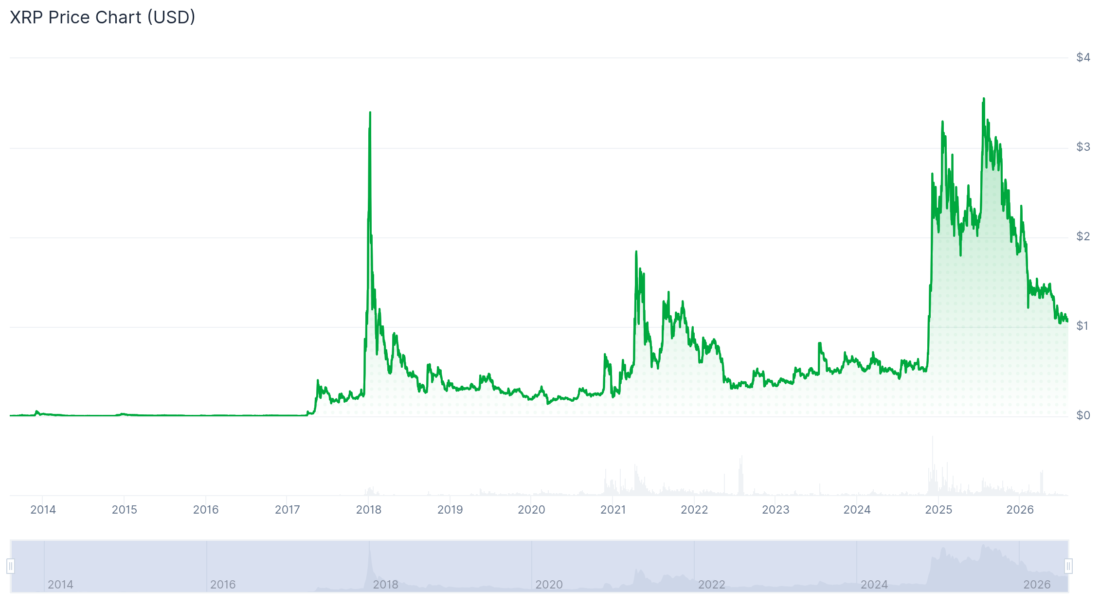
Taken together, legal developments, adoption, partnerships, and broader market cycles are the biggest forces behind XRP’s price — and understanding them helps explain why certain stories dominate XRP headlines throughout the year.
Ripple (XRP), Bitcoin (BTC), and Ethereum (ETH) rank among the largest cryptocurrencies, but each serves a different purpose. Understanding these differences helps newcomers place XRP within the broader market. Further reading: Ethereum eth and ripple xrp jockey for 2nd place less.
Bitcoin, created in 2009, is the original cryptocurrency. Many use it as a store of value — often called “digital gold” — as well as a way to send money between people.
XRP, introduced in 2012, was built for faster, cheaper cross-border transactions. Beyond storing value, it moves funds across currencies in about 3–5 seconds.
Bitcoin relies on energy-intensive Proof-of-Work (PoW) mining, while the XRP Ledger (XRPL) uses an independent validator consensus system instead — making XRP considerably more energy efficient.
Ethereum launched in 2015 as a blockchain built for smart contracts and decentralized applications (dApps). Thousands of developers use it to build DeFi platforms, NFTs, blockchain games, and more.
XRP serves a different purpose: payments, liquidity, and international money transfers. The XRP Ledger can support other blockchain capabilities, but its primary role remains fast, low-cost value transfer.
| Feature | XRP | Bitcoin (BTC) | Ethereum (ETH) |
| Launch Year | 2012 | 2009 | 2015 |
| Main Purpose | Cross-border payments and liquidity | Store of value and payments | Smart contracts and decentralized applications |
| Native Token | XRP | BTC | ETH |
| Consensus Mechanism | XRP Ledger Consensus | Proof of Work (PoW) | Proof of Stake (PoS) |
| Transaction Speed | 3–5 seconds | Around 10 minutes per block | Usually seconds to minutes |
| Transactions Per Second (TPS) | Up to 1,500 TPS | Around 7 TPS | Around 15–30 TPS on Layer 1 |
| Transaction Fee | Around 0.00001 XRP | Varies, often from under $5 to over $50 | Varies depending on network demand |
| Maximum Supply | 100 billion XRP | 21 million BTC | No fixed maximum supply |
| Energy Use | Low | High | Low |
| Best Known For | Fast global payments | Digital gold | Smart contracts and dApps |
Each cryptocurrency solves a different problem: Bitcoin is mainly a store of value, Ethereum is a smart contract and dApp platform, and XRP is built for fast, cheap cross-border payments and liquidity.
That focus is why XRP is most often recognized as a utility token tied to moving value between currencies, even though many people also hold it as an investment. Understanding these distinctions makes it easier to follow XRP news, track its price drivers, and place Ripple (XRP) within the wider crypto landscape.
Like any major cryptocurrency, Ripple (XRP) carries its own set of risks alongside its advantages. Understanding them can help you make more informed decisions before using or investing in XRP.
Decentralization is one of the biggest debates around XRP. Critics argue that Ripple holds too much influence given the large amount of XRP still sitting in escrow.
Supporters counter that the XRP Ledger (XRPL) itself is open-source and run by independent validators around the world, separate from Ripple’s holdings. This debate has run for years and remains one of the most discussed topics in the XRP community.
Regulation is another key risk. The SEC’s 2020 lawsuit against Ripple led several exchanges to suspend or delist XRP trading. The incident showed just how much government decisions can move crypto markets.
The eventual legal resolution brought clarity, but future regulatory changes could still affect XRP and the broader crypto sector.
XRP also faces real competition. Blockchain networks like Ethereum, Solana, and Stellar, along with stablecoins such as USDT and USDC, are all competing for the same payment and settlement use cases — and traditional financial firms are upgrading their own payment systems too. That means Ripple has to keep innovating and driving adoption to stay competitive.
Despite these challenges, XRP remains one of the largest cryptocurrencies by market cap. Its future will likely hinge on adoption, innovation, regulation, and competition across the fast-moving digital payments space.
XRP has stayed one of the most talked-about cryptocurrencies for more than a decade. Despite the rise and fall of countless digital assets, it remains a key player in conversations about payments, blockchain adoption, and the future of finance.
XRP’s significance comes from its real-world application. The XRP Ledger (XRPL) is built to move value quickly and cheaply, with transactions typically settling in 3–5 seconds for less than a cent — making its “bridge currency” role one of the clearest utility cases in crypto.
In recent years, the XRP ecosystem has expanded well beyond payments to support stablecoins, tokenized assets, decentralized finance tools, and other blockchain applications.
The SEC lawsuit was one of the most consequential moments in XRP’s history, weighing on its price, exchange listings, and overall sentiment for years.
Court rulings and the case’s eventual resolution shifted the narrative, letting more people look past the legal headlines toward XRP’s actual adoption and real-world use — a pivotal turn in the asset’s trajectory and identity within crypto.
XRP’s future will likely hinge on three factors: adoption, regulation, and product development.
As more businesses adopt XRP and the XRP Ledger, demand is likely to grow. Greater regulatory clarity could open the door to more institutional involvement, while new products built around the Ripple ecosystem may draw in new users.
No one can predict exactly what comes next, but XRP has already shown it can adapt to shifting market dynamics and stand the test of time. Whether readers see it as a utility token, an investment, or both, XRP remains a central part of the global cryptocurrency conversation.
Ripple is a financial technology company. XRP is a cryptocurrency used on the XRP Ledger to make quick, low-cost payments.
No. Ripple is the company, and XRP is the digital asset. They’re connected, but not the same thing.
The XRP Ledger (XRPL) is an open-source blockchain that lets individuals and organizations transfer money swiftly and affordably across the globe.
In 2023, a U.S. court ruled that XRP sold on public exchanges is not a security. Crypto regulations can still change, though.
Most XRP transactions take 3 to 5 seconds, with fees usually under a cent.
It affected XRP’s price, exchange listings, and market sentiment for years, and it stands as one of the biggest legal cases in cryptocurrency history.
XRP is used mainly for cross-border payments, liquidity, and transaction fees on the XRP Ledger, helping move funds quickly between currencies.
Explore more