
US Spot Bitcoin ETFs Pull In $622M as Winning Streak Hits 6 Weeks

Latest in XRP ETF
US Spot Bitcoin ETFs Pull In $622M as Winning Streak Hits 6 Weeks
Ripple’s XRP ETFs Shock Wall Street With $1.5B Inflows in Record Time
Canary XRP ETF Records 26M Volume in First 30 Minutes
Massive ETF Inflows: BTC, ETH, SOL, XRP See $521M Surge
Bitrue Sees 212% Surge in XRP Buying: The Case for Next Price Rally?

Searches for “XRP ETF approval” tend to spike whenever a rumor or a prediction-market number moves, often well before any filing has actually changed. That pattern makes basic product literacy worth building before the next headline lands, rather than during the scramble that follows it.
This guide covers what an XRP ETF actually is and how it differs from spot, futures, and self-custody. It explains how filings and approvals work in practice, ways to read inflow and outflow figures without treating them as a price floor and more. With so many ETF headlines flooding the news stream, the article also explains how to sort through them and glean meaningful information.
Ripple’s legal history comes up only where it shapes the ETF path itself; full depth on that case is covered separately in Live Bitcoin News’s Ripple-SEC coverage, and price-specific analysis lives in the site’s XRP price analysis hub. What follows is organized for a reader to jump straight to the section that answers their actual question, rather than reading the whole thing to find one figure.
Three threads currently define the XRP ETF story, and each moves on its own schedule.
Since the SEC introduced generic listing standards for commodity-based crypto ETPs in late 2025, most new XRP-linked filings have moved through the same auto-effective mechanics that let Canary Capital’s XRPC reach the market in a matter of weeks rather than the multi-year fight the first Bitcoin spot filings went through. Issuers still amend registration statements after staff feedback, and new leveraged variants, including GraniteShares’ 3x leveraged filing, keep entering the queue behind the spot products already trading.
Combined net assets across the seven listed XRP ETFs sat at roughly $953 million as of August 7, 2026, against cumulative net inflows of about $1.51 billion since the first spot launches, according to SoSoValue’s XRP ETF dashboard. The gap between those two numbers is not a mystery. XRP itself traded near $1.02 that day, down from the roughly $1.40 range that supported an earlier $1.4 billion net-assets snapshot Live Bitcoin News covered when XRP ETF clients added $3.87 million in early May. Token price, not just redemptions, moves that headline figure.
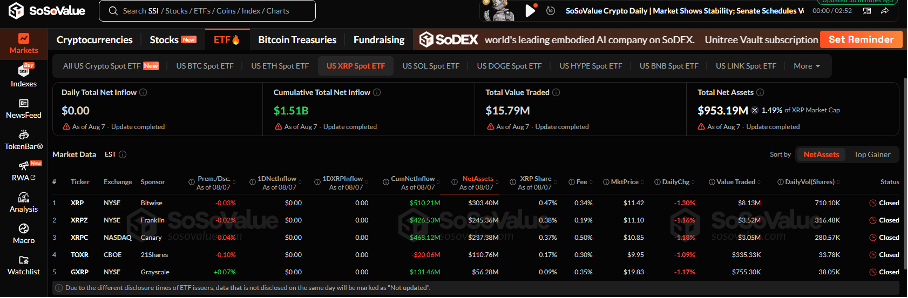
XRP ETFs now clear through the same order flow as any listed equity, which is a different distribution question than whether an exchange holds spot XRP directly. Standard brokerage accounts, including ones that do not support direct XRP custody, can place orders on tickers like XRPC, XRP, XRPZ, GXRP, TOXR, and XRPR without the account holder ever touching a wallet.
The category did not begin with a spot product. It began with derivatives, moved through a foreign exchange first, then finally reached the United States in stages rather than one single “approval day.”
The first XRP ETF to trade anywhere wasn’t even a spot fund. Teucrium’s leveraged 2x Long Daily XRP ETF, ticker XXRP, started on NYSE Arca back on April 8, 2025, months before any spot approval existed anywhere in the world. CME Group followed with its own regulated XRP futures. The exchange confirmed plans in an April 24 press release, then trading actually opened about a month later, on May 19, with a smaller 2,500-XRP micro contract sitting alongside the standard 50,000-XRP size. Volatility Shares built on that plumbing almost immediately, and XRPI, the first non-leveraged XRP futures ETF, landed on Nasdaq roughly a week after CME’s launch. None of this involved a single spot token changing hands inside a US-listed fund, not yet; it proved regulated exposure was possible before anyone had to solve custody.
Brazil, not the US, hosted the first true spot XRP ETF. Hashdex’s XRPH11 began trading on the B3 exchange on April 25, 2025, managed alongside Genial Investimentos and tracking the Nasdaq XRP Reference Price Index after clearing approval from Brazil’s securities regulator, the CVM, that February. Canada followed within two months: Purpose Investments’ XRP ETF launched on the Toronto Stock Exchange on June 18, 2025, the same day 3iQ listed a competing spot XRP fund on the same exchange. Geography led the calendar by more than half a year before a US spot product existed at all.
Momentum on the regulatory side built through the summer. Ripple and the SEC closed their five-year case on August 7, 2025, when both sides filed to end their respective appeals, leaving the earlier ruling that XRP is not a security in secondary-market retail sales intact, alongside a $125 million penalty and a permanent injunction covering certain institutional sales. Roughly three weeks later, the SEC’s new generic listing standards for commodity-based crypto ETPs took effect, and a cluster of asset managers, including Canary Capital, Bitwise, Franklin Templeton, Grayscale, and 21Shares, began amending existing filings or submitting fresh ones to use that faster path rather than waiting on individual exemptive orders.
REX-Osprey reached the market first among truly XRP-holding US products, launching XRPR on Cboe BZX on September 18, 2025 alongside a companion Dogecoin fund; Bloomberg Intelligence analyst James Seyffart noted at the time that the structure held XRP directly while also retaining derivatives flexibility, rather than qualifying as a pure spot filing under the older rulebook. Canary Capital’s XRPC followed on November 13, after the firm’s Form 8-A went automatically effective twenty days after an October 24 amendment, a path that market participants now treat as the standard route rather than an exception. Bitwise’s XRP ETF launched on NYSE a week later, on November 20, the same week Franklin Templeton’s XRPZ debuted on NYSE Arca and Grayscale converted its existing private trust into the listed GXRP, certified for NYSE Arca trading on November 21 and live by November 24. 21Shares closed out the wave in December, listing TOXR on Cboe BZX with custody split across Anchorage, BitGo, and Coinbase Custody.
The new funds absorbed capital quickly at first; Live Bitcoin News tracked XRP ETFs pulling in $1.5 billion in inflows in record time not long after the November launches. Outflow days followed the same pattern every crypto ETF category has seen, often clustered with broader risk-off stretches; one such period saw XRP ETFs buck a $500 million wave of Bitcoin and Ethereum outflows in one direction while later weeks ran the other way. By August 2026, 21Shares’ TOXR sat in cumulative net outflow since inception even as the category overall remained net positive, a reminder that fund-level and category-level flow figures do not always point the same direction.
Access has widened past crypto-native platforms since the November wave. Standard brokerage accounts at firms like Fidelity and Schwab now support XRP ETF tickers, even on platforms that still will not let that same client buy XRP directly. CME, for its part, added extended near-24/7 trading hours for its XRP futures and options about a year after the original May 2025 launch, a move aimed more at institutional desks than everyday retail traders.
Every ETF-adjacent headline can, honestly, be sorted with the same handful of questions, and running through them takes less time than just reacting on impulse. Spot, futures, or some multi-asset sleeve that happens to include XRP, which is it, exactly? Which issuer, which exchange? A filing amendment, a listing notice, or neither of those? Is the number being reported an actual flow print, or is it a price-gossip figure dressed up to look like data? And does the source trace back to a primary filing, or is it a rumor quietly repeating another rumor?
Live issuer rosters and daily ticker movements change too often for a guide like this one to freeze into permanent numbers; Live Bitcoin News’s ongoing ETF coverage is the better place for that day’s print. This page is meant to work as the scorecard readers return to when they need to know what a headline actually means, not as the place for today’s exact figure. Ripple-SEC headline days still surface occasionally and are worth noting only as path context here; the full chronology of that case lives elsewhere on the site.
Grouping issuers by what their product actually holds answers “who filed” and “who launched” more usefully than a name-dropped roster ever does, since a roster like that expires within weeks of publication.
Pure-play spot issuers now trading in the US include Canary Capital (XRPC), Bitwise (XRP), Franklin Templeton (XRPZ), Grayscale (GXRP), and 21Shares (TOXR); REX-Osprey’s XRPR sits closer to a hybrid structure that holds XRP directly but retains derivatives flexibility. Futures-based products, including Volatility Shares’ XRPI and Teucrium’s leveraged XXRP, track CME contracts rather than holding spot tokens, which changes how each fund behaves during a basis dislocation even when the headline price move looks identical. Outside the US, Hashdex’s XRPH11 in Brazil and Purpose Investments’ fund on the Toronto Stock Exchange, launched the same day as a competing 3iQ listing, show that a pure-play spot wrapper reached retail investors on two continents before the first one existed in America.
BlackRock headlines deserve a filing check before an assumption gets repeated as fact. As of early 2026, the firm had not filed a US spot XRP ETF and had separately denied an earlier, fabricated “iShares XRP Trust” rumor that circulated in 2025; executives have pointed to concentrated client demand in Bitcoin and Ethereum rather than XRP itself as the reason for holding back, while stopping short of ruling out an eventual filing. For a live, current issuer-and-ticker breakdown rather than a snapshot that will read as outdated by next quarter, Live Bitcoin News’s dedicated ETF coverage tracks each new filing as it lands, and its reporting on Japan’s exchange leadership backing XRP ETFs covers the parallel conversation building in Asia.
An XRP ETF is a brokerage-listed wrapper for XRP price exposure. Spot products aim to track an XRP reference rate and give regulated share exposure without asking the investor to self-custody tokens. Futures-based XRP ETFs, including leveraged variants, use derivatives instead of holding spot XRP the same way, and that difference in product type matters more than the ticker’s surface-level branding suggests. Multi-asset crypto funds that include an XRP sleeve are also not the same thing as a pure-play spot XRP ETF, even when marketing language blurs the distinction. Geography matters too: spot XRP ETFs were listed outside the US well before any American product existed. Ripple Labs equity is still not what any of these products deliver; an XRP ETF tracks the token, not shares in the company that built the ledger it runs on.
US spot XRP ETF launches usually require exchange listing filings plus issuer registration work, and the SEC can extend its review window without that delay meaning automatic denial. A delay is common calendar behavior, not a verdict. Issuers often amend filings after SEC feedback, including changes to cash versus in-kind creation and redemption mechanics for authorized participants, and several managers can sit in the pipeline at the same time without any of them blocking the others. Prediction-market approval odds and viral “filing rumor” headlines are temporary by nature; verifying the actual issuer and exchange filing before treating a rumor as a real product remains the only reliable check, however confident a Polymarket percentage looks on a given day.
Exchange listing rules keep changing even after spot products are already trading. On September 3, 2026, the SEC approved Nasdaq Texas Rule 5711(d) changes for Commodity-Based Trust Shares (Release No. 34-106268). The order adds a 15% NAV buffer for certain otherwise-ineligible holdings, writes a digital-commodity definition into that exchange’s listing standard, and allows actively managed strategies under the same rule family. Bitcoin, Ether, Solana, and XRP appear in the order as worked examples of assets that already meet the exchange’s eligible-commodity tests. That is exchange plumbing for one venue. It is not a fresh federal statute reclassifying XRP, and it is not approval of any specific new fund. Treat “SEC cleared XRP as a commodity” headlines as a misread of a listing-standard update unless the underlying filing actually changes a product.
XRP ETF inflows show how much money enters spot XRP ETF products. Outflows show money leaving those products through redemptions. Therefore, ETF wrappers can be used to gauge demand for XRP using net inflows. However, they do not directly measure demand for XRP in the wider spot market.
When the inflows reverse, the holdings and assets under management of the ETFs can change as well. After a new ETF launches, trading volume is an indicator of early interest, but it does not mean that the XRP price floor is established. The list of institutional holdings can also be posted shortly after the ETF’s launch. Early holdings, however, indicate distribution and access, not long-term demand.
Strong inflows can be followed by long periods of outflows. These are moves that can occur in broader risk-off periods in crypto ETFs. Meanwhile, broader brokerage access can make XRP ETF products easier to buy. This can open more opportunities for investors even if the XRP spot price fluctuates.
Therefore, readers should look at inflows, outflows, AUM, trading volume, and access all together. Don’t expect any one ETF number to be a 100% guarantee of the price of XRP.
A brokerage-listed fund built to track XRP’s price, either by holding the token directly (spot) or by holding derivatives contracts tied to its price (futures). Buying a share does not transfer any XRP into an investor’s own wallet.
One that holds actual XRP as its underlying asset rather than futures contracts, aiming to track a reference rate like the CME CF XRP-Dollar Reference Rate as closely as possible after fees.
An ETF share cannot be sent, staked outside the fund’s own structure, or withdrawn to a personal wallet; ownership stays inside a brokerage account and is subject to that account’s trading hours and settlement rules. Direct token ownership carries none of those restrictions but shifts custody and security entirely onto the holder.
In practice, it usually means an issuer’s registration statement went effective, often automatically under the newer generic listing standards, rather than the SEC issuing an affirmative statement endorsing the product. The distinction matters because an auto-effective filing can happen with far less public drama than the phrase “SEC approval” implies.
Useful as a sentiment gauge, not as a substitute for reading the actual filing status. Odds can swing on rumor volume alone, while the underlying paperwork often has not moved at all.
Bitwise, Grayscale, 21Shares, Canary Capital, Franklin Templeton, and REX-Osprey all had listed XRP-linked ETFs trading in the US by the end of 2025. BlackRock had filed nothing as of early 2026, despite recurring rumors to the contrary.
No. Inflows measure demand for the wrapper, and strong early volume is distribution evidence rather than a price commitment. Outflow days have followed even long, well-covered inflow streaks.
Brazil’s Hashdex XRPH11 launched first, in April 2025, followed within two months by competing spot funds from Purpose Investments and 3iQ on the Toronto Stock Exchange. Both markets had working spot products before the first one existed in the US.
Teucrium’s leveraged XXRP and Volatility Shares’ 1x XRPI both track CME XRP futures contracts rather than holding spot tokens, and both reached the market before any US spot XRP ETF did.
Sort every headline by product type, issuer and exchange, filing stage, and whether the number cited is a real flow print or informal chatter dressed up as one. Live tracking pages update faster than any static guide ever will.
Not even close. Ripple Labs is a private company; none of the listed XRP ETFs deliver equity in it. They track the token’s price, which is a separate asset from the company that developed the XRP Ledger.
Interest built steadily through 2025, tracking the CME futures launch in May, the Brazil and Canada spot listings that followed, and then spiked hardest around the September through December run of US listings once REX-Osprey, Canary, Bitwise, Franklin Templeton, Grayscale, and 21Shares had all reached the market within a few months of each other.
Product literacy for XRP funds also sits beside the site’s stablecoins hub when comparing cash-like crypto exposure to ETF wrappers.
Explore more