
Latest in Buy XRP & Wallets
6
Total stories
3
Writers
XRP Basics: How to Buy XRP and Choose a Secure Wallet
Wondering how to buy XRP and where to store it once you own it?
XRP is among the most liquid digital currencies in crypto, and with just a few steps, you can purchase it. This guide covers how to buy XRP on a reputable exchange and how to pick the best XRP wallet for your needs, from a hot wallet for everyday use to a Ripple cold wallet for long-term storage.
Ripple is the private company that builds financial products and solutions using the XRP Ledger; whose native utility token is XRP. People often confuse buying “Ripple” with buying XRP, a mix-up covered in more detail below. Tracking XRP news helps you follow price swings and security updates, and the golden rule of self-custody still applies: not your keys, not your coins.
Getting Started with XRP
Buying XRP starts with clearing up a common mix-up: many searches look to buy Ripple crypto when they actually mean XRP. Knowing the difference between an exchange and a wallet before you begin makes the rest of the process far simpler.
Buying Ripple Shares Is Not Buying XRP
Retail investors, especially newbies, often type in “buy Ripple” when they intend to purchase XRP. These are different products. XRP is the asset found on the ledger that you can buy on an exchange and move to a wallet that you manage. Meanwhile, what they search implies equity ownership in a private company called Ripple, not a simple retail ticker.
Some public companies engage in XRP treasuries or exposure to the entire Ripple ecosystem, such as through non-Ripple token sales. Sometimes, there’s a special-purpose vehicle between a buyer and the asset, and some fees will also be added, so “exposure” language in headlines needs to be read with care. For regular traders, the road to XRP remains the same: purchase XRP on a reliable exchange and store it in the appropriate wallet.
How to Buy XRP Step by Step
This is a step-by-step guide to purchasing XRP that is easy to follow.
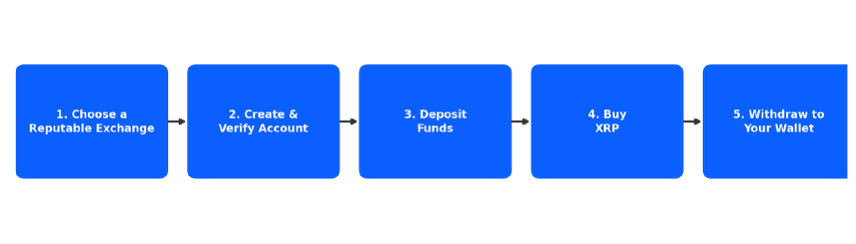
Step 1: Choose a Reputable Exchange
Review country support, regulatory status, XRP/USD liquidity, security history and security fees, and see reviews plus official registration.
Step 2: Create and Verify Your Account
Register, set up 2FA, and verify your identity (government ID and selfie).
Step 3: Deposit Funds
Make your deposit via bank transfer, card, or cryptocurrency, depending on your region.
Step 4: Buy XRP
Click on the XRP/USD or any supported XRP/fiat trading pair, then click on ‘spot buy’ and view the total fees before finalizing.
Step 5: If Not Staying on Exchange, Withdraw XRP to Your Wallet
Withdrawing to a personal wallet improves security. Verify the address and destination tag, and note the network fee.
Be wary of “recovery expert” services and presale offers that hijack buy-XRP search intent. As the FTC warns, anyone charging upfront to “recover” lost funds or pre-selling a “new XRP” is almost always running a scam.
Types of XRP Wallets
Storage choice matters as much as where you buy. Custodial vs non-custodial storage and hot vs cold wallets both affect where to store , including when a cold wallet for XRP outperforms convenience-first storage.
Custodial vs Non-Custodial Wallets
A custodial wallet is one in which you give your private keys to an exchange, while a non-custodial wallet gives you control of your private keys:
| Wallet Type | Pros | Cons |
| Custodial | Beginner-friendly; no key management; support can help with account recovery. | Exchange controls your keys; exposed to hacks, freezes, or insolvency. |
| Non-Custodial | Full control of your keys; no counterparty or exchange risk. | You are solely responsible for backups; lost keys mean lost funds. |
Hot Wallets vs Cold Wallets
Hot wallets are applications on mobile, desktop, and/or browser that stay connected to the internet with their private keys online. Cold wallets could be hardware or paper wallets that keep keys offline.
| Wallet Type | Pros | Cons |
| Hot Wallet | Convenient for frequent transactions; usually free; fast for active trading. | Connected to the internet, so more exposed to malware and phishing. |
| Cold Wallet | Keys stored offline; strongest protection for long-term holdings. | Less convenient for frequent trades; hardware devices carry an upfront cost. |
XRP-Specific Considerations
Not every cryptocurrency wallet supports the XRP Ledger. Investors should verify XRPL compatibility before transferring funds.
The XRP Ledger also requires a small reserve amount to activate a new wallet address. This reserve helps reduce spam accounts across the network and may change through community governance.
Some exchanges require destination tags when receiving XRP deposits. Omitting the destination tag remains one of the most common causes of delayed or missing deposits among new users.
Also, all wallets must be compatible with the and properly process destination tags.
Additionally, the XRPL reserve requirement needed to keep the wallet active isn’t spendable, so that needs to be taken into consideration when withdrawing from an exchange.
How to Choose a Secure XRP Wallet
What wallets support XRP and Ripple comes down to three criteria:
- security,
- usability, and
- reputation.
When you’re looking for the best Ripple wallet, comparing wallets that support Ripple, or just looking for an XRP wallet app, take these factors into consideration.
Security features to look for
The most secure wallets allow users to control their private keys instead of relying on third-party custodians. Self-custody reduces the risk of exchange failures and unauthorized access while giving investors complete ownership of their assets.
When comparing the best XRP wallet, important security features include:
- A private key system that you have control over, not a system in which someone else freezes your funds.
- Independent auditing by means of strong encryption and open-source code (where applicable).
- Two-factor authentication on all connected accounts and partner apps.
Usability and Compatibility
Security should be balanced with ease of use. A wallet that is difficult to navigate may increase the likelihood of mistakes during transfers.
When evaluating what wallets support XRP, investors should consider:
- User-friendly interface for a first-time XRP holder.
- Accessibility on the devices you use: smartphone, tablet, or computer.
- Full XRPL compatibility: send, receive, and tag destination.
Reputation and Support
A wallet provider’s reputation plays a significant role in long-term security. Investors should research the wallet’s development history, update frequency, and customer support before transferring assets.
Factors worth reviewing include:
- A history of successful operations that hasn’t had any significant security issues that have not been resolved.
- An active developer team that is constantly working on keeping the wallet updated while working on new features.
- Easy-to-find helpdesk/ support channels & documentation.
Established wallets supporting Ripple generally offer greater reliability than newly launched or inactive projects.
Best practices for safely storing XRP securely
Protecting XRP extends beyond choosing a wallet. Good security habits significantly reduce the risk of theft, phishing attacks, and accidental loss.
Create a security habit for the wallet you selected with this checklist.
Back Up Your Recovery Phrase
- Put it in writing on paper (and keep a second one in a different secure place).
- Never store it digitally; no screenshots, email, or cloud notes.
Protect Your Device and Accounts
- Always use a strong, unique password for exchange accounts and wallets, and enable 2FA.
- Update your operating system and wallet applications to fix known vulnerabilities.
Avoid Common Mistakes
- Avoid giving away your seed phrase or private keys, not even to “support staff”.
- Avoid clicking on links in emails or messages you don’t know.
- Purchase hardware wallets from the official manufacturer or an authorized reseller.
- Always confirm addresses and destination tags; one of the most common XRPL deposit mistakes still surprises new users.
Test Before You Transfer Large Amounts
Sending a small test transaction before transferring larger balances helps confirm that the wallet address and destination tag are correct.
Once the test transaction arrives successfully, the remaining XRP can be transferred with greater confidence.
FAQ
How do I buy XRP?
Open an account on a reputable exchange, verify your identity, deposit funds, and place a spot buy order for XRP/USD.
Where can I purchase Ripple/XRP?
Most major exchanges that support the XRP Ledger let you buy XRP; compare fees, liquidity, and country availability first.
Is buying Ripple stock the same as buying XRP?
No. Ripple Labs is private, so there is no public “Ripple stock”; buying XRP means buying the token itself.
What wallets support XRP?
Any wallet built for the XRP Ledger works, spanning mobile, desktop, and hardware options; always confirm destination tag support.
What is the best XRP wallet?
It depends on use: active traders often prefer a hot wallet, while long-term holders favor a hardware-based Ripple cold wallet.
What is a cold wallet for XRP?
A cold wallet keeps your private keys entirely offline, such as a hardware device, making it far harder for remote attackers to reach.
Where should I store Ripple/XRP?
Small, active-trading amounts can stay on an exchange or hot wallet; larger long-term holdings belong in a non-custodial cold wallet.
Do I need a destination tag to send XRP?
Many exchanges require one to credit your deposit correctly, and forgetting it is a leading cause of missing XRP transfers.
Can I use an ETF instead of a wallet?
An XRP-linked ETF offers exposure without wallet management, but you won’t directly own or control the underlying XRP.
When did destination tags become a big beginner issue?
They have tripped up newcomers since XRP trading volume grew, since most other blockchains don’t require an equivalent field.
Are XRP mining/Robinhood wallet mining offers real buy guides?
No. Mining promos and “earn daily” wallet pitches that hijack buy-XRP intent are misleading; stick to verified exchanges and official wallets.
Buying XRP is quick once you know the steps, and the right wallet simply matches your storage method to how you plan to use the asset. Buy from a reputable source, protect your keys, double-check every address before sending, and keep following XRP news to stay current on wallet and exchange security.
Explore more
A Brief Introduction to Bitcoin Wallets & Security
AI & Meme Token Presales: How to Read Hype, Fair Launches, and “Best Meme Coin” Searches
Altcoins Explained: Altcoin Season, News, and the Full Coin Map
Bitcoin Basics: Bitcoin ETF, Institutional & Corporate Adoption
Bitcoin Basics: Bitcoin Investing & Valuation
Bitcoin Basics: Bitcoin Mining & Supply Economics