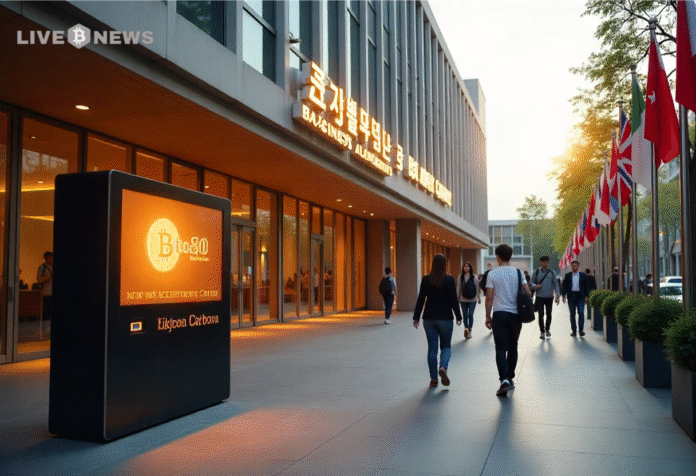

HKU Business School explores accepting Bitcoin payments for tuition, boosting crypto adoption in education with secure, compliant systems.
The University of Hong Kong (HKU) Business School, one of Asia’s most prestigious institutions, is exploring the use of Bitcoin and other digital currencies for tuition payments and donations. The school is moving toward incorporating cryptocurrency into its financial operations, which marks a step toward increasing acceptance of digital assets in higher education.
HKU to Build Secure Structure for Crypto Transactions
During this week’s CryptoFi Forum, the dean of HKU Business School announced plans for this possible change. According to university representatives, all the necessary technical systems are in place for the relevant processing of digital assets. This would enable future students and donors to pay in Bitcoin or other comparable digital currencies.
Related Reading: Spar Supermarkets in Switzerland Now Accept Bitcoin Payments | Live Bitcoin News
The project is considered a progressive step toward the utilization of financial innovation. The business school assures that it will construct a safe and transparent structure. This would make transactions in digital currencies legal and compliant. The school is focusing on key regulatory issues. It is addressing anti-money laundering (AML) rules. It is also following know your customer (KYC) requirements. These steps help ensure safe and legal crypto transactions.
The potential adoption of digital assets at HKU can be seen as part of the broader trends in finance and education worldwide. Earlier this year, BlackRock received its first investment from the United States in the form of bitcoin by Brown University, which bought shares in the regulated spot Bitcoin ETF. There is an increasing interest in digital assets at universities all over the world.
Several developments in Hong Kong underlie this change. The city’s financial regulator, the Securities and Futures Commission (SFC) has already authorized 11 virtual asset trading platforms. This regulatory clarity helps institutions embrace blockchain-based payment mediums. Thus, Hong Kong’s regulatory environment is becoming more favorable towards crypto innovation.
Crypto Payments Could Boost International Student Access at HKU
Lawmaker Johnny Ng Kit-chong observed that digital currencies have been slow to be used in daily life in the city. He noted that although digital payments are common in other countries, Hong Kong’s awareness is quite low. He said that crypto price changes can be managed with smart financial methods. One way is to quickly change crypto into local money.
HKU’s acceptance of Bitcoin and digital assets highlights the growing impact of blockchain in both education and finance. Moreover, cryptocurrencies tied to traditional currencies like the U.S. dollar offer a practical solution to make crypto payments more stable and accessible. As a result, these digital assets can reduce the risks caused by sudden price changes. In particular, they provide a reliable payment option for international students and donors. Therefore, by embracing blockchain and stablecoins, HKU is setting an example for how educational institutions can safely integrate digital finance into their systems.
The Hong Kong-based company’s founder, Zhao Changpeng of Binance, attending the CryptoFi Forum is yet another indication of the significance of Hong Kong as a burgeoning centre for digital assets. Industry leaders feel the city can compete with other international crypto hubs, such as the United States and the United Arab Emirates. However, clear policy support and early government action is still needed to keep the momentum going.
If the plan goes ahead, HKU could be one of the first big Asian universities to accept cryptocurrency for tuition and donations. This would make it easier for students and donors to pay using digital money. It could also inspire other schools in Asia to do the same. As a result, blockchain technology might become more common in education.