
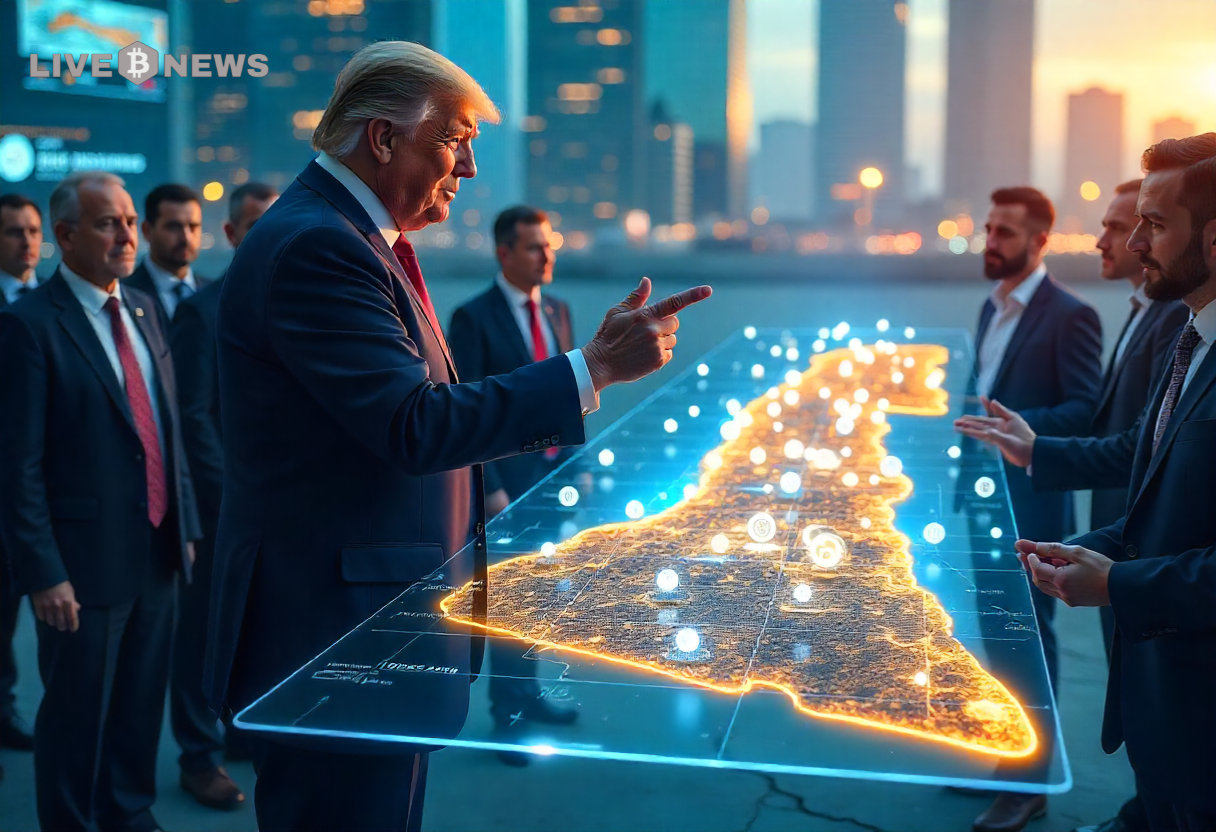
Trump’s idea for a Gaza peace plan with tokenized land that marries blockchain with real estate in post-war reconstruction
Donald Trump is reportedly writing a controversial Gaza plan that calls for tokenized land. This is a new concept that arises in response to the current developments in the conflict, to change the future for Gaza. According to sources, Trump has a vision of changing land ownership using blockchain technology.
It has been reported by The Washington Post that the program will make it possible for both residents and investors to acquire digital tokens that represent ownership interests in real estate (Washington Post, 2025). The way that peace is conceived of in the Middle East may undergo a fundamental transformation as a result of these developments.
Tokenization: Is It Possible to Reinvent Real Estate in Gaza?
The idea also suggests a land transfer system that is based on blockchain technology, which might be helpful in attracting foreign investment. In light of the aftershocks that Gaza experienced, it raises problems regarding administration and sovereignty.
Reports indicate that the idea put up by Trump calls for the relocation of the Palestinian population that resides in Gaza to a location that is comparable to the Riviera.
As a result of this, a luxurious dwelling would be offered that allows for electronically transferable land units. Assuming the proposal goes through, economic innovations will be fused with political compromise.
Many who object to this tokenization are of the opinion that it may make real estate in a conflict zone into a commodity that further encloses the land instead of uniting it. One side says the case brings property rights into the 21st century in an area that has been looked at as recalcitrant.
Blockchain Meets Geopolitics: Where Does This Leave Gaza?
This proposal represents an important conceptual change in our understanding of the role technology disruptors play in geopolitics.
One of the potential benefits of tokenized land is that it has the potential to allow transparency that wasn’t possible before; it also raises questions around equity and accessibility.
Trump advisers apparently believe that approaching diplomatic relations this way circumvents institutional bureaucracies interfering with more traditional methods of making peace.
But adoption probabilities in transnational and regional fraught arrangements still stand as an open question.





Leave a Reply
You must be logged in to post a comment.