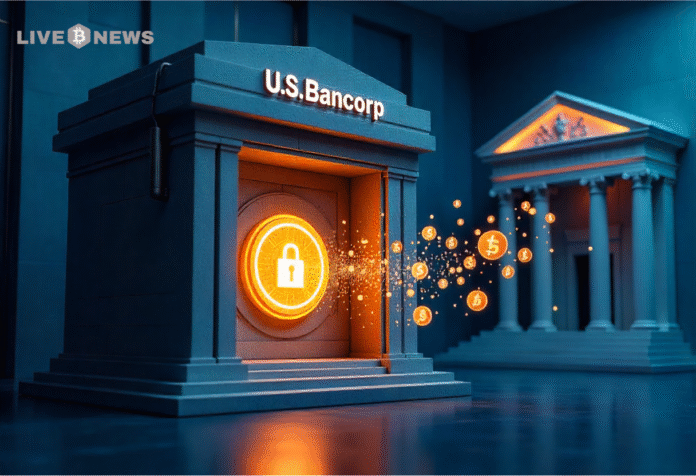

U.S. Bancorp resumes crypto custody with NYDIG after SEC rule changes, targeting Bitcoin ETFs and institutional clients amid rising demand.
U.S. Bancorp, the fifth-largest commercial bank in the United States, has relaunched its cryptocurrency custody service. The bank is collaborating with NYDIG, a fintech company specializing in Bitcoin. According to Bloomberg, this service will initially be provided in support of Bitcoin to a limited group of registered financial institutions and exchange-traded fund (ETF) providers. The decision follows a significant regulatory overhaul by the U.S. Securities and Exchange Commission (SEC).
NYDIG Partners Again with U.S. Bancorp for Crypto Custody
In 2021, U.S. Bancorp announced a partnership with NYDIG to offer cryptocurrency custody services to its customers. However, according to strict SEC rules the bank stopped the service. Crypto activities were required to hold additional capital on their balance sheets, which is a requirement of the SEC. This made such services expensive for banks to provide. In the second year of President Donald Trump’s term, the SEC withdrew this guidance. The move paved the way for U.S. Bancorp to re-enter the crypto custody business.
Related Reading: SEC and CFTC Support Spot Crypto Trading on Registered Platforms | Live Bitcoin News
Stephen Philipson, executive vice president of U.S. Bank (USB) and head of wealth, corporate, commercial and institutional banking, provided details about the relaunch. He said the bank is thrilled to be back partnering with NYDIG. NYDIG, a subsidiary of Stone Ridge Holdings Group, is a frontrunner in Bitcoin-related services. The company is the technology and support provider for U.S. Bancorp’s custody platform.
For now, U.S. Bancorp has chosen Bitcoin custody to work on. The service is aimed towards traditional registered funds and ETFs. In the future, the bank can include other cryptocurrencies. This conservative approach provides the bank with an opportunity to test the market while satisfying client demand.
Other larger banks are also making their way into the crypto custody space. Similar services are already provided by the Bank of New York Mellon Corp. and Fidelity Investments. Another big bank, Citigroup, has shown an interest in crypto custody. These actions reflect an increasing confidence of conventional financial institutions in digital assets.
Spot Bitcoin ETFs Spark Custody Race Among Banks
The regulatory changes in recent years are the main reason why there is a renewed interest in crypto custody. Under the current US administration, regulatory conditions for banks looking to enter into the crypto market are more favorable. This has, in turn, prompted banks to provide services such as digital asset custody. Asset managers of spot Bitcoin ETFs are major customers for these services.
Bitcoin ETFs have soared in popularity this year. The SEC approved these products in January 2024, and they have garnered a lot of interest. For example, the BlackRock iShares Bitcoin Trust (IBIT) has reached a market cap of over $80 billion. Nearly a dozen asset managers now provide ETFs that reference the spot price of Bitcoin. This booming trend has elevated the need for trustworthy custody services.
The rebranding of U.S. Bancorp is indicative of the times. As the value of Bitcoin continues to increase and the number of investors increases, banks see an opportunity to serve this market. A collaboration with NYDIG sets U.S. Bancorp up to compete with other banks in the crypto custody arena. Bitcoin wallet: The bank wants to offer a Bitcoin wallet that is secure and trusted by the clients.
The crypto custodial space is a space that is still being shaped. This space will continue to be influenced by regulatory changes that affect how banks operate. For now, the move by U.S. Bancorp is a sign that cryptocurrencies are becoming more accepted in traditional finance. As more banks follow suit, the industry could expect to see even more growth and innovation.