
 Bilal Hassan·19hr ago
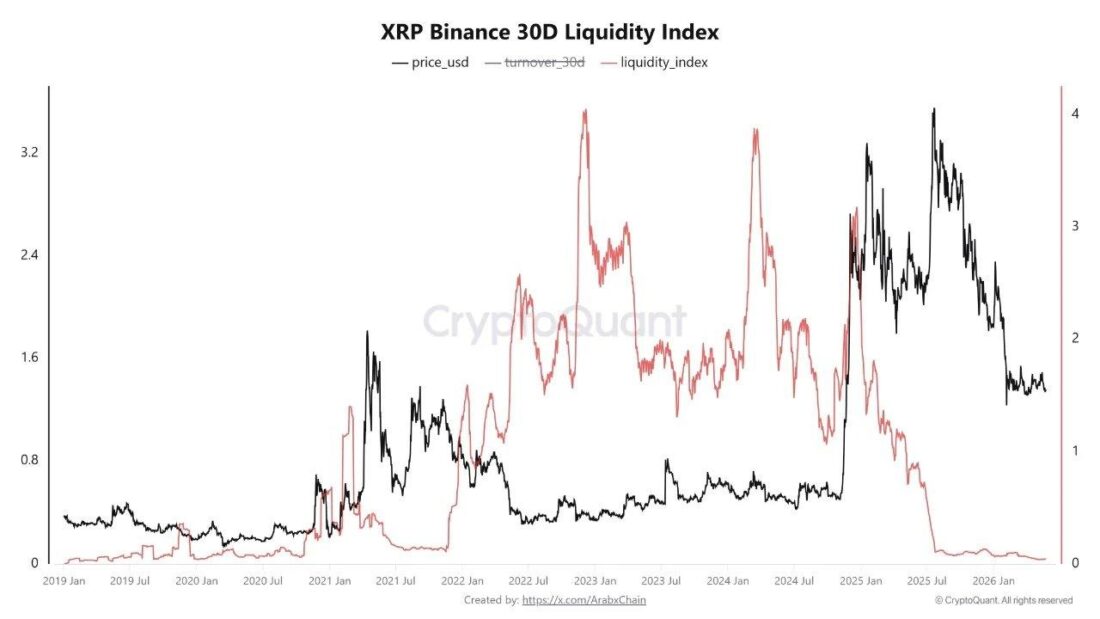
XRP’s 30-day liquidity index on Binance has dropped to 0.043, its lowest reading since January 2020, with the token trading near $1.34.
The number is small. Deceptively small. XRP’s 30-day liquidity index on Binance currently sits at roughly 0.043, per CryptoQuant data — a reading not seen since early 2020.
That was before the last bull cycle. Before institutional money arrived. Before XRP hit its highs above $3.
Between 2022 and 2024, the same index registered readings above 3 and occasionally above 4. High speculative activity, deep order books, money flowing in from all directions. The index told a story of a liquid, active market.
Now it reads 0.043. That’s not a gradual drift. That’s a collapse in market depth that unfolded mostly in silence while price held in the $1.30 to $1.50 range and traders kept watching other charts.
The data was flagged by ArabxChain on X, who published the CryptoQuant chart tracking XRP’s Binance 30D Liquidity Index from 2019 through 2026. The visual is hard to argue with. The liquidity line is essentially flat against the x-axis right now.
Source: CryptoQuant via ArabxChain on X | cryptoquant.com
At $1.34, XRP is not exactly distressed. But the environment underneath the price is thin. Very thin.
Whale withdrawal activity has also been part of the picture. Daily outflows from Binance accumulated to roughly 403 million XRP between May 3 and May 15, with large holders pulling tokens almost every session. That kind of consistent exit from the exchange supply pool does not always coincide with healthy market depth.
When order book depth is shallow, large trades move price harder. A buy or sell that might barely register in a deep market can swing price by several percentage points here. The math does not care about intent.
CryptoQuant’s analysis notes that periods of low liquidity are historically associated with sharper, faster price moves when volume suddenly picks up. The mechanism is not complicated: fewer resting orders means less friction.
Low liquidity is not a directional signal on its own. The market could move up on a volume spike as easily as down. What it does do is change the size of the move. The same order that nudges price by 1% in thick conditions might do 4% or 5% when the books are thin like this.
Derivatives positioning has been shifting at the same time. Open interest on XRP-USDT at Binance and the relationship between leverage and market depth is something analysts have been tracking closely, given that rising open interest into a thin liquidity environment historically precedes volatile, short-lived swings in either direction.
The XRP market in late May 2026 is not well-capitalized at the order book level. That much is clear from the data. Whether that sets up a squeeze or a flush depends on which side shows up first with size.
Related News
Explore more