
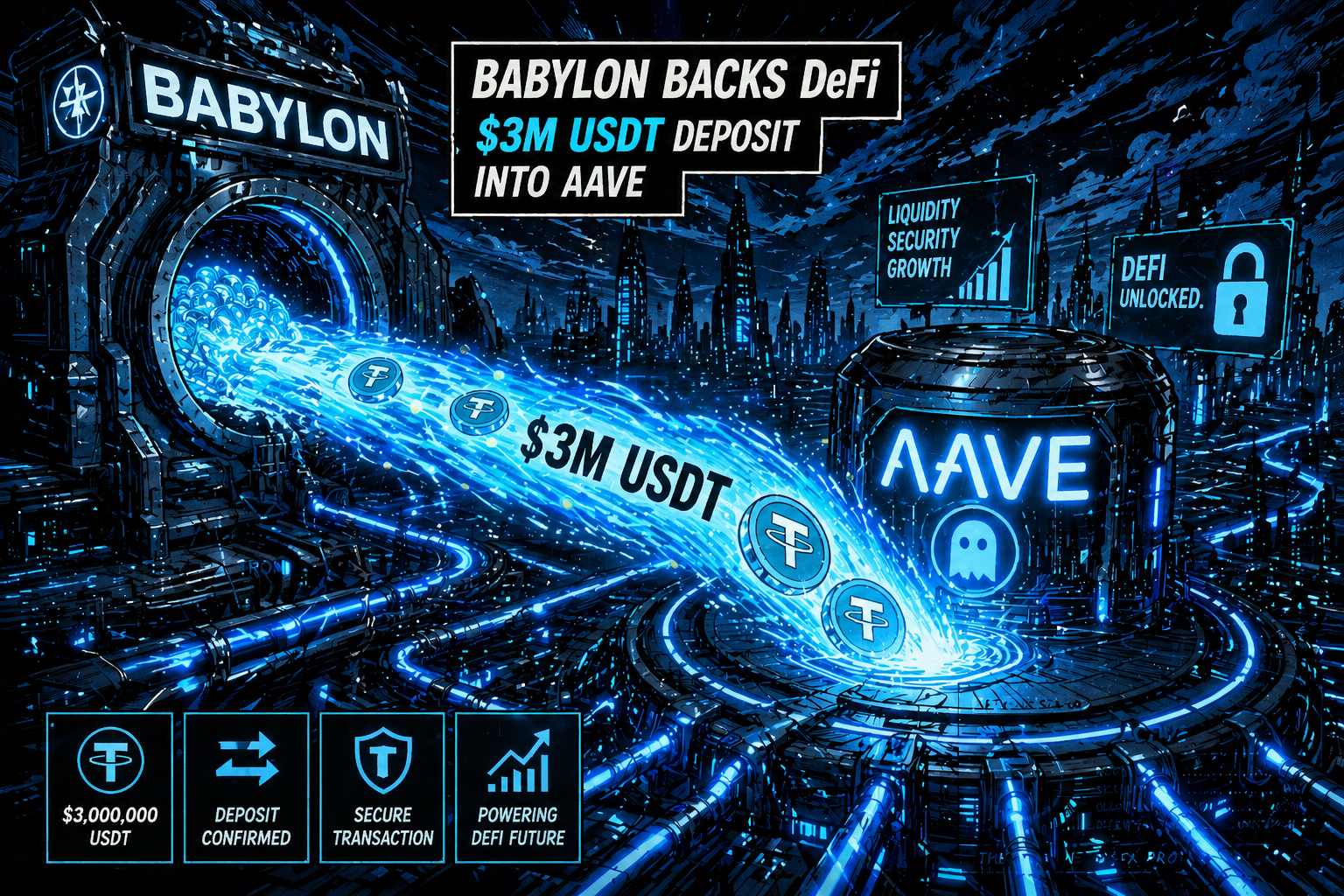
Babylon’s Aave deposit reinforces DeFi recovery, keeping liquidity active while recycling yield to support long term growth
Capital is flowing into decentralized finance, signaling renewed confidence in the sector. Babylon Foundation has stepped in with a $3 million USDT deployment into Aave, reinforcing liquidity at a time when confidence remains fragile. The move signals more than a simple deposit, as returns are set to cycle back into the ecosystem to support ongoing recovery.
Babylon Strengthens DeFi Recovery With Strategic Aave Liquidity Injection
Babylon Foundation confirmed a $3 million USDT allocation into Aave, split between two protocol versions. The move reflects a belief that DeFi remains a core pillar of modern finance, even during periods of uncertainty.
Funds are distributed with $2 million directed to Aave V3 and $1 million to V4. This structure allows support across both established and evolving layers of the protocol. Babylon is not just adding liquidity. It is backing a broader recovery effort already in motion across the ecosystem.
Any yield generated from the deposit will not leave the system. Instead, it will return to Aave through incentives tied to future integrations with Babylon. This creates a loop where capital continues to support growth.
Babylon also outlined how the funds will circulate within the ecosystem over time. Interest generated will support incentives tied to Aave integrations, while liquidity remains active within lending markets to support user activity.
Part of the capital will contribute to recovery efforts linked to rsETH backing, while future campaigns aimed at adoption will also draw from the same yield stream. This reflects a long term approach where capital remains active rather than static.
Ecosystem-Wide Coordination Drives DeFi Recovery and Liquidity Support
Aave has already begun coordinating a broader recovery framework alongside ecosystem partners. Service providers and aligned projects have formed a fund designed to address recent disruptions, particularly around rsETH backing.
Pending governance decisions remain part of the process, including discussions within the Arbitrum DAO. Several agreements are still being finalized, but technical work is already underway.
The initiative, known as DeFi United, reflects a collective response rather than isolated action. More protocols continue to join, adding both capital and technical support to the effort.
Participation in the recovery initiative continues to expand as more protocols commit resources. Frax Finance has joined despite no direct exposure to rsETH, while Lido Finance and EtherFi are contributing to liquidity support efforts. Mantle has also added funds aimed at stabilizing DeFi markets, with additional partners coordinating to close gaps and rebuild trust.
These contributions show how interconnected DeFi protocols have become. Even projects without direct exposure are stepping in to support overall system health.
Babylon’s deposit arrives at a time when confidence needs reinforcement. By committing capital and recycling returns back into the ecosystem, the foundation positions itself as a long term participant rather than a passive observer.




Leave a Reply
You must be logged in to post a comment.