
 Samuel·2d ago

Bitcoin price slides below $67K as a bear flag breaks down. Analysts eye $42K support while a capital rotation theory gains traction.
Bitcoin is under fresh selling pressure after breaking a bear flag pattern to the downside. The leading cryptocurrency trades at $66,767, down 1.87% in 24 hours and 10.85% over the past week, per CoinGecko data.
Analysts are now watching key support levels closely. Some voices on Crypto Twitter point to a possible capital rotation as a contributing factor. The mood is cautious.
Related reading:
Analyst Warns Bitcoin Could Drop Another 20–25%: Here’s the Outlook
Analyst CryptoCon flagged the bear flag breakdown on social media, pointing to the Volume Profile as a guide for what comes next.
According to the analyst, the next meaningful support sits between $38K and $43K. That zone also lines up with the cycle bottom targets from the Realized Market Cap and the Golden Ratio Multiplier models.
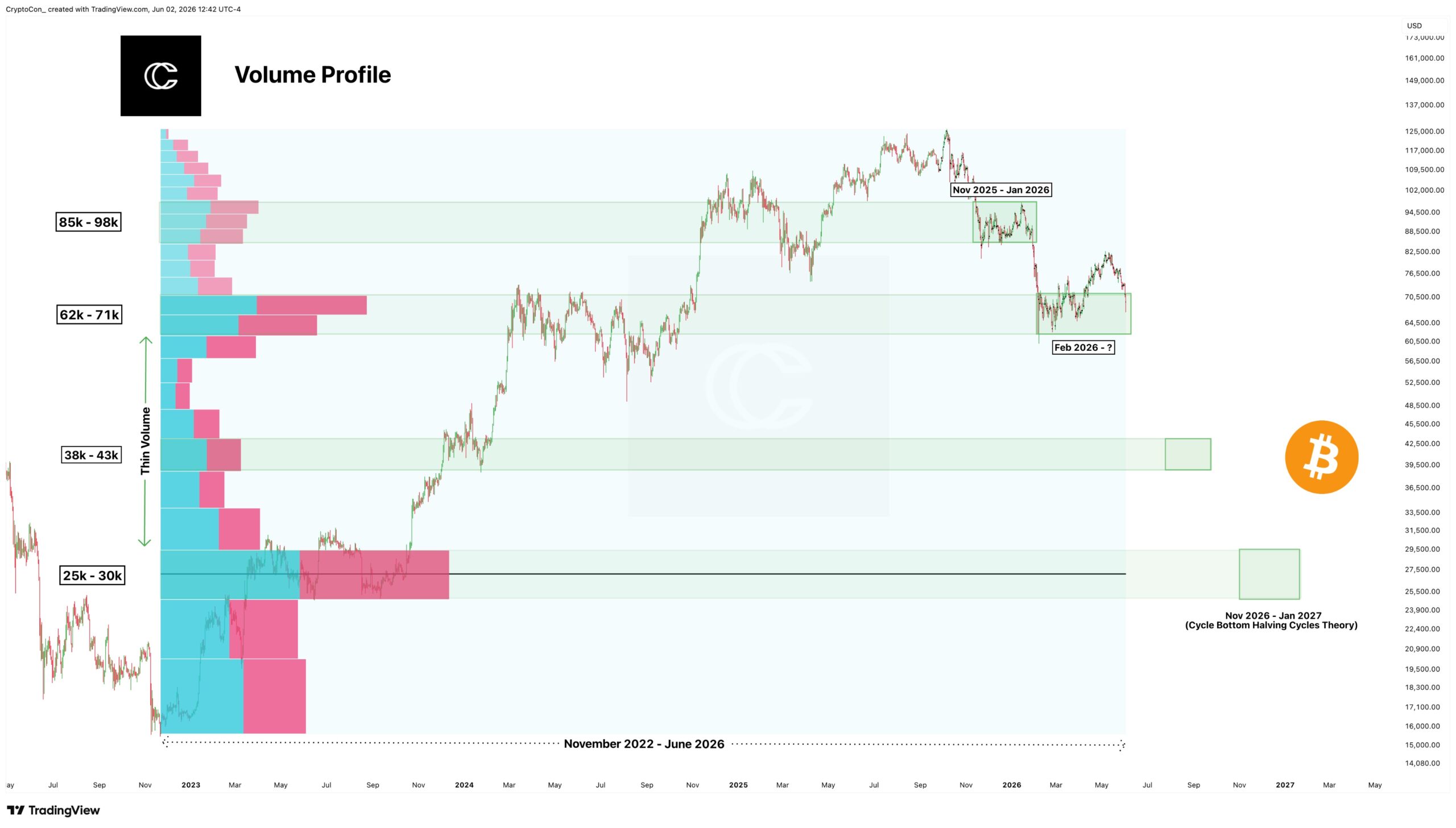
CryptoCon noted, however, that volume in that region is relatively thin compared to current price levels.
Below it, the next strong support block falls between $25K and $30K, which aligns with the Magic Bands and Bear Bands bottom targets. The analyst called $42K the most likely next major stop.
CryptoCon also reminded followers that the Halving Cycles Theory remains on track.
Per that framework, a confirmed bottom is not expected until the end of the year. The analyst cautioned that calls of a bottom on the next drop will likely emerge, as they did in prior pullbacks.
Trader That Martini Guy highlighted a critical level on the charts.
In a post, he described the $66K–$67K area as a major volume node and the completion point of the current corrective structure. That is also where buyers have finally appeared after weeks of lower highs and lower lows.
The trader kept his take straightforward. Hold that zone, and BTC could work its way back into the high-volume region where most recent trading occurred.
BTC is sitting right on the level that matters.
On both charts, the area around $66k-$67k lines up with a major volume node and the completion of this corrective structure.
That’s where buyers have finally shown up after weeks of lower highs and lower lows.
What happens next… pic.twitter.com/3mKWyeNnoM
— That Martini Guy ₿ (@MartiniGuyYT) June 3, 2026
Lose it, and the chart opens up quickly given the thin structure below. That Martini Guy said he is not calling a bottom. His focus is on whether Bitcoin can defend the first level that actually matters after a $15K decline.
The framing is telling. After weeks of choppy price action, traders are treating this level as a binary decision point rather than a gradual process.
One theory gaining traction on Crypto Twitter comes from analyst Wise Advice. The post raises a question worth considering.
Bitcoin dropped from $74K to $65.5K in 48 hours with no major ETF panic, no exchange collapse, and no obvious black swan event. Yet sellers kept showing up.
Wise Advice pointed to a possible wave of large private capital raises hitting markets in the coming months.
🚨 What if Bitcoin isn't crashing because of Saylor…
What if it's funding the AI supercycle?$BTC just dropped from $74K to $65.5K in 48 hours.
No major ETF panic.
No exchange blowing up.
No obvious black swan.Yet sellers keep showing up.
Here's a theory that actually…
— Wise Advice (@wiseadvicesumit) June 3, 2026
The analyst listed potential figures: a SpaceX IPO at around $75 billion, an OpenAI raise near $100 billion, an Anthropic raise exceeding $100 billion, and a Google equity issuance around $80 billion. That adds up to over $350 billion competing for investor dollars.
The core of the theory is that Bitcoin’s current investor base, tech investors, growth funds, venture capital, family offices, and macro funds, overlaps heavily with those seeking AI exposure.
For the past two years, many in that group treated Bitcoin as an AI proxy. Now, with direct access to OpenAI, Anthropic, and SpaceX potentially on the table, some may be rotating from the narrative to the actual builders.
Wise Advice was careful not to call it a long-term bearish signal. If AI drives a fresh liquidity boom, Bitcoin could ultimately benefit.
But in the near term, the analyst suggested the biggest competition for Bitcoin capital may not be gold or bonds. It may be the most anticipated AI fundraising cycle since the dot-com era.
Related News
Explore more