
300 GPUs Seized as Mexican Authorities Probe Cartel Crypto Mining
 Samuel·2d ago

DeFi has lost nearly $770M to hacks in 2026. April alone saw $606M stolen across 12 incidents. Here’s what’s driving the crisis
Crypto’s decentralized finance sector is facing a brutal year.
Nearly $770 million has been lost to hacks and exploits in 2026. April alone saw $606 million drained across 12 separate incidents in just 18 days.
That figure is already 3.7 times the entire first quarter’s combined losses of $165.5 million, according to data from DefiLlama. The numbers are raising serious questions about DeFi’s security infrastructure.
Related reading:
Another DeFi Blow: Volo Protocol Hit by $3.5M Hack, Freezes Vaults on Sui
Two attacks account for roughly 95% of April’s total losses. Drift Protocol on Solana lost $285 million on April 1.
Analysts linked the incident to a social engineering attack connected to North Korea’s Lazarus Group. Then on April 19, Kelp DAO lost between $292 and $293 million.
The exploit targeted a LayerZero V2 bridge route configured as a single point of failure. That attack left Aave carrying $246 million in bad debt. In response, Aave launched its “DeFi United” initiative, raising over $200 million to back affected assets.
Analyst @0xALTF4 on X noted that neither attack involved a simple smart contract flaw.
Both targeted cross-chain infrastructure, including messaging layers and bridge configurations. That shift signals a broader change in how attackers operate across the ecosystem.
April 2026 is becoming crypto's worst month for hacks in over a year
And we're not even talking about some random DeFi rug. The numbers are genuinely alarming.
$606 million stolen across 12 incidents in just 18 days. That's already 3.7x the entire first quarter's combined… pic.twitter.com/NRTi9BIh9T
— ALTF4 (@0xALTF4) April 28, 2026
For years, smart contract bugs drove most DeFi losses.
The industry responded.
Audits improved, bug bounties scaled up, and formal verification became standard for major protocols. But attackers shifted too, according to @0xALTF4.
The new targets are bridge layers, oracle systems, signing infrastructure, and multisig key holders. Those attack surfaces are far harder to audit than a smart contract.
Crypto analyst @Satori_btc flagged additional vectors emerging in April.
On April 25, Litecoin suffered a 13-block reorganization attack. The incident exploited its MWEB privacy layer and enabled double-spend attempts on cross-chain swaps.
Earlier in Q1, Step Finance lost $27.3 million to a key compromise, Truebit lost $26.4 million to a smart contract bug, and Resolv Labs lost $23 million via a private key breach.
🚨 2026 DeFi has already lost nearly $770 MILLION to hacks.
And we’re only in mid-April.
The bloodbath started early, and cross-chain bridges have officially become the ultimate hacker ATM. 📉Here is the full breakdown of how we got here 🧵👇
🗓 Jan – Mar: The Warm-Up
Over… pic.twitter.com/SNNgyihf6W— Satori 🎴 💀 (@Satori_btc) April 28, 2026
DeFi’s total value locked recently crossed $120 billion, according to @0xALTF4. That growth brings greater incentive for attackers to find exploits.
Every new chain integration and bridge route expands the attack surface. DefiLlama’s cumulative tracker puts total crypto hack losses over the past decade at $17 billion.
The 2026 pace is adding to that total faster than any period since the $1.4 billion Bybit breach in February 2025.
@WorldOfMercek on X pointed to the broader challenge this creates for adoption.
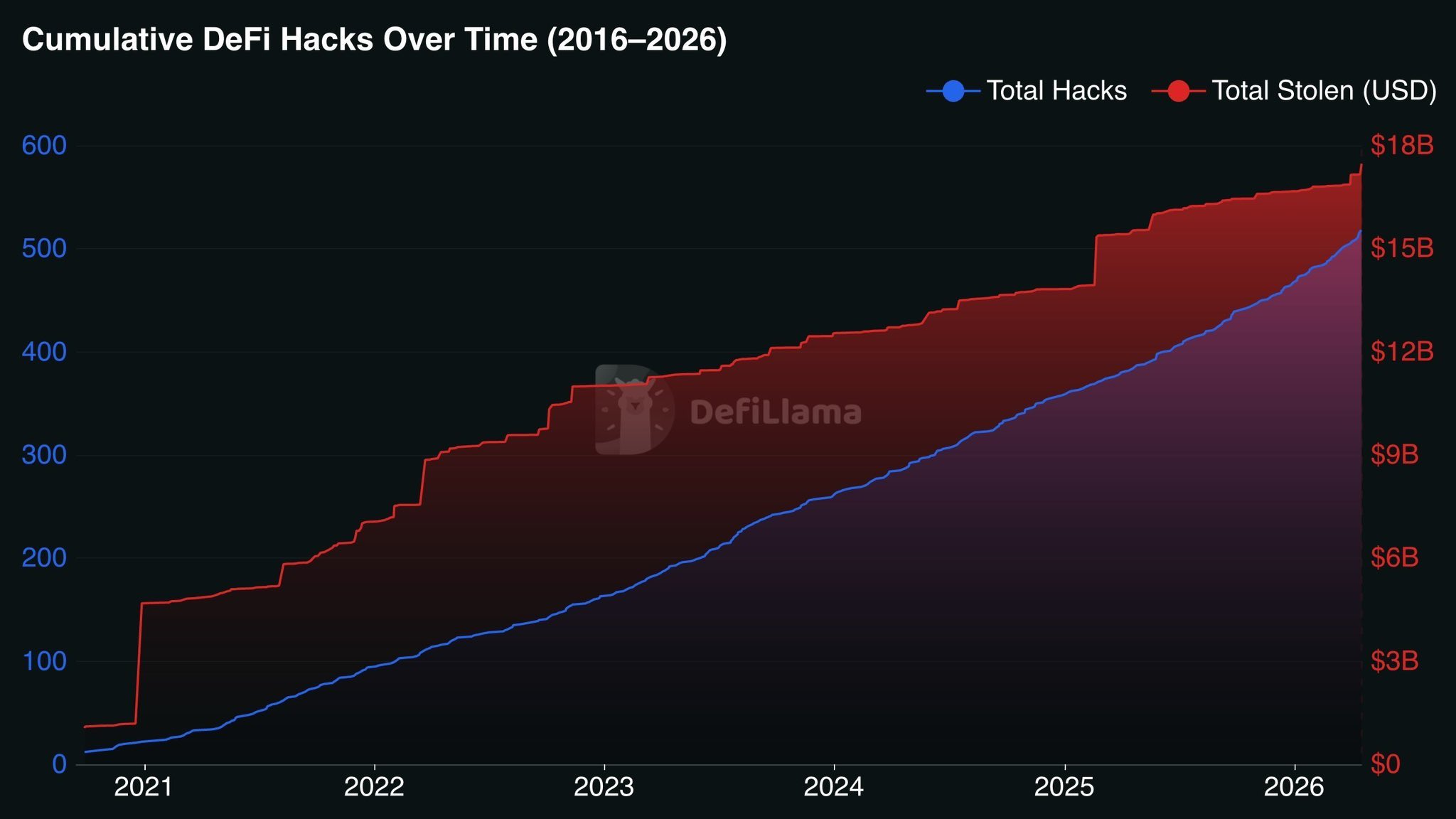
Over 500 hacks have hit DeFi in 10 years. The sector keeps learning through costly incidents. With wallet risks, oracle vulnerabilities, and bridge flaws all in play, mass adoption remains a difficult path.
Jefferies has reportedly flagged that the current hack streak could dampen Wall Street’s appetite for DeFi tokenization projects, adding institutional hesitation to the growing list of consequences.
Samuel·2d ago Samuel·6d ago
 Antony Jackson Srithar·September 4, 2026