
Kraken Parent Payward Eyes Hyperliquid for U.S. Perpetual Futures
 Peter Mwenda·3d ago

Grayscale has formally named tokenization as one of the most substantial investment opportunities in the digital asset space.
The firm’s latest research frames the shift of traditional financial infrastructure onto blockchain rails as a multi-decade transformation.
With global securities markets valued at approximately $300 trillion, and tokenized assets currently representing just $30 billion of that total, Grayscale sees the gap between current adoption and full potential as the defining investment thesis of the coming decade.
Grayscale’s report makes a direct case for institution-centric blockchain networks as the near-term leaders in tokenization. The firm points to privacy as the central issue.
Open blockchain networks process transactions on publicly visible ledgers, which creates an immediate barrier for regulated financial institutions bound by confidentiality requirements.
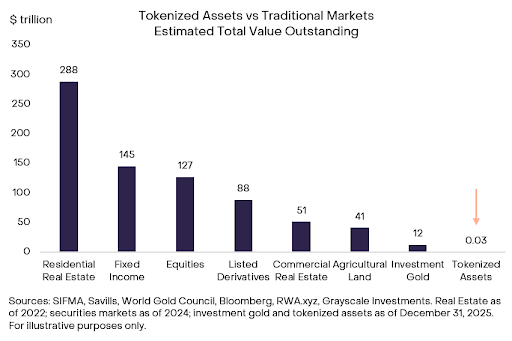
Canton stands out as the clearest beneficiary of this dynamic. The network recorded over $348 billion in tokenized asset value and secured a partnership with the DTCC, the primary clearing and settlement infrastructure for U.S. capital markets, under the SEC’s No-Action Letter framework.
Visa, Circle, and Apollo Global have also joined as Super Validators, adding to a network of over 60 institutional participants.
Canton’s 2026 momentum extended further with major partnership announcements involving Nomura and Mizuho.
Grayscale’s analysis positions Canton as having a meaningful window to build durable network effects before open networks close the privacy gap.
Provenance, developed by Figure Technologies, holds the second spot among institution-centric networks, with a track record in home equity lines of credit and structured credit products.
Grayscale does not treat institution-centric networks as permanent leaders. The firm expects open architecture networks to develop sufficient privacy solutions over time, at which point their structural advantages become decisive.
Ethereum enters that longer-term competition from a position of strength. It leads all blockchain networks in developer activity, market capitalization, and decentralized finance infrastructure, with approximately $50 billion in total value locked and around $16 billion in tokenized assets on-chain.
Solana offers a different set of credentials, throughput exceeding 1,000 transactions per second and more than 100 million daily transactions, numbers that align closely with capital markets’ demands.
Grayscale sees Solana as particularly suited for retail-facing use cases such as on-chain consumer stock trading.
BNB Chain completes the leading trio among open networks. Its direct connection to Binance, the largest centralized exchange by trading volume globally, provides a distribution reach that competitors have not matched.
Avalanche also draws a mention as a hybrid network supporting institutional names, including KKR, Citi, and Apollo Global, bridging customization controls with open ecosystem connectivity.
Grayscale’s view is that open networks represent a more expansive long-term vision, one that could rearchitect capital markets rather than simply improve existing infrastructure.
The permissionless nature of these networks opens access to a broader global user base, which the firm sees as a structural advantage in the later stages of tokenization adoption.
Grayscale reserves particular emphasis for Chainlink as an investment angle that does not depend on picking a winning blockchain.
The firm describes Chainlink as one of the clearest “picks and shovels” opportunities in the tokenization theme, providing middleware infrastructure, including proof of reserves, data delivery, and compliance tooling, that spans the full lifecycle of tokenized assets.
Because Chainlink operates across multiple blockchains simultaneously, its growth is not contingent on any single network’s success.
Whether institution-centric networks maintain an early lead or open networks accelerate adoption in later phases, Chainlink’s infrastructure remains integral to both scenarios.
Grayscale puts it plainly: the tokenization of capital markets is difficult to envision without tools like Chainlink, regardless of which platform leads at any given stage.
The firm does acknowledge headwinds. Regulatory uncertainty remains a live risk, as does the pace at which open networks can develop privacy solutions at scale.
Many tokenized assets also still rely on off-chain infrastructure for core functions like custody and voting rights, a gap that will need to close before the full economic benefits of tokenization are realized.
Peter Mwenda·3d ago Peter Mwenda·4d ago
 Peter Mwenda·September 11, 2026