
 Samuel·11hr ago

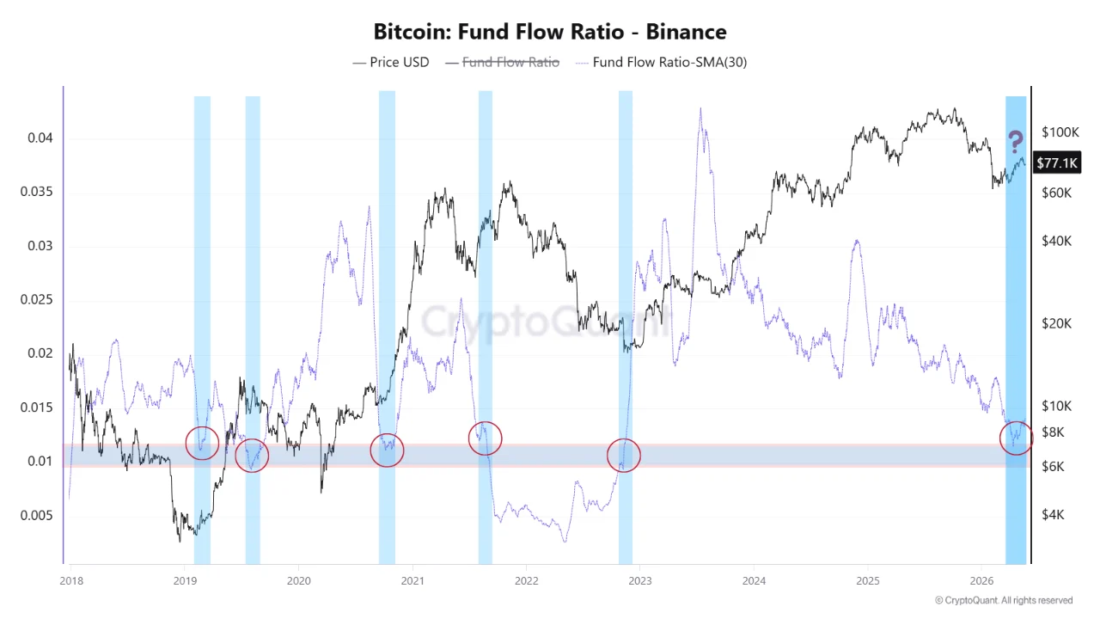
Bitcoin’s Fund Flow Ratio on Binance has returned to the 0.010-0.012 zone for the sixth time since 2018, a level tied to every major market turning point.
The number is 0.010. It doesn’t look like much. But it has shown up at the edge of every major Bitcoin turning point since 2018, and it just returned.
According to CryptoQuant, Bitcoin’s Fund Flow Ratio on Binance has compressed back into the 0.010-0.012 range for the sixth time since the platform began tracking the metric. The reading landed there once in early 2019. Once before the 2020 bull run. Each prior visit preceded a structural shift in price.
The Fund Flow Ratio measures BTC moving into and out of Binance relative to total network-wide transfers. When it rises, exchange-driven activity is pulling more of the network’s attention. Traders are positioning. Speculation runs hot. CryptoQuant’s data shows the ratio peaked near 0.035 during the 2021 cycle top and again spiked into late 2022 before collapsing.
The chart shows six circled instances dating back to 2018 where the ratio compressed into this narrow band. Blue vertical shading marks each occurrence. Every one of them sat near a pivotal price zone, and every one preceded a meaningful price move.
Source: CryptoQuant
Sell-side had worn itself down. That’s the basic read. Sellers spending through exchanges had already done their damage, and the compression in ratio reflected what was left.
The current reading sits near $77,100 in price terms, according to the chart annotation. The ratio’s 30-day SMA confirms the compression, threading through the bottom band with the same shape it printed in 2020 before Bitcoin ran from under $10,000 to near $65,000 in roughly 14 months.
What separates the current setup from prior ones isn’t just the level. It’s the context around exchange activity that has been retreating across the broader market. Centralized spot volumes hit a 24-month low in March. The compression isn’t isolated to one metric.
CryptoQuant’s note on the development explains that a low ratio signals reduced speculative participation. Exchange activity represents a shrinking share of total on-chain movement. Per the firm, that can mean two things. Either demand has gone cold, or sell-side exhaustion is quietly building a floor.
History has answered that question six times. The answer keeps being the same.
That said, the pattern has never guaranteed timing. Early 2019’s touch took months to resolve. The demand side had not yet returned when the ratio first compressed. Low ratio and no buyers is still just a waiting room.
The recent ETF outflow data adds another layer to watch. Bitcoin investment funds bled $1.04 billion in weekly outflows just days ago, snapping a six-week inflow streak. Institutional demand, at least through that channel, pulled back. That’s not what you’d want to see alongside a ratio signal that needs demand to confirm.
CryptoQuant’s framing puts it directly: the market is approaching a decision zone. Either demand stays weak and the low ratio just reflects apathy. Or what looks like silence is actually the setup before the next recovery phase. The sixth touch is on the board. The question mark in the chart sits exactly where Bitcoin trades now.
Related News
Explore more