
Binance Bitcoin Reserves Hit 702,900 BTC as Price Bounces to $81K
 Emily John·16hr ago

Bitcoin’s bear market sell signal hit extreme levels in June, but on-chain data shows 99% came from a single miner, not industry-wide stress.
The bear market sell pressure signal arrived with numbers that looked alarming. On June 4, miners transferred 12,413 BTC to exchanges in a single day. The figure ranks among the largest miner-driven supply injections recorded in the post-fourth-halving era, per CryptoQuant data.
At 27.6 times the daily block reward, the Miner Selling Pressure Index pushed firmly into what analysts classify as Extreme Reserve Liquidation territory. The 7-day average broke higher. Supply hitting exchanges from miners looked, by every surface measure, like the kind of event that precedes sharper price moves.
More than 99% of that activity traced back to one entity. According to the CryptoQuant analysis, BTC.com accounted for virtually all the transfer volume in the surge period. The rest of the mining cohort averaged somewhere between 50 and 85 BTC per day. Stable. Routine. Unremarkable.
Miner flows had fallen to 3,243 BTC on May 31. Then, without clear warning, volumes spiked to 11,360 BTC on June 1 and held above 9,500 BTC across the following sessions. Two separate days came in above 12,400 BTC.
The persistence of the flows is what pushed MSPI above its rolling average. Not a single large move followed by normalisation — extended, concentrated outflows from one pool. CryptoQuant describes this as a genuine increase in exchange-bound supply, not routine operational selling from the broader network.
Broad participation from multiple mining entities typically signals industry-wide profit-taking or financial strain. That picture, which analysts associate with systemic miner capitulation, is not present here. The data points toward a highly localised liquidity event.
Separately, the crypto crash conversation had already been heating up around short-term holder behaviour. On-chain prints from earlier in the week showed 53,800 BTC moved to exchanges at a loss in a single 24-hour window. Different cohort, different pressure point. The two events are running in parallel.
CryptoQuant noted the concentration factor as a critical distinction. Headline selling pressure looks substantially larger than what the wider miner ecosystem is actually doing. One pool skewing an index does not carry the same structural weight as a coordinated industry move.
Non-BTC.com miner flows showed no meaningful deviation across the period. Systemic miner capitulation, the kind that historically aligns with deep bear market drawdowns, is not currently visible in the data. That distinction matters for how the supply event gets priced in.
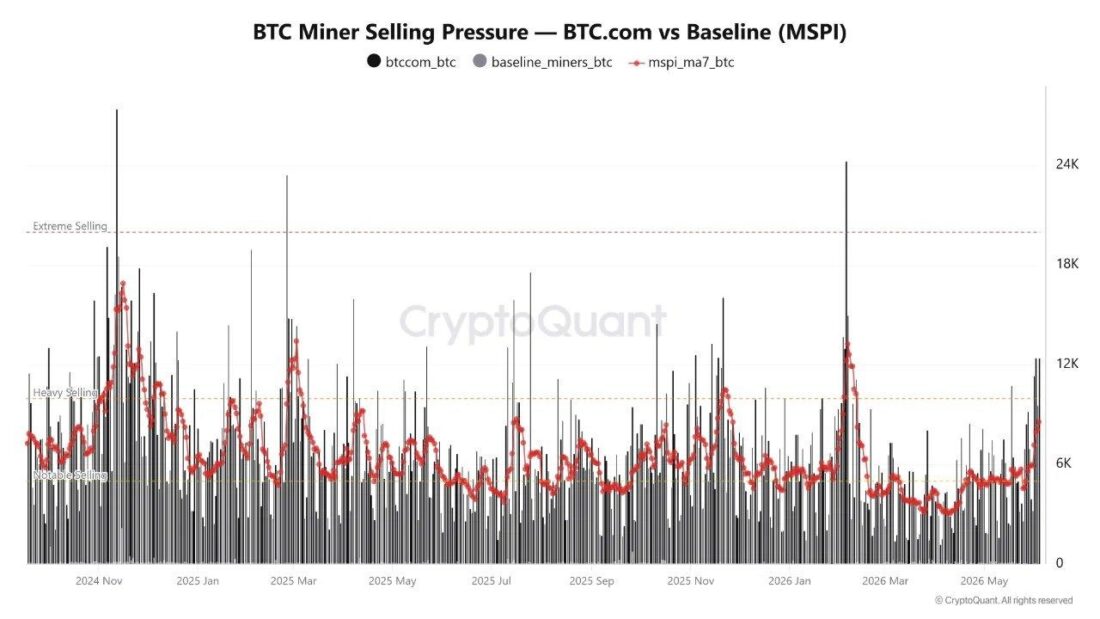
Source: CryptoQuant — BTC Miner Selling Pressure (MSPI)
The market is absorbing the supply regardless. Whether BTC.com is covering operational costs, repositioning reserves, or something else entirely — the coins went to exchanges. Buyers on the other side of those trades are absorbing one of the heavier miner-sourced supply windows of this halving cycle.
Baseline miner flows for the non-BTC.com cohort averaged around 50 to 85 BTC daily throughout the spike window. That number has not shifted. Not yet, anyway.