 Samuel·2hr ago
Say a meme coin claims that part of every trade goes to charity. That claim only means something once you can answer three questions: who sets the percentage, when do they set it, and what happens to that slice of the fee between a trade happening and a charity seeing anything. Most crypto-charity efforts never answer all three. They answer the first two in a launch announcement and let the third one quietly disappear once the attention moves on. PUMPCHANGE is designed to answer all three inside the product itself, before a single trade happens. Here’s the chain, as it’s designed to run, from a creator picking a cause to a reader being able to check what happened.
PUMPCHANGE is a Solana launchpad: a site where a creator launches a new cryptocurrency and sets its donation rules before anyone trades it. Meme tokens on PUMPCHANGE are for entertainment. They carry no ownership, no profit share and no promise about future value.
The chain has five parts:

None of the five depends on a creator remembering to donate, or on PUMPCHANGE announcing anything after the fact. That’s the difference between this and a one-off giving campaign.
The donation percentage is fixed before the token exists, in the same step where the creator decides what the token is.
Creating a token moves through a few fields on one screen:
A live preview of the token page updates alongside, on the same screen.
The create-coin form is direct about what happens next: “Choose carefully, these cannot be changed once the coin is created.” Once the token launches, the charity and the percentage are locked for its life. A creator who sets 10% can’t raise it later if the token trades heavily, and can’t lower it if it doesn’t.
Putting the charity choice in the same step as the name and the image is deliberate rather than incidental: it’s not an add-on configured after the token is real, it’s one of the things that makes the token what it is. The charity’s name, its website, and the fee breakdown will appear on the token’s page before anyone places a trade, so the donation is visible to a buyer before they buy, not disclosed after the fact.
Tokens are created and traded on Raydium, an open-source Solana protocol; PUMPCHANGE provides the interface. The charity mechanism above runs on Raydium’s contracts, not a separate PUMPCHANGE-operated one.
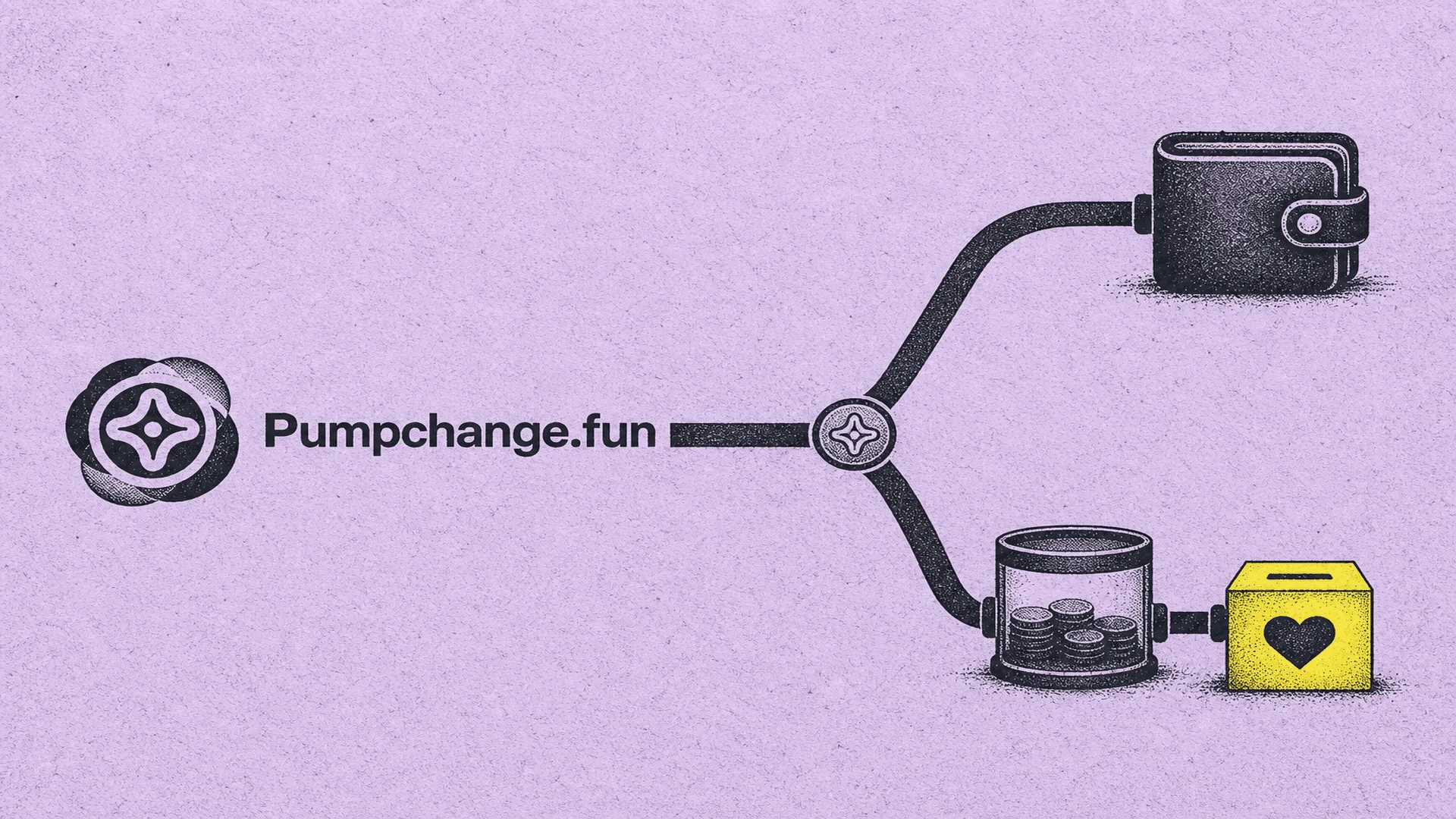
Every buy and every sell carries a 1.25% fee, and that fee is where the donation comes from. Charging a fee on every trade is standard for a meme coin launchpad; what’s different here is where part of that fee goes.
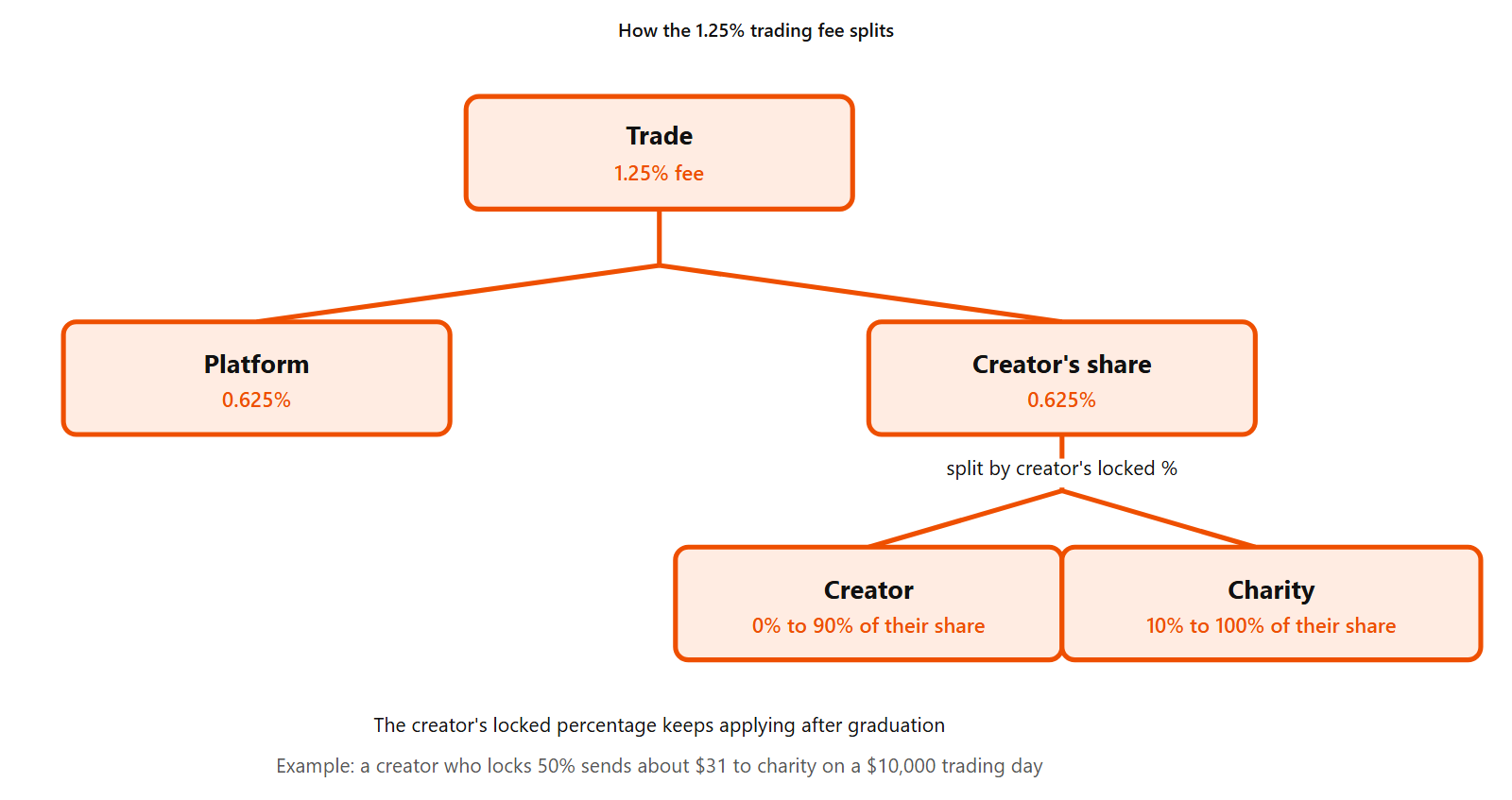
Half goes to the platform. The other half (the creator’s share) is split again, this time according to whatever percentage the creator locked in at creation. A creator who kept everything for themselves would take the full 0.625%. A creator who gave away their entire share, per the 100% Charity Creator badge built for exactly that case, would take none of it and send the whole 0.625% to charity. Everything in between is the slider from the creation step, applied automatically to every trade for as long as the token exists.
| Recipient | Share of each trade |
|---|---|
| Platform | 0.625% |
| Creator + charity combined | 0.625%, split by the creator’s locked percentage |
The percentage a creator sets always applies to their own half, never to the platform’s. A creator who locks in “100%” is giving away 100% of their share, not 100% of the fee.
Worked example. A creator who locks 50% gives the charity 0.3125% of every trade. On a $10,000 trading day, that sends about $31 to the charity and about $31 to the creator, with $62.50 going to the platform.
That’s the whole mechanism at the trade level. Nobody decides, trade by trade, whether this one counts: the percentage chosen at creation applies the same way to the first trade a token ever sees and the ten-thousandth.
The waitlist is at pumpchange.fun/waitlist, for anyone who wants to watch this split apply once trading opens.
Fees don’t move trade by trade. They build up and go out on a schedule, not the instant a trade clears.
Every trade generates a fee, but that fee isn’t split and sent out the moment the trade happens. Instead, it accumulates (the platform’s cut, the creator’s cut and the charity’s cut all building up together) and goes out at regular intervals. A token that trades constantly for a week doesn’t produce a week of individual micro-donations; it produces one accumulated share that gets paid out when the interval comes around. That’s true of all three recipients equally: the platform, the creator and the charity are all waiting on the same clock, not just the charity.
The charity’s share has a specific destination, not a generic pool. The Giving Block has created an individual Gemini account for every charity on the platform. When a payout runs, PUMPCHANGE will send SOL directly to that account, the same SOL the trading fee generated, not the meme token itself. The Giving Block’s part stops at setting the account up: it isn’t in the transfer, and the SOL moves straight from PUMPCHANGE to the charity.
Each token’s page will include a Payments tab breaking out total fees collected, what the creator has earned, and what’s been allocated to the charity, the same three numbers as the fee table above, tracked over the token’s life rather than one trade at a time. Read together with the payout records below, it’s designed as a running total a reader checks, not a one-time announcement.
Graduation changes where a token trades, not whether the donation keeps happening.
While a token is new, it trades on a bonding curve: a pricing mechanism common to new cryptocurrency launches, where price moves along a predetermined path as people buy and sell, instead of being set by matching a buyer to a seller. Buying pushes the price up; selling pushes it back down, with no order book and no counterparty to wait for. It’s also the only phase in which a token can qualify for Changemaker status: a badge that tracks trading volume and distinct holders while a token is still on the curve.
When a token reaches a market capitalization set by Raydium, currently 85 SOL, it graduates, moving from the bonding curve onto Raydium’s open trading pool, tradeable against a standard liquidity pool. That threshold is Raydium’s to set and can change; it isn’t a PUMPCHANGE number. Graduation is a mechanical checkpoint, not a milestone to trade toward or a marker of anything about the token beyond that trading volume.
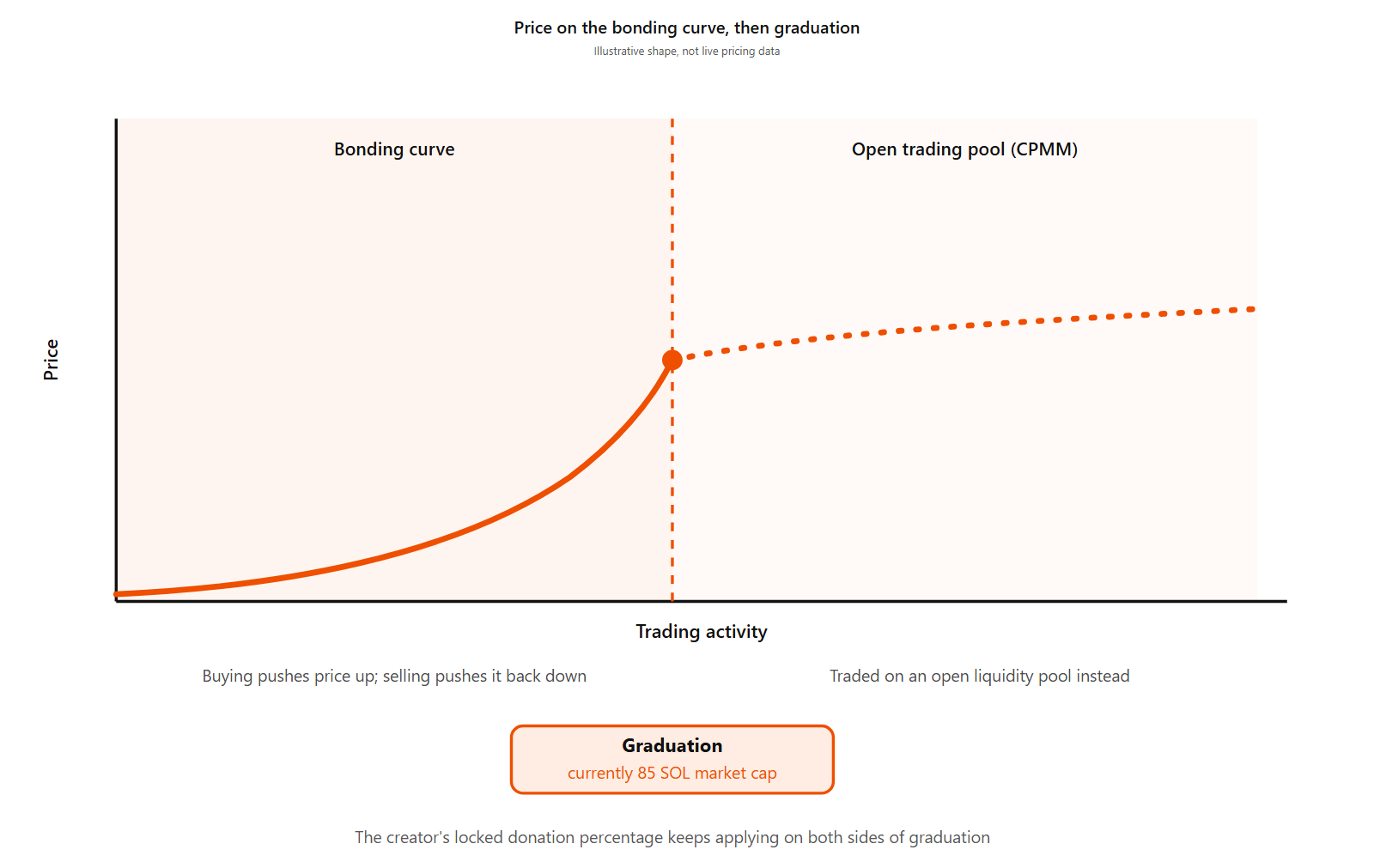
The creator’s locked donation percentage keeps applying after graduation: the fee still runs on every trade, and the charity’s cut is still whatever the creator set at creation.
Every payout will be published on-chain, with a transaction hash a reader will be able to look up independently.
Payout details, including the blockchain transaction hash for each payout, will be published at the bottom of every token’s page, next to its trade history. That’s not a summary a reader has to trust: a transaction hash is a unique reference to one recorded transaction on the Solana blockchain. At launch, a reader will be able to take that hash from any token page and look it up directly on a Solana block explorer, a public site that displays the contents of blockchain transactions to anyone who asks, PUMPCHANGE included.
It doesn’t guarantee any particular outcome for a charity, and it isn’t a claim that money has already moved. The platform hasn’t launched, and none of this exists to check yet. The commitment is narrower: the record behind the fee split, the accumulation and the payout will be public and on-chain, not a figure PUMPCHANGE reports and asks readers to take on faith. The mechanism is what this piece has walked through; the record is what will let someone confirm it happened as described.
Meme tokens on PUMPCHANGE are traded for entertainment purposes only and have no inherent value or utility. They confer no equity, ownership, profit share, governance rights or dividends. Nothing here is investment, legal or tax advice, and blockchain transactions can’t be reversed once confirmed. The platform is for users aged 18 and over and won’t be available in New York or California.
That’s the full chain: a percentage locked before the token exists, a fee split that applies it automatically on every trade, a payout that accumulates and clears on a schedule, and a record designed to be checked independently rather than taken on trust. Nothing in it depends on a press release, a follow-up post, or anyone remembering the token existed a year later. That’s what the design is for. PUMPCHANGE is built as a Solana launchpad specifically around that donation mechanic, not as a meme coin launchpad with charity added on afterward. The waitlist is open at pumpchange.fun/waitlist, ahead of the point where all of this becomes something to check rather than something to read about.
Related News
Explore more