
BIS Study Finds Higher Bank Deposit Rates Slow Stablecoin Growth

Latest in Stablecoins
Imagine you're a crypto trader in 2013. You've been watching Bitcoin swing 20% in a single afternoon; up, then down, then sideways, then up again. You want to lock in your gains. You want to sit on the sidelines for a day, maybe a week. You want to hold something boring and stable.
But here's your problem: the moment you convert Bitcoin to actual dollars, you have to go through a bank. That means wire transfers, business hours, two-to-five business days, and fees that make you wince. Once that money is out of the crypto ecosystem, getting it back in is another waiting game. You're not just losing time. You're losing opportunity.
What you really want is a dollar that lives inside the crypto world. A dollar that never sleeps. A dollar you can move at 2 a.m. on a Sunday without asking anyone's permission.
That's the problem stablecoins were invented to solve. And what started as a niche workaround for crypto traders has quietly become one of the more interesting monetary experiments of the 21st century; one that governments, banks, payment companies, and central banks are now watching very, very carefully.
Let's start from the beginning.
What a stablecoin actually is, and what makes the $1 promise credible
How four different engineering approaches try to maintain the peg; and why each has its own failure mode
The full origin story: from BitUSD in 2014 to Tether's first full audit in 2026
What happens when stablecoins break; and what the break is actually telling you
How the economics work (spoiler: the issuer earns the interest, not you)
Where regulation stands globally, from the EU's MiCA to America's GENIUS Act
Why PayPal, Visa, Stripe, and Ripple are suddenly in the stablecoin business
What "agentic payments" means and why stablecoins are one candidate for it

A stablecoin is a private token; issued by a company or a protocol; designed to track the value of a real-world currency, almost always the U.S. dollar.
Notice the words in that sentence. Private. Token. Designed to track. Not government-issued. Not legally guaranteed. Not a bank deposit. A private issuer makes a promise: send me $1, I'll give you 1 token, and you can redeem that token for $1 whenever you want.
The token lives on a blockchain. It can move 24 hours a day, 7 days a week, across the world, without asking a bank for permission. That's the whole point.
But here's the question that will follow us through this entire article, because it's the most important question in the stablecoin world:
When a token says it's worth $1, what makes that promise credible?
Different stablecoins answer that question in very different ways. And the answer you choose determines what kind of risks you're taking on.
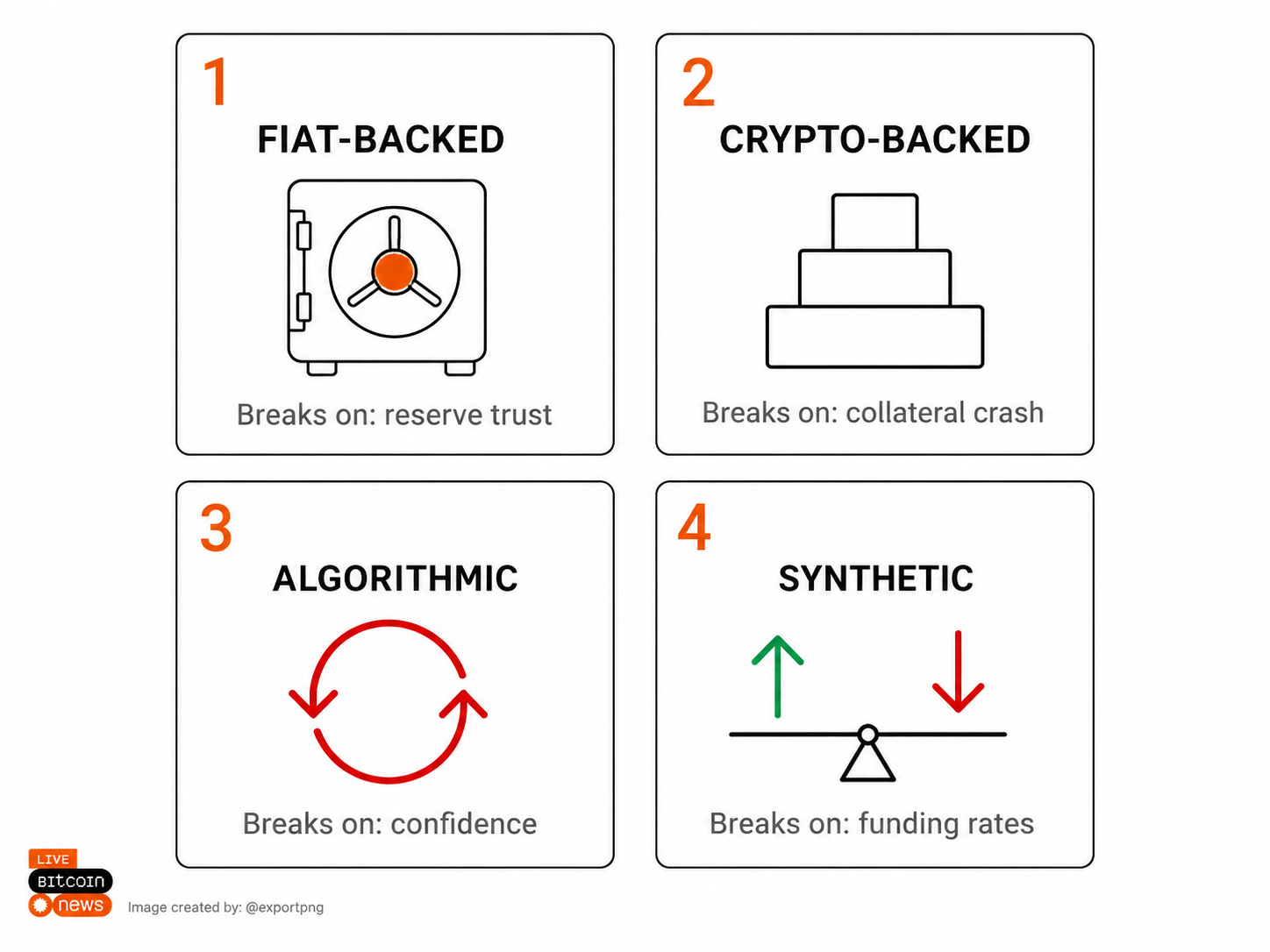
Think of a stablecoin peg like a promise. "This token is worth $1." There are basically four different ways to back up that promise, and each one has a different kind of failure mode.
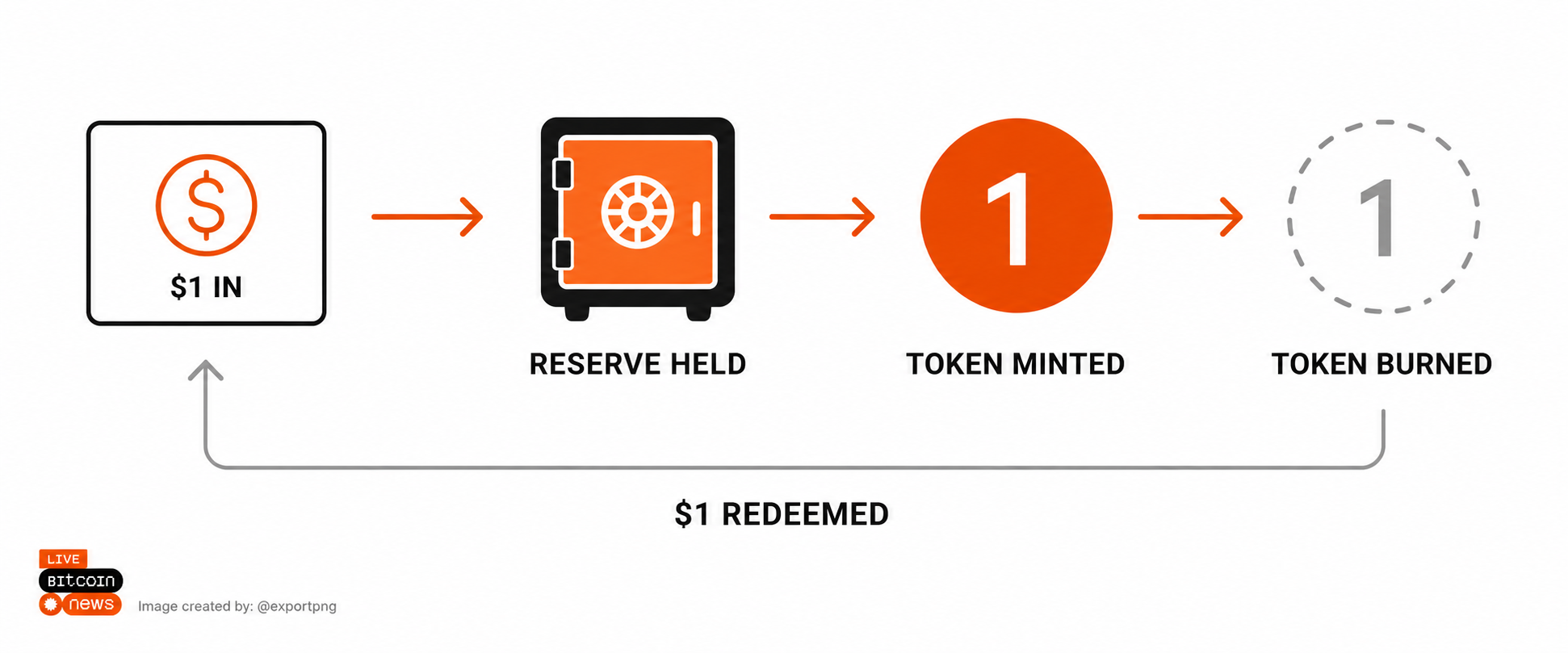
This is the simplest idea. You send $1 to the issuer. The issuer holds that $1 (or something very close to it) in reserve. You receive 1 stablecoin. When you want your dollar back, you return the token, the issuer burns it, and you get your $1 back.
The flow looks like this:
$1 deposited → 1 stablecoin minted
Token circulates freely on the blockchain
Token redeemed → token burned → $1 returned
This is how USDT (Tether) and USDC (Circle) work at a high level.
The "reserve" doesn't have to be a pile of cash sitting in a vault. Reserves can include bank deposits, short-term U.S. Treasury bills, repurchase agreements, money-market funds, and other permitted liquid assets. The important thing is that the reserve is liquid enough to honor redemptions.
The peg holds because: if the token trades below $1, arbitrageurs buy it cheap and redeem it at $1 from the issuer, pocketing the difference and pushing the price back up. If it trades above $1, people mint new tokens at $1 and sell them, pushing the price back down. Arbitrage is the rubber band that keeps the peg taut.
The failure mode: issuer risk, reserve risk, banking access risk. If the issuer is dishonest about what's in the reserve, or if the reserve assets become temporarily inaccessible, or if the issuer faces regulatory shutdown; the peg can wobble or break. The peg is only as credible as the institution behind it.
What if you don't want to trust a company? What if you want a stablecoin that's governed by code and community instead of a CEO?
That's the idea behind DAI, created by MakerDAO and launched in 2017.
Here's how it works. You deposit cryptocurrency; say, ETH; into a smart contract. The contract lets you mint DAI against it, but not dollar-for-dollar. You have to put in more than you take out.
Why over-collateralize? Because ETH is volatile. If ETH drops in price, there needs to be a cushion so the DAI is still fully backed. If your collateral falls below a certain threshold, the protocol automatically liquidates it; sells the ETH to buy back and burn the DAI; before the system becomes undercollateralized.
Price feeds called oracles tell the smart contract what ETH is worth at any moment. The whole system is governed by MakerDAO, a decentralized organization where token holders vote on parameters like collateral ratios and interest rates.
Over time, DAI (now evolving toward USDS under the Sky protocol) expanded to accept multiple types of collateral, including real-world assets.
The failure mode: collateral risk, liquidation risk, governance risk, oracle risk. If ETH crashes faster than liquidations can process, or if an oracle is manipulated, or if governance makes a bad decision; the system can become undercollateralized. The decentralization that makes it trustless also makes it slower to respond to crises.
What if you don't want to hold any collateral at all? What if you could maintain a peg purely through supply management; expanding supply when the price is too high, contracting it when the price is too low?
That's the dream of algorithmic stablecoins. And it has, so far, been the most dangerous dream in the stablecoin world.
NuBits tried this in 2014. TerraUSD (UST) tried it at much larger scale in 2022. Both failed.
The Terra/UST collapse is the most instructive example. UST maintained its peg through a mechanism linked to a sister token, LUNA. When UST traded below $1, you could burn UST to mint LUNA, reducing supply and theoretically pushing the price back up. When UST traded above $1, you could burn LUNA to mint UST.
The system worked as long as confidence held. But it was deeply dependent on a protocol called Anchor, which was offering extremely high yields on UST deposits; yields that concentrated demand artificially. When large holders began exiting, the mechanism went into reverse. Burning UST minted more LUNA, which diluted LUNA's value, which reduced confidence in the whole system, which caused more exits, which minted more LUNA. A confidence spiral with no floor.
In days, tens of billions of dollars in value evaporated.
The failure mode: reflexive confidence failure. Algorithmic systems can work in normal conditions but are vulnerable to the moment confidence breaks. Once the spiral starts, the mechanism designed to restore the peg can accelerate the collapse instead.
A newer approach, exemplified by USDe from Ethena, uses derivatives positions; specifically, delta-neutral hedging strategies; to maintain a stable value without holding traditional reserves.
The mechanics involve holding crypto assets while simultaneously taking offsetting short positions in futures markets, so that price movements in the underlying asset are neutralized.
The failure mode: funding risk, derivatives market risk, counterparty risk. If funding rates turn negative, or if counterparties default, or if derivatives markets become illiquid; the stability mechanism can break down.
The Origin Story: A Timeline of an Idea
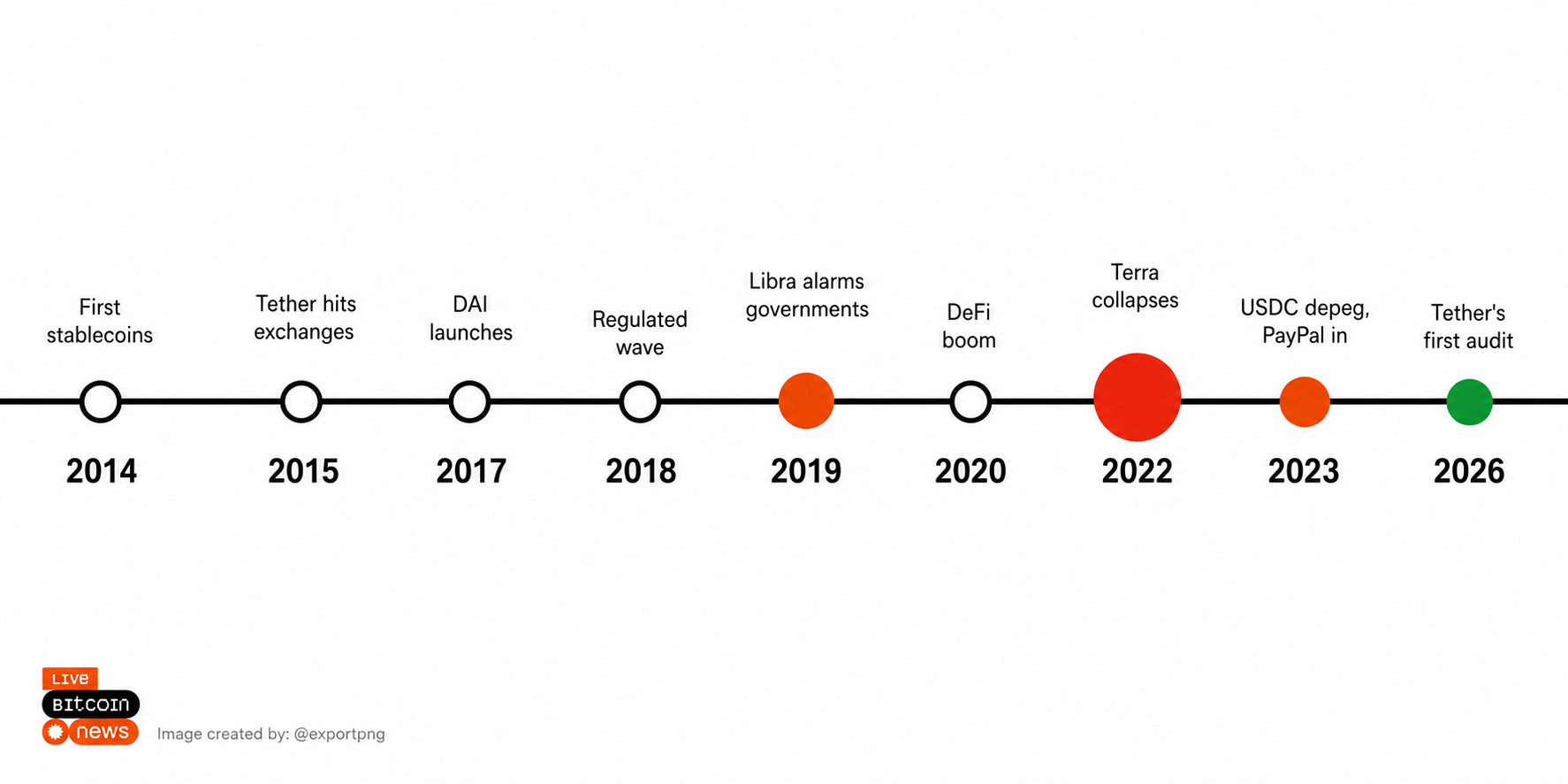
The history of stablecoins is the history of a question being answered, failing, re-answered, and refined. Here's how it unfolded.
Three projects launched in the same year, each with a different theory of how to hold a peg.
July 2014: BitUSD; generally identified as the first live stablecoin; launched as a crypto-collateralized experiment on the BitShares blockchain.
2014: NuBits; an early algorithmic attempt. It would later fail, demonstrating the fragility of supply-management without collateral.
2014: Realcoin; which quickly rebranded to Tether; launched with the simplest pitch: one token, one dollar, held in reserve. No fancy mechanism. Just a promise and a reserve.
Tether reached major exchanges by 2015. This was the moment stablecoins stopped being an experiment and started being infrastructure. Traders could now move in and out of dollar positions without leaving the crypto ecosystem. Exchange liquidity deepened. The 24/7 dollar was real.
DAI launched, giving the world a stablecoin that didn't require trusting a company. You locked up ETH, you got DAI. The code was the custodian. MakerDAO was the governance layer. For people who believed crypto's whole point was to remove institutional trust, this was the answer.
USDC, PAX (Paxos Standard), and GUSD (Gemini Dollar) launched; a wave of fiat-backed stablecoins designed with regulatory compliance in mind from the start. These issuers were regulated financial institutions, not offshore entities. The pitch: same dollar token, but with a paper trail.
Facebook announced Libra; a proposed stablecoin (later renamed Diem) backed by a basket of currencies, designed to serve Facebook's billions of users globally.
The reaction from governments was swift and alarmed. Suddenly, stablecoins weren't a crypto curiosity. They were a potential challenge to monetary sovereignty. A private company with two billion users issuing its own money? That was a different conversation entirely.
After Libra, governments began treating private digital money as a monetary-policy and sovereignty issue. Regulators who had been watching from a distance started drafting frameworks.
The decentralized finance boom made stablecoins the core unit of account for an entire parallel financial system. You needed stablecoins to lend, borrow, provide liquidity, earn yield. DAI, USDC, and USDT became the dollars of DeFi. Stablecoin supply expanded dramatically.
TerraUSD (UST) collapsed. Tens of billions of dollars in value disappeared in days. It was the most visible stablecoin failure in history, and it reshaped the regulatory conversation globally. Every regulator who had been drafting frameworks accelerated their work.
Also in 2022: Tether removed commercial paper from its stated reserve composition, moving toward Treasuries and other liquid instruments; a significant shift in the transparency and composition of the world's largest stablecoin reserve.
March 2023: USDC temporarily depegged. Part of USDC's reserves were held at Silicon Valley Bank, which failed. When SVB collapsed, there was a brief period of uncertainty about whether Circle could access those funds. USDC traded below $1 for a short period. The reserves were ultimately accessible and the peg restored; but the episode demonstrated that even well-regulated, transparent fiat-backed stablecoins carry banking access risk.
The depeg wasn't a diagnosis of USDC being fraudulent. It was a symptom pointing to an underlying risk: what happens when the bank holding your reserves fails?
2023: BUSD stopped. Following regulatory actions, new issuance of BUSD (Binance's stablecoin, issued by Paxos) halted and supply was wound down. A major stablecoin disappeared from the market not because of a mechanism failure but because of regulatory pressure on its issuer.
2023: PYUSD launched. PayPal, one of the world's largest payments companies, launched its own stablecoin through Paxos. Stablecoins were no longer just a crypto-native product; mainstream payments infrastructure was issuing them.
2023: CCTP launched. Circle introduced the Cross-Chain Transfer Protocol, a system for moving USDC natively between blockchains without the risks of traditional bridge approaches. More on this shortly.
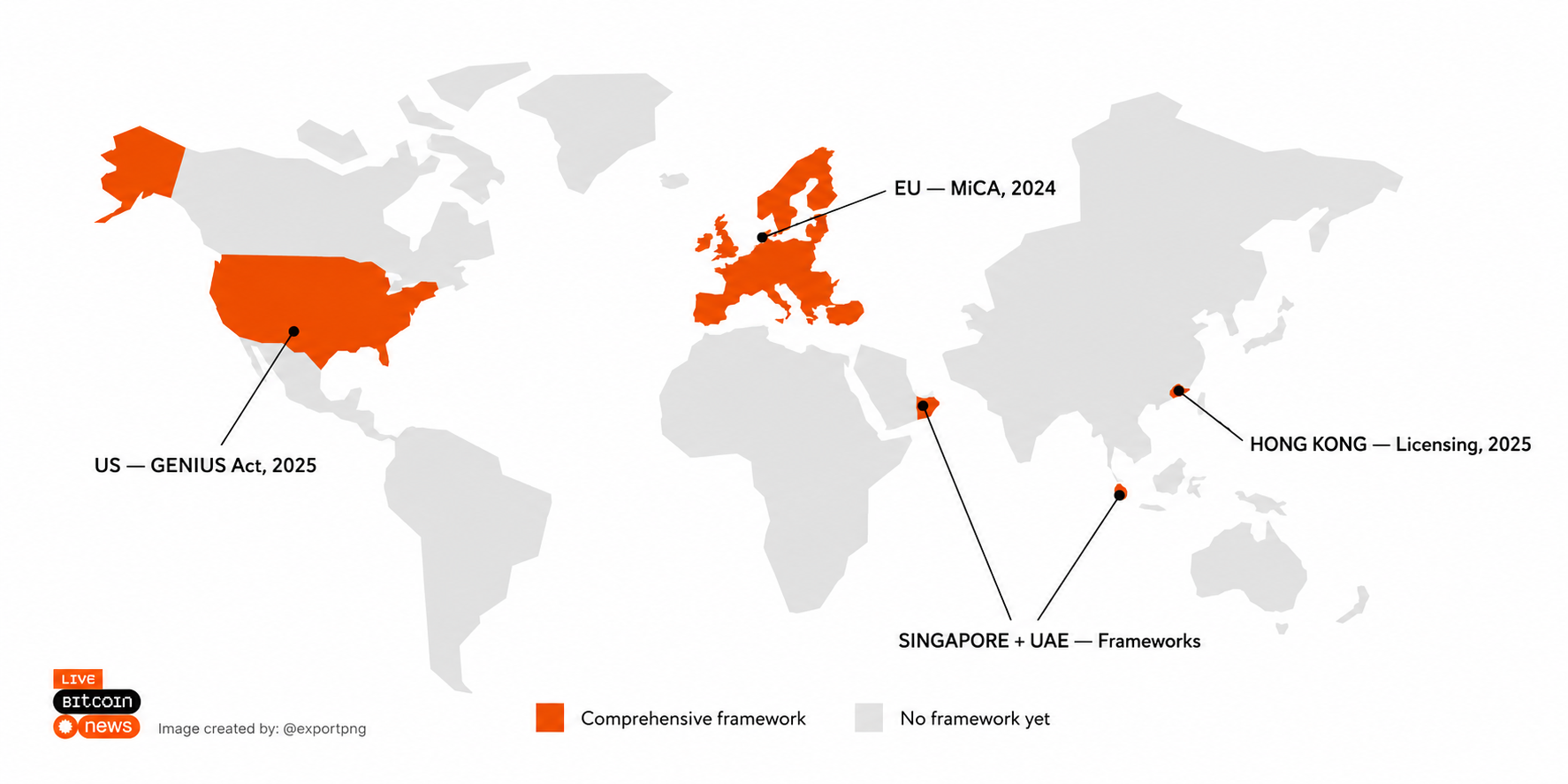
EU MiCA; the Markets in Crypto-Assets regulation; brought stablecoin rules to Europe, covering reserve requirements, redemption rights, and issuer authorization. The first major jurisdiction to create a comprehensive framework.
RLUSD launched; Ripple's enterprise-positioned stablecoin, aimed at cross-border payments and institutional use cases.
The GENIUS Act passed in the United States in 2025, establishing a federal framework for stablecoin issuance. Implementation and rulemaking continued into 2026.
Hong Kong moved to a licensed issuer framework in 2025. Singapore and the UAE developed their own frameworks. The global regulatory patchwork was becoming a global regulatory landscape.
Australia has taken its own step toward stablecoin-specific regulation, another licensed-issuer path rather than a CBDC.
Stable.com Partners With Polygon for Direct Bank Stablecoin Transfers
Hong Kong Plans Stablecoin Settlement for Tokenized Funds
Visa expanded stablecoin settlement across multiple blockchains in 2025–26. The largest card network in the world is now using stablecoins as a settlement layer.
2026: Tether announced its first full financial-statement audit. For a company that had operated for over a decade with attestations rather than full audits, this was a significant announcement; though the contents of the audited statements were not yet available at the time of this writing.
2026: Agentic payments began growing. Software agents and AI systems making purchases on behalf of users created new demand for programmable, 24/7, internet-native settlement. Stablecoins emerged as one candidate for this use case.
No stablecoin story is complete without spending some time on Tether, because Tether is the stablecoin that made all of this commercially real; and also the one that raised the most questions about what "fully backed" actually means.
Tether launched in 2014 with a simple claim: every USDT is backed one-for-one by a dollar in reserve. For years, that claim was taken largely on faith. Tether had a relationship with Bitfinex, a major crypto exchange, and the two entities shared significant operational overlap.
Over the years, Tether faced regulatory scrutiny including actions by the CFTC and the New York Attorney General. Questions arose about whether the reserves were actually there, what they were composed of, and whether the one-for-one claim was accurate at all times.
What emerged over years of public pressure and regulatory engagement was a more complex picture. Tether's reserves included not just cash but commercial paper, other instruments, and assets of varying liquidity. In 2022, Tether removed commercial paper from its stated reserve composition, shifting toward Treasuries and other liquid instruments; a meaningful improvement in reserve quality, by most assessments.
Tether moved from no transparency to attestations (third-party reviews of reserve snapshots) to, in 2026, an announcement of a first full financial-statement audit.
The Tether story is the stablecoin trust story in miniature: a private issuer making a promise, operating in a regulatory gray zone, facing scrutiny, gradually improving transparency, and remaining the dominant stablecoin by volume throughout all of it.
This doesn't make Tether good or bad. It makes it complicated; which is exactly what you'd expect from a decade-old financial institution that grew up in an unregulated environment and is now navigating a regulated one.
Let's make the mechanics concrete, because this is where a lot of confusion lives.
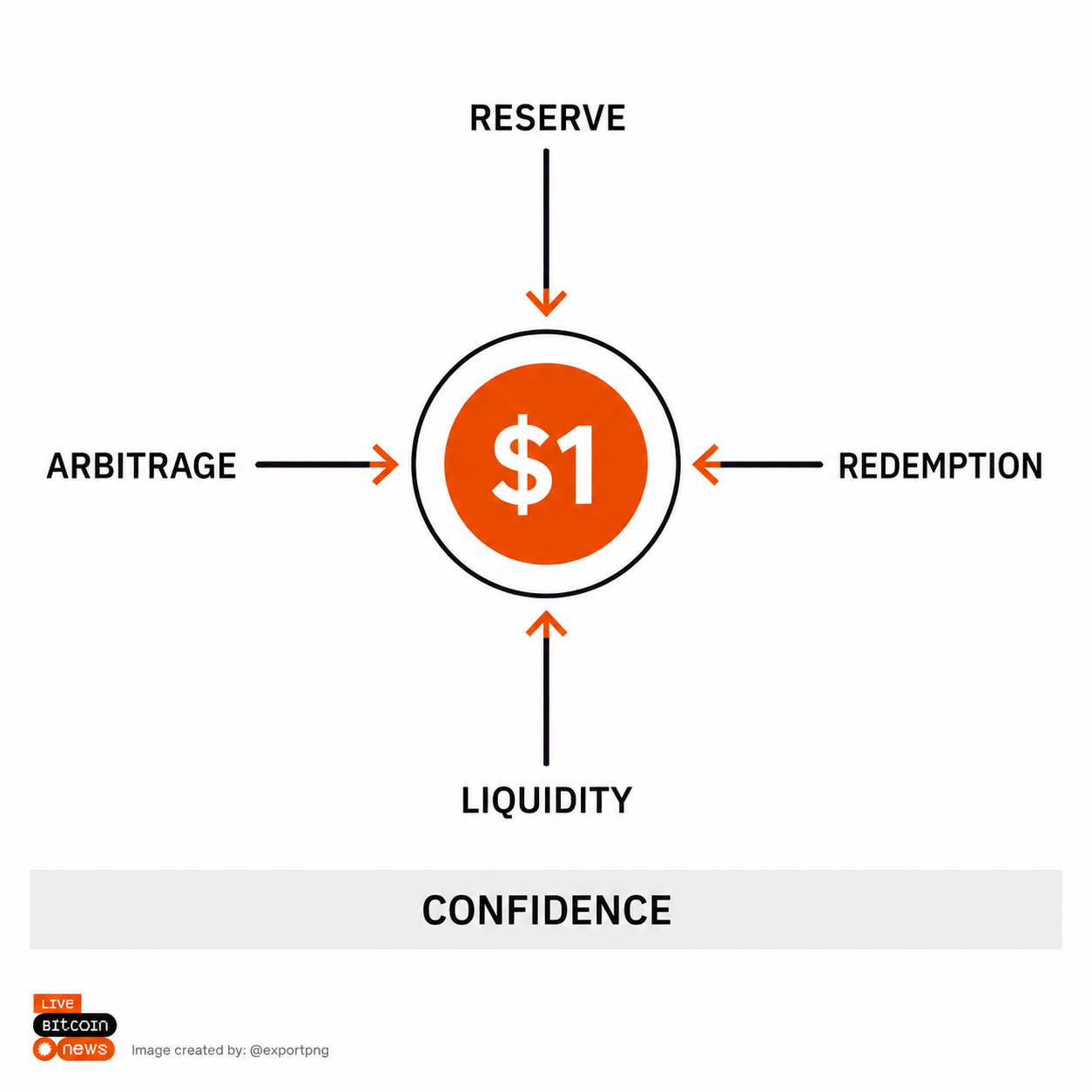
For a fiat-backed stablecoin, the peg holds through a combination of four forces:
Reserve credibility. If you believe the issuer actually holds the reserves they claim, you believe redemption is possible. That belief is the foundation of everything.
Redemption. The ability to actually send 1 USDC to Circle and get $1 back is what gives the token its floor. Without real redemption, the peg is just a number on a screen.
Liquidity. The peg also holds because large market makers are constantly buying and selling the token on exchanges. Deep liquidity means small imbalances get absorbed before they become large imbalances.
Arbitrage. If USDC trades at $0.98, sophisticated traders buy it and redeem it at $1.00, pocketing the difference. That buying pressure pushes the price back up. If USDC trades at $1.02, traders mint new USDC at $1.00 and sell it at $1.02. That selling pressure pushes the price back down. Arbitrage is the automatic stabilizer.
All four forces depend on confidence. And confidence depends on transparency about the reserve.
This is why reserve transparency debates are never just technical arguments. They're arguments about the credibility of the promise.
Here's something that surprises most people when they first encounter it.
When you hold a stablecoin, you are holding a claim on a dollar. The issuer is holding that dollar; or Treasury bills, or repos, or other permitted liquid assets; and earning interest on it.
You are not.
Think about what this means at scale. If a stablecoin issuer has $100 billion in reserves and those reserves earn 4% annually, that's approximately $4 billion in gross reserve income per year. (That's a simplified illustration; reserve income is not net profit after expenses; but the order of magnitude is real.)
The issuer earns the yield. The token holder gets stability and programmability. That's the deal.
That split is why yield headlines get loud. Coinbase has even paid USDC yield in bitcoin for premium users. The mechanism question is still who earns the float.
This is a significant business model. It's also why the stablecoin business becomes more attractive when interest rates are high (more yield on reserves) and less attractive when rates are near zero (almost no yield). It's why large fiat-backed stablecoin issuers are, in effect, operating something that resembles a narrow bank or a money-market fund; without (in most current frameworks) being regulated as one.
When a stablecoin depegs; trades significantly below or above $1; the instinct is to say "the stablecoin broke." But that's the symptom, not the diagnosis.
Every major depeg in history has pointed to an underlying failure mode:
NuBits: The algorithmic mechanism couldn't maintain confidence when demand fell. The supply-management system had no collateral floor. When confidence broke, there was nothing to catch it.
TerraUSD (UST): The mechanism was reflexive; designed to restore the peg, but capable of accelerating the collapse when confidence broke. Anchor's concentrated, artificially high-yield demand meant the system was fragile in ways that weren't visible until they were.
USDC in 2023: Not a reserve fraud. Not a mechanism failure. A banking access problem. Part of the reserve was temporarily inaccessible because the bank holding it failed. The peg restored when access was confirmed. The failure mode was: what happens when your reserve custodian fails?
BUSD: Not a depeg in the traditional sense. Supply wound down because the issuer was directed to stop new issuance. The failure mode was regulatory; the issuer couldn't continue operating under the new environment.
Each depeg tells you something different about where the risk in that specific stablecoin lives. Understanding the failure mode is more useful than the headline number.
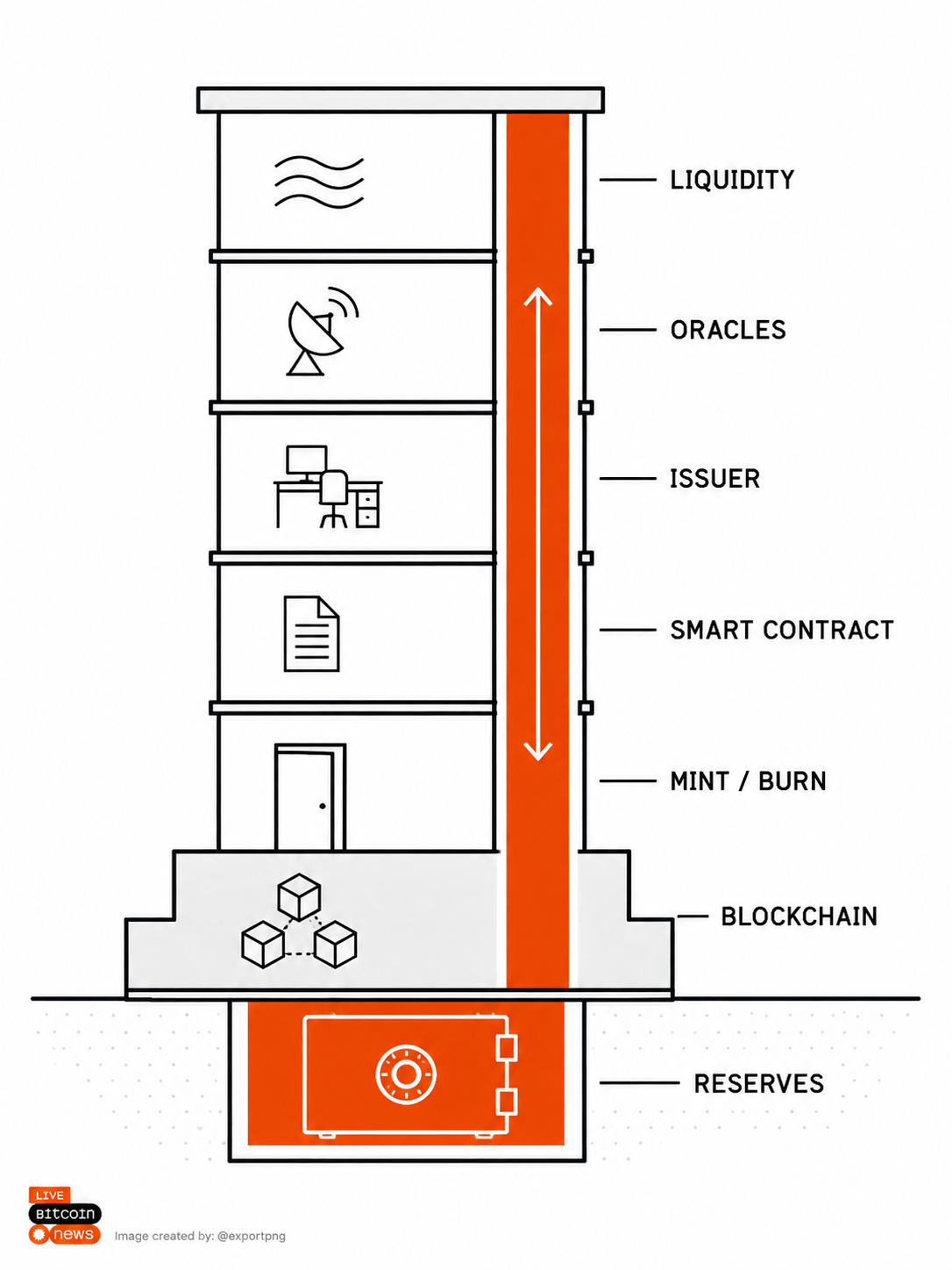
You don't need to be an engineer to understand the layers that make a stablecoin work. Think of it like a building:
The blockchain is the land the building sits on. Ethereum, Solana, Tron, Base, Avalanche; stablecoins can live on many different blockchains.
The token smart contract is the building itself. It defines the rules: how tokens are created, transferred, and destroyed.
The mint/burn mechanism is the front door. Tokens come into existence when reserves come in; they disappear when reserves go out.
The issuer or protocol is the management company. For Tether, that's a company. For DAI, that's a decentralized protocol.
The reserve or collateral system is the vault. This is what backs the promise.
Oracles are the price feeds that tell the system what things are worth in the real world; critical for crypto-backed stablecoins.
Custody is who actually holds the assets in the vault.
Liquidity is the network of market makers and exchanges that let you buy and sell the token near $1 at any time.
Multi-chain interoperability is the elevator that lets you move between floors; between blockchains.
That last layer has become increasingly important as stablecoins spread across dozens of blockchains.
Here's a problem that sounds technical but has real economic consequences.
USDC exists on Ethereum. It also exists on Solana. And Base. And Avalanche. And others. But "USDC on Ethereum" and "USDC on Solana" are not the same token; they're separate instances of a token contract on separate blockchains.
If you want to move your USDC from Ethereum to Solana, you need some kind of bridge. The traditional approach is lock-and-wrap: lock your USDC on Ethereum, mint a "wrapped" representation on Solana. The problem is that wrapped tokens introduce bridge risk; if the bridge is hacked or fails, the wrapped tokens become worthless.
Circle's answer is CCTP; the Cross-Chain Transfer Protocol, launched in 2023. Instead of locking and wrapping, CCTP works like this:
You burn your USDC on the source chain
A cross-chain message is sent with an attestation (a cryptographic proof that the burn happened)
Native USDC is minted on the destination chain
No wrapped tokens. No bridge holding a pile of locked assets. The token is destroyed on one chain and created on another, with Circle's attestation as the trust anchor.
This is a meaningful improvement in the architecture of cross-chain stablecoin movement. But it also means trusting Circle's attestation infrastructure; which is a form of centralization.
Chain-level demand shows up in flows too. Sui has attracted about $1.8 billion in stablecoin inflows, which is distribution of dollar tokens onto a network, not a new peg design.
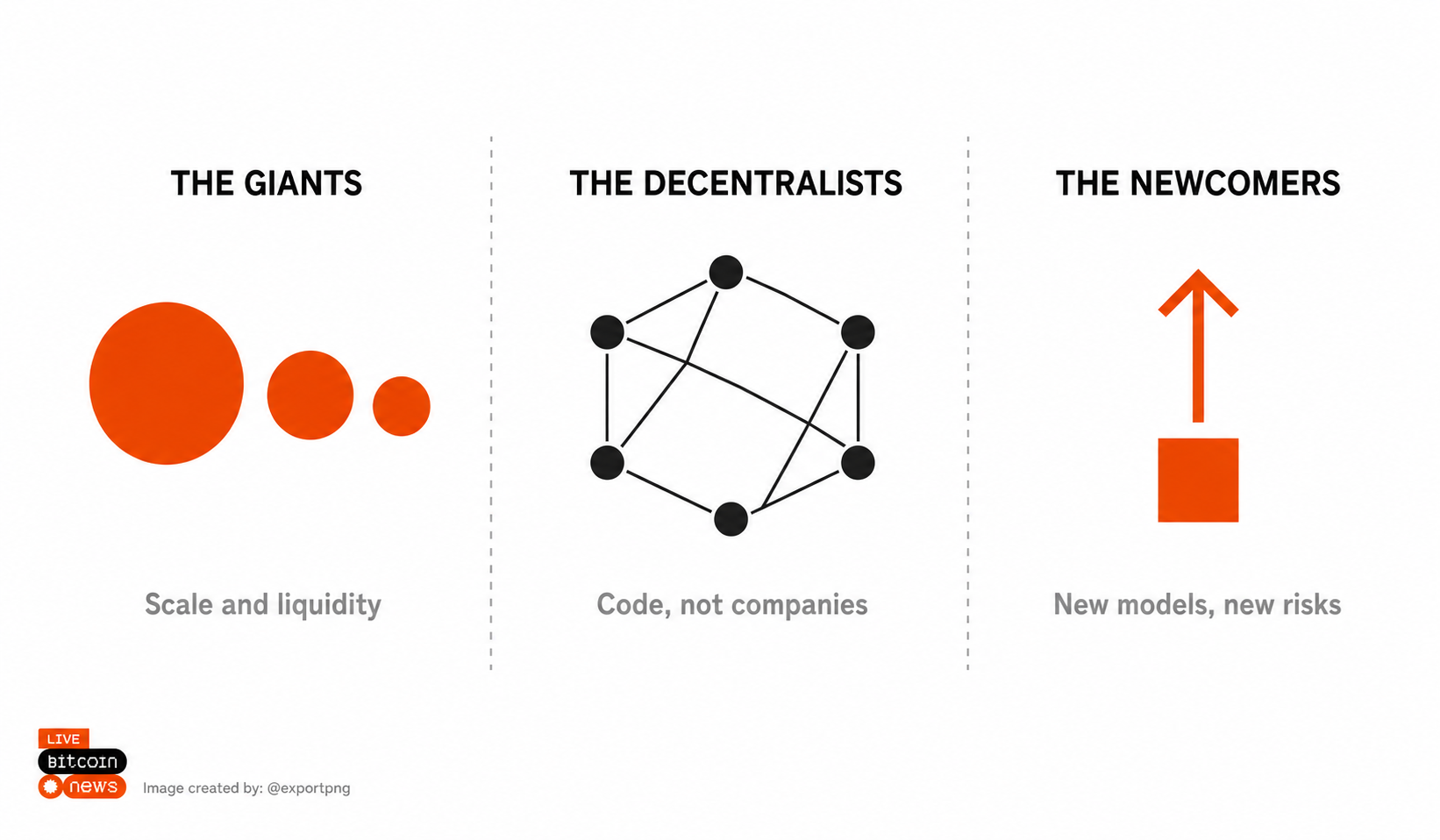
The stablecoin landscape has several distinct players, each with different positioning. Rankings and market sizes change frequently.
USDT (Tether): The oldest and largest fiat-backed stablecoin by volume. Deep liquidity, especially in Asian markets and crypto trading. Long reserve-transparency arc.
USDT also now moves on Bitcoin's Lightning Network, which is a payments-rail story as much as a trading-pair story: Tether's USDT on Lightning.
USDC (Circle): Fiat-backed with institutional and regulatory focus. The primary stablecoin for DeFi and U.S.-regulated contexts.
Circle has also used USDC as internal settlement plumbing, moving $68 million in about 30 minutes.
DAI / USDS (Sky/MakerDAO): Crypto-collateralized and increasingly real-world-asset-backed. The flagship decentralized stablecoin.
USDe (Ethena): Synthetic, derivatives-backed. A newer model with different risk characteristics.
PYUSD (Paxos/PayPal): Fiat-backed, distributed through PayPal's massive user base. The mainstream payments play.
RLUSD (Ripple): Enterprise and cross-border payment positioning.
FDUSD (First Digital): Exchange-focused, particularly in Asian markets.
USDP (Paxos): Regulated trust-company model.
GUSD (Gemini Dollar): One of the earliest U.S.-regulated stablecoins.
EURC (Circle): A non-dollar example; a euro-denominated stablecoin, illustrating that the model isn't limited to USD.
The landscape is not static. New issuers enter, old ones exit or wind down, and the relative sizes shift with market conditions and regulatory changes.
Banks weighing their own coins, Japan bank consortia for yen and USD stables, and US-oriented Tether variants show issuer competition beyond a two-ticker market. Bank of America has weighed stablecoin plans as rivals such as Circle push deeper into payments. Bank research "market size by 2030" notes are attention signals, not forecasts this page treats as fact. USDT and USDC remain the owned search anchors for this category.
That rivalry sits next to the ticker map above. PayPal-class brands, bank groups, and crypto-native issuers are fighting over the default on-chain dollar, not only over who has the deepest trading pair.
Twelve European banks have gone further under Qivalis, aiming to launch a euro stablecoin in 2026. Wells Fargo's WFUSD trademark is the same contest from a US bank payments desk.
US statutes such as the GENIUS Act change how major issuers can mint in the US market (including Tether's US path). Central banks may also propose temporary holding limits as a stability tool. The Bank of England has floated caps on how much stablecoin a household or business may hold. Stablecoin-specific rules for USDT and USDC-class products belong on this page; broad market-structure bills still belong with crypto regulation coverage, not this product gate.
This is where a lot of confusion lives, so let's be precise.
Regulated does not mean government-issued. A stablecoin issued by a licensed, regulated company is still a private token; a claim on that company's reserves. It is not a government liability. It is not insured by a government deposit scheme (in most cases). It is a private promise that operates within a regulatory framework.
Here's a rough map of the different ways governments relate to stablecoins:
Regulation: Setting rules for how stablecoins must be structured, reserved, and operated (the EU's MiCA, the U.S. GENIUS Act)
Licensing: Requiring issuers to obtain approval before operating (Hong Kong's 2025 framework)
Sandboxes: Allowing limited experiments under regulatory supervision
Government-private cooperation: Governments working with private issuers on payment infrastructure
Official payment acceptance: Governments accepting stablecoins for taxes or services (rare, and not the same as endorsing them)
Government-issued digital money: CBDCs; central bank digital currencies; which are government liabilities, not private tokens
These are distinct things. A stablecoin can be fully regulated and still be a private promise. A CBDC is a government promise. The difference matters.
The EU's Markets in Crypto-Assets regulation established comprehensive rules for stablecoin issuers operating in Europe: reserve requirements, redemption rights, issuer authorization, and caps on non-euro stablecoins used for payments. The first major jurisdiction to create a comprehensive framework.
The U.S. passed the GENIUS Act in 2025, establishing a federal framework for stablecoin issuance. As of this writing, implementation and rulemaking continued into 2026; meaning the framework exists but the detailed rules are still being finalized.
A separate US bill fight over stablecoin yield is already moving markets: Circle stock dropped after legislation targeted yield.
Hong Kong moved to a licensed issuer framework, requiring stablecoin issuers to obtain licenses before operating. Part of a broader effort to position Hong Kong as a regulated crypto hub.
Both developed their own frameworks, contributing to a global regulatory landscape that is increasingly coordinated in its goals (reserve requirements, transparency, redemption rights) even if the specific rules differ.
The overall direction is clear: stablecoins are moving from a regulatory gray zone toward a regulated financial product. What's less clear is exactly how the rules will be implemented, enforced, and coordinated across jurisdictions.
Stablecoins are argued as a messaging-era leap for remittances and transfers. Consumer wallets integrating USDC, PayPal's PYUSD distribution, and Circle gateway and chain integrations show how dollar stables move beyond exchange trading pairs into payment plumbing. Utility is distribution plus settlement, not a moon chart.
For most of stablecoin history, the primary use case was crypto trading. You held USDT to sit on the sidelines between Bitcoin trades. You used USDC as collateral in DeFi protocols.
But something shifted. Payments companies started noticing that stablecoins could do things traditional payment rails couldn't; or couldn't do as cheaply.
PayPal launched PYUSD in 2023. A company with hundreds of millions of users issuing its own stablecoin is a different kind of statement than a crypto-native issuer doing the same thing.
GCash integrating USDC in the Philippines is the same pattern: a wallet people already have, not only a listing on an exchange.
Visa expanded stablecoin settlement across multiple blockchains in 2025–26. The largest card network in the world is now using stablecoins as a settlement layer.
Stripe and Bridge built business APIs for stablecoin payments; making it easier for companies to send and receive stablecoins without building blockchain infrastructure themselves.
For companies that need a checkout rail, not a token science project, that stack already includes cryptocurrency payment gateways for international businesses.
Ripple launched RLUSD with explicit enterprise and cross-border payment positioning. Cross-border payments are one of the clearest use cases for stablecoins: moving value across borders without correspondent banking delays and fees.
Exchanges are treating the category as core product too. Brian Armstrong has said Coinbase is focused on an everything exchange, stablecoins, and DeFi.
Why does this matter? Because it means stablecoins are no longer just a crypto-native tool. They're becoming part of the payments stack that regular businesses use.
Most stablecoins are dollar-denominated. That's not an accident; the dollar is the world's reserve currency, and demand for dollar-denominated assets is global.
Here's something worth sitting with. To hold dollars today, you typically need a U.S. bank account. Getting one as a non-U.S. resident is difficult. In many countries, it's practically impossible.
A dollar-denominated stablecoin changes that equation. If you have a smartphone and a crypto wallet, you can hold something that tracks the dollar's value; without a U.S. bank account. For people in countries with weak currencies or limited banking access, this is genuinely significant.
It also has geopolitical implications. Dollar-denominated stablecoins can increase global demand for short-term U.S. Treasuries; since issuers hold Treasuries as reserves. In a world where stablecoin supply is measured in hundreds of billions of dollars, that's a meaningful flow of capital into U.S. government debt.
This is one reason the U.S. government has taken a relatively favorable view of dollar-denominated stablecoin frameworks; they extend dollar reach without requiring the U.S. to do anything.
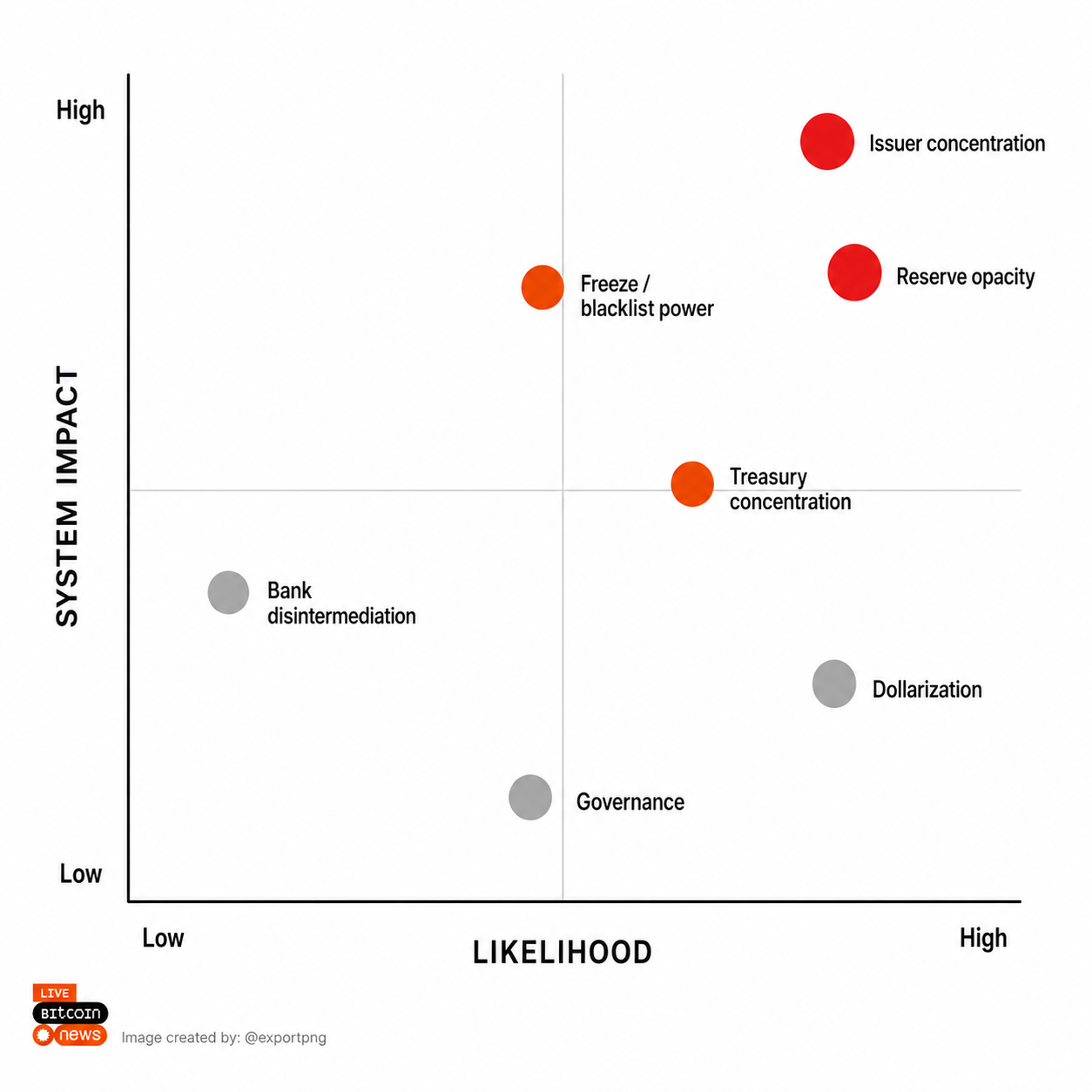
Stablecoins are not without serious critics, and the criticisms are worth understanding.
Reserve transparency. Even with attestations and improving disclosure, the question of what exactly is in the reserve; and how liquid it is in a crisis; remains live. Attestations are snapshots, not continuous monitoring. Full audits are better, but even audited financial statements have limitations.
Freeze and blacklist functions. Most fiat-backed stablecoins include the ability for the issuer to freeze or blacklist specific wallet addresses; usually to comply with sanctions or law enforcement requests. This is a form of centralized control that sits uncomfortably alongside crypto's decentralization narrative.
Issuer concentration. A large fraction of stablecoin supply is controlled by a small number of issuers. If one of those issuers fails or is shut down, the market impact is significant.
Bank disintermediation. If people hold stablecoins instead of bank deposits, banks have less money to lend. At scale, this could affect credit creation. Regulators are watching this carefully.
Treasury concentration. If stablecoin reserves are a significant holder of short-term Treasuries, that creates a new kind of systemic connection between the stablecoin market and the government debt market.
Dollarization. Dollar-denominated stablecoins spreading globally can undermine monetary sovereignty in smaller economies; making it easier for citizens to hold dollars than local currency, which complicates local monetary policy.
Political and corporate governance. Who governs a stablecoin? For centralized issuers, it's a company with shareholders. For decentralized protocols, it's a token-holder community. Neither is the same as democratic governance of a currency. These are real governance questions without clean answers.
People often confuse stablecoins with other instruments that sound similar. Here's a quick map:
| Instrument | Issuer | What You Hold |
|---|---|---|
| Stablecoin | Private company or protocol | A token/claim designed to track a currency |
| Bank deposit | Commercial bank | A bank liability, insured up to limits |
| Tokenized deposit | Commercial bank | A bank deposit represented on token rails |
| CBDC | Central bank | A central bank liability; government money |
| Money-market fund | Asset manager | An investment claim on short-term securities |
A stablecoin is not a bank deposit. It's not FDIC-insured (in most cases). It's not government money. It's a private token; a claim on a private issuer's reserve. Understanding this distinction matters when you're thinking about risk.
Here's where things get genuinely speculative; but interestingly so.
Imagine a world where software agents; AI systems acting on your behalf; are making purchases, paying for services, and settling transactions continuously, at all hours, across the internet.
An AI agent that needs to purchase compute time, license data, or pay for an API call can't wait two days for a wire transfer. It can't use a credit card that requires a human to authorize. It needs a payment method that is:
Available 24/7
Programmable (can be triggered by code)
Internet-native (no physical infrastructure required)
Capable of handling small amounts (micropayments)
Settleable without human intervention
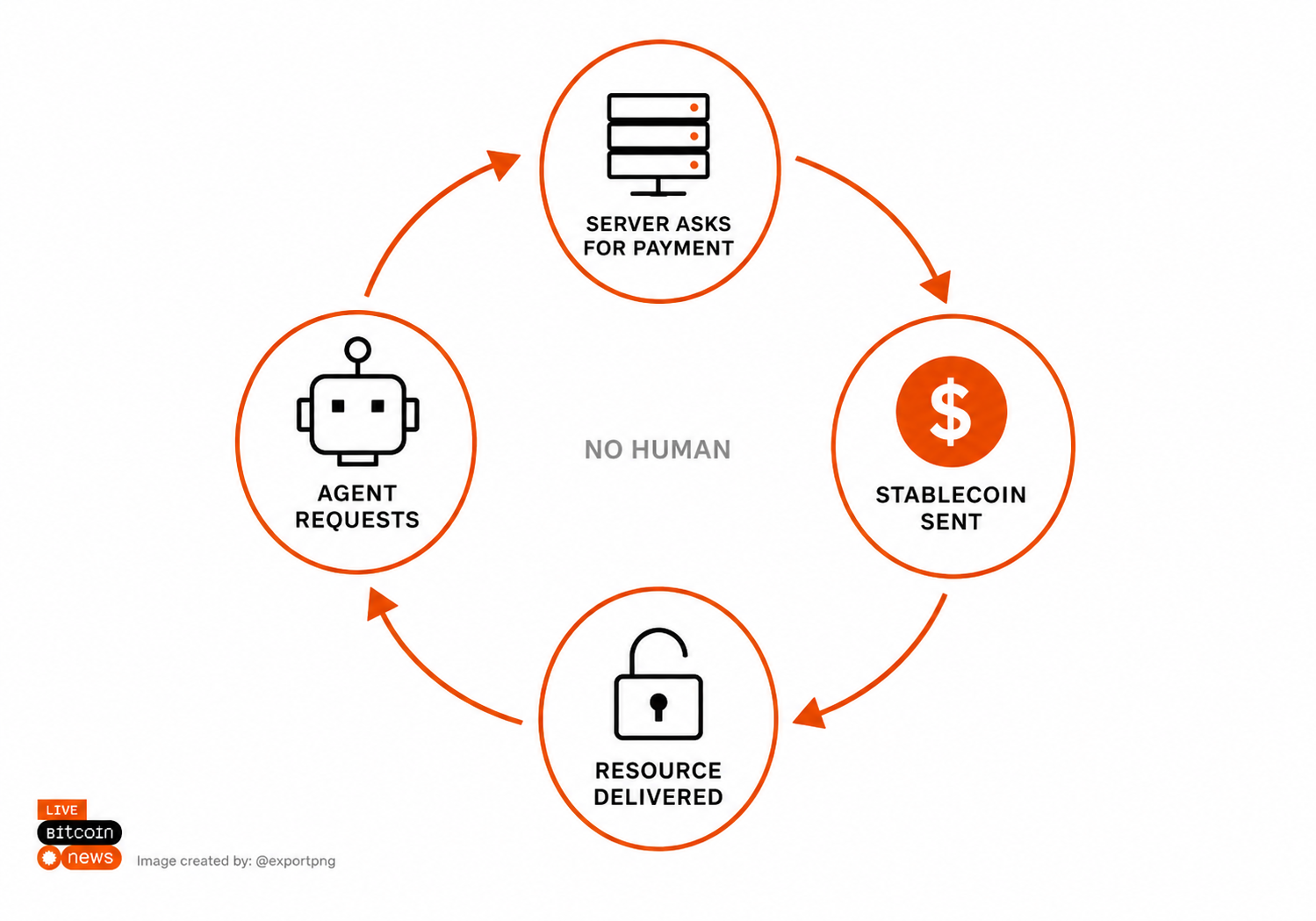
Stablecoins, running on public blockchains with smart contracts, match several of these properties. Coinbase's x402 protocol is a practical example of this kind of flow: an agent requests a resource, the server requests payment, the agent sends a stablecoin, the server provides the resource. Machine-to-machine, no human in the loop.
This is still early. Card networks and traditional payment systems are also evolving to serve agentic use cases. Tokenized bank deposits and other instruments are candidates too.
But the direction of travel is interesting. The properties that made stablecoins useful for crypto traders in 2014; 24/7 availability, programmability, no banking intermediary; turn out to be exactly the properties that software agents need.
We've covered a lot of ground. But every section of this article has circled back to the same question:
When a token says it's worth $1, what makes that promise credible?
For fiat-backed stablecoins, the answer is: the reserve, the issuer's credibility, the regulatory framework, and the arbitrage mechanism.
For crypto-backed stablecoins, the answer is: the overcollateralization, the liquidation mechanism, the oracle feeds, and the governance system.
For algorithmic stablecoins, the answer has repeatedly turned out to be: confidence; which is fragile.
For synthetic stablecoins, the answer is: the derivatives position and the counterparty structure.
Each answer comes with a different set of risks. Each risk has shown up in a real failure at some point in the last decade. And each failure has driven the next iteration of the idea.
That's the pattern. Problem → solution → new weakness → iteration. The stablecoin story isn't a story of a finished product. It's a story of an idea being stress-tested in real time, by real money, in real markets.
The fact that governments, banks, payment companies, and central banks are all paying attention now isn't because the problem is solved. It's because the stakes have gotten high enough that ignoring it is no longer an option.
Are stablecoins safe?
It depends on the type and the issuer. Fiat-backed stablecoins from regulated issuers carry issuer risk, reserve risk, and banking access risk. Crypto-backed stablecoins carry collateral and liquidation risk. Algorithmic stablecoins have shown the most catastrophic failure modes. "Safe" is relative to what you're comparing them to and what risks you understand.
Is a stablecoin the same as a CBDC?
No. A stablecoin is a private token issued by a company or protocol. A CBDC (central bank digital currency) is a liability of a central bank; government money in digital form. These are fundamentally different things even if they both track a currency's value.
Do I earn interest on stablecoins?
Typically not from the issuer directly. The issuer earns interest on the reserves and keeps it. You can earn yield by lending your stablecoins through DeFi protocols or centralized platforms, but that introduces additional risks.
What happened to Terra/UST?
UST was an algorithmic stablecoin that maintained its peg through a mechanism linked to a sister token, LUNA. When large holders began exiting, the mechanism went into a reflexive collapse; burning UST minted more LUNA, diluting LUNA's value, reducing confidence, causing more exits. In days, tens of billions of dollars in value were destroyed.
What is CCTP?
Circle's Cross-Chain Transfer Protocol. It allows USDC to move between blockchains by burning on the source chain and minting natively on the destination chain, rather than using lock-and-wrap bridge approaches that introduce additional risk.
What does "fully backed" mean?
It means the issuer holds assets sufficient to redeem all outstanding tokens. But "fully backed" doesn't mean a pile of cash in a vault; reserves can include Treasury bills, repurchase agreements, money-market funds, and other permitted liquid assets. The quality and liquidity of those assets matters.
What is the GENIUS Act?
A U.S. federal law passed in 2025 establishing a framework for stablecoin issuance; covering reserve requirements, issuer eligibility, and regulatory oversight. Implementation and rulemaking continued into 2026.
Why are dollar stablecoins so common?
The dollar is the world's reserve currency, and global demand for dollar-denominated assets is enormous. Stablecoins make it possible to hold something that tracks the dollar without a U.S. bank account; which has significant appeal in countries with weak currencies or limited banking access.
Stablecoins started as a workaround. A clever engineering solution to a trader's inconvenience: how do you hold a dollar inside a blockchain ecosystem that never sleeps?
Ten years later, that workaround has become infrastructure. It's the settlement layer for decentralized finance. It's the tool PayPal and Visa are building with. It's the subject of legislation in Washington, Brussels, Hong Kong, and Singapore. It's the candidate payment method for software agents making micropayments at machine speed.
The core idea; a private token that holds its value because the issuer holds reserves; is simple. The execution is complicated. The risks are real. The failures have been expensive. And the iteration continues.
The next time someone tells you stablecoins are just a crypto thing, you can explain why that's not quite right anymore. They're a monetary experiment; one that started in the margins of the financial system and is now being absorbed, regulated, and built upon by the institutions that once ignored it.
Are you still with me? Good. Because the most interesting questions; what happens when every major bank issues a stablecoin, what happens when software agents become significant payment actors, what happens when the GENIUS Act rules are finalized; are the ones that don't have answers yet.
That's where the story goes next.
Explore more