
Bitget Plans Phased Withdrawal Resumption as Security Checks Continue

Latest in AI & Blockchain
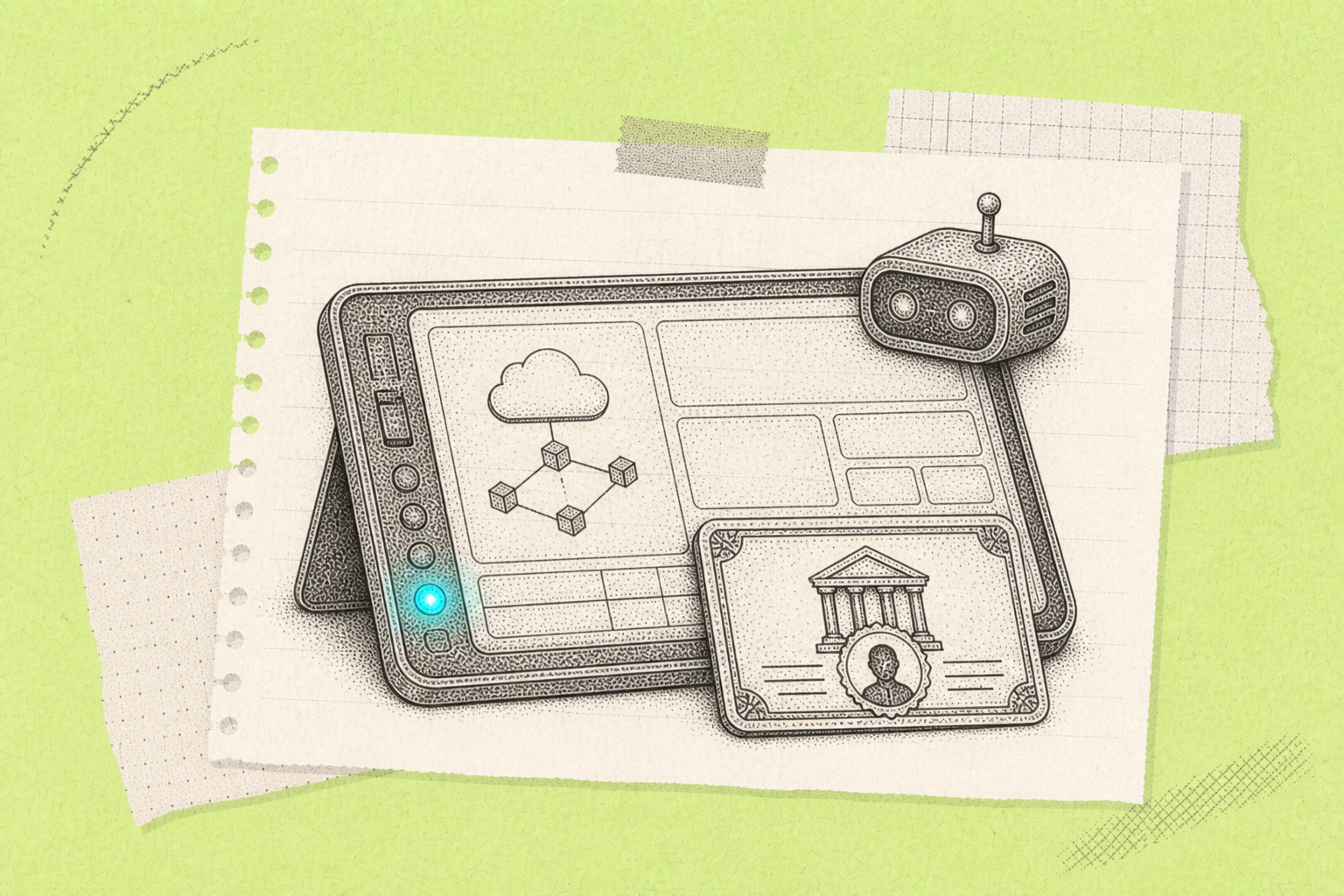
In 2026, a piece of software with no human at the keyboard can do all of the following in a single afternoon: control a blockchain wallet, buy an API call, read a verified price feed, rent GPU compute by the hour, call a smart contract, and pay another service in dollar-pegged stablecoins.
And yet the large language model doing the reasoning behind all of that almost certainly does not run on a blockchain at all.
That is the contradiction worth sitting with. If the AI is not actually running on-chain, where exactly do AI and blockchain technology meet?
The answer is not the one the market’s loudest voices usually give. AI is not being “put on the blockchain.” Large models are far too compute-heavy to run inside ordinary smart contracts, and no amount of engineering enthusiasm changes the arithmetic. What is actually happening looks more like this:
AI thinks off-chain → verification and oracle systems check the work → blockchain handles identity, ownership, incentives, payments and execution.
To understand why that shape emerged, it helps to rewind: not to a definition, but to a problem.
Blockchain technology is a shared ledger plus the tooling around it: identity, ownership, payments, and programmable settlement. Large AI models think off-chain on GPUs; the chain records results, proofs, and money movement. Tokenized markets, one-click chain launch, and agent wallets are infrastructure stories, not coin tips. A proof that a model ran is not a proof that the output is correct.
Blockchain was built to keep a shared record of digital value without a single bank as referee.
Bitcoin, launched in 2009 by an unknown person or group using the alias Satoshi Nakamoto, was not designed as an investment. It was designed to answer a narrow, stubborn question:
How can people transfer digital value without one bank maintaining the master ledger?
Digital files are trivially copyable. Without a central authority keeping score, nothing stops someone from spending the same digital coin twice: the double-spending problem. Every previous working digital cash system had solved this by appointing a referee: a company, a bank, a clearing house. Refereeless designs had been proposed: Wei Dai’s b-money and Nick Szabo’s bit gold among them, but none had ever run.
Bitcoin’s answer was to remove the referee and replace it with four ingredients working together:
Think of it as a public notebook that thousands of people hold identical copies of. Whenever anyone records a transaction, every copy updates. Because every copy would have to change simultaneously for a fraudulent edit to go unnoticed, and because the copies are spread across the globe, the ledger becomes, in practice, tamper-resistant.
That shared ledger plus the tooling around it is what people now call blockchain technology. Blockchain is the specific data structure underneath that notebook: transactions are grouped into blocks, and each block is cryptographically linked to the one before it, forming a chain. Altering any block would break every link that follows. As Investopedia puts it, the Bitcoin blockchain is a distributed database of transactions secured by encryption and validated by peers (nodes) across the network.
Bitcoin proved something that had not been demonstrated before: independent computers with no relationship to each other could maintain a shared record and a working economic system without a central operator.
That proof mattered more than the currency itself. It established that trust could be a property of a protocol rather than a property of an institution.
Bitcoin could move value. It could not do much else: its scripting language was deliberately limited.
The obvious next question was whether the shared ledger could be made programmable.
Ethereum, proposed by Vitalik Buterin in late 2013 and launched in July 2015, extended Bitcoin’s insight in one direction: instead of recording only value transfers, the blockchain could store and execute arbitrary code. Those programs are called smart contracts: a term the computer scientist and legal scholar Nick Szabo introduced in the mid-1990s, long before there was a blockchain to run one on.
The cleanest way to understand a smart contract is the vending machine:
Input / condition → code executes → asset or state changes.
You put in a coin, you press a button, the machine drops the item. There is no shopkeeper deciding whether to serve you, no negotiation, no discretion. The rule is the machine.
A smart contract works the same way, except the “item” is any digital state change:
Ethereum.org states it plainly: smart contracts define rules and enforce them automatically via code. Once deployed, they cannot be deleted by default, and interactions with them are irreversible.
The practical consequences are large. Smart contracts reduce the need for trusted intermediaries, lower arbitration costs, and reduce fraud losses. They are the foundational building blocks of decentralized finance: lending, trading and derivatives protocols that run without a central exchange, and of NFTs, which encode ownership records directly on-chain.
A smart contract is powerful for one specific reason: many computers can independently verify that the same deterministic outcome is correct.
The Ethereum Virtual Machine (EVM) is the runtime that makes this work. Every node runs the same code on the same inputs and arrives at the same result. No single node’s output is authoritative; agreement across all of them is.
That property is also precisely why a normal blockchain is a terrible place to run a giant AI model.
Computation on the EVM is not free. Every operation costs gas: the unit that measures computational effort, and the price of that gas is quoted in gwei, a small denomination of ether, which compensates validators for the resources they spend. More complex operations cost more gas, and Ethereum’s block gas limit caps how much computation fits into each block.
Now hold that thought against what a modern AI model actually requires.
Imagine a vending machine again. Now imagine asking it to read your mood, suggest what you might want, negotiate a price, and then complete the sale.
That is what an AI model does. And it is a fundamentally different kind of machine.
Blockchains are built to make many computers agree; AI is built to make a few very powerful computers think.
The mismatch is not a matter of degree, and it is not going to be closed by faster block times. Every node on Ethereum would have to re-execute an entire model inference to validate it, and the same probabilistic model can return different outputs on different runs, which breaks the determinism the consensus depends on. Floating-point arithmetic behaves differently across hardware. Sampling introduces randomness by design.
So the overwhelming majority of AI computation happens off-chain, on conventional GPU hardware, exactly as it always has.
If the AI stays outside the blockchain, then blockchain’s role has to be something other than running it. It needs ways to coordinate what the AI does, verify that it did it, and settle the consequences.
That is where the real crossover begins.
Here is the mental model to carry through the rest of this piece. Everything that follows is an implementation of one of these layers.
        AI MODEL / AGENT
        reason · predict · generate
                 ↓
        OFF-CHAIN COMPUTE
        GPU · cloud · decentralized compute
                 ↓
        VERIFICATION
        oracle · zkML · TEE · validators
                 ↓
        BLOCKCHAIN
        identity · ownership · smart contracts
                 ↓
        ACTION
        payment · trade · asset · governance
AI thinks off-chain; blockchain verifies, coordinates and settles.
In this architecture, the blockchain is commonly acting as:
It is not acting as the AI compute engine. Nothing in this stack requires it to.
Each arrow in that diagram is also a trust boundary, and each has its own failure mode. Most of the interesting engineering, and most of the unsolved problems, live on the arrows rather than in the boxes.
Major exchanges are designing platforms where equities and ETFs can exist as ledger tokens while keeping familiar shareholder rights such as dividends and votes. The product thesis is continuous matching (including outside classic cash-session hours) plus fractional, dollar-sized purchases so high-priced shares become retail-accessible. Bank partners supply custody and cash rails beside the exchange matching engine. Until regulators approve, treat announcements as architecture intent, not live market structure. For this page, the durable lesson is infrastructure: tokenization is a market-plumbing upgrade, not a tip on any single coin.
That is the same ownership layer already in the stack above. NYSE plans for 24/7 tokenized stock trading are architecture intent until they clear. So is Canton Network moving fixed-term funds in real time, and Chainlink’s work to put tokenized financial products onto Finchain across Asia. The Bank of Japan testing blockchain for core settlement is the same idea inside a central bank, not a new ticker.
Builder tooling now packages custom chain launch as a console workflow: permissions, base tokens, gas parameters, and integrations configurable in minutes rather than months of setup. Roadmaps typically bolt on bridges, oracles, DEX templates, and fiat on/off-ramps as modules. In parallel, fiat-to-crypto “connect” products sit under apps as compliance-gated rails instead of as destination exchanges. Readers should evaluate these as platform capabilities (time-to-deploy, modularity, ramp coverage), not as short-term token narratives.
Aurora Labs’ cloud console for instant chain deployment is that productized launch pitch. Binance Connect is the on-ramp sitting under an app rather than as a destination exchange.
Autonomous AI agents that settle or verify on-chain require L1 features (contracts, signatures, intent-style apps) plus ecosystem capital for builders. Market-maker and foundation funds can underwrite that stack without collapsing the topic into AI-meme presales. Consumer brand deals (sports, games) show a second distribution path: on-chain assets reaching users through entertainment platforms. Keep AI-meme token-sale FOMO on the meme-token coverage, not on this technology page.
DWF Labs teaming with NEAR to develop an AI agent is builder capital on an L1, not a ticker sale. So is T54 Labs raising for AI-agent finance trust. FIFA working with Mythical Games is the entertainment distribution path: users meet the chain through a product they already have.
The first serious attempts to combine the two technologies did not try to run neural networks on-chain. They tried something more modest and more sensible: using a blockchain to create open markets for intelligence.
SingularityNET, launched in 2017 by a team including the AI researcher Ben Goertzel, was among the earliest decentralized AI-service marketplaces. The design was straightforward:
The marketplace reached beta in 2019. Its architecture already contained the shape of everything that followed: chain for coordination and settlement, conventional servers for the actual computation.
Bittensor took a different angle. Its first main network iteration launched in 2021 as a single network of miners and validators; the permissionless subnet architecture it is now known for arrived with a major upgrade in October 2023. Rather than a marketplace of listed services, it built an incentive network for producing digital commodities.
The mechanics are worth understanding because they recur elsewhere:
The chain never runs the model. It runs the market: the accounting of who contributed what, and who gets paid.
The first meaningful AI × blockchain crossover was never:
“run a neural network on Ethereum.”
It was:
use a blockchain to create open markets for intelligence.
Every later development (compute marketplaces, verification layers, agent payments) is a refinement of that same idea.
Then the AI boom created a physical bottleneck, and the market went looking for supply.
Modern models need GPUs: a lot of them, for long stretches, with fast interconnects between them. GPU access has been, variously: expensive, scarce, allocated by relationship rather than by price, and concentrated in a small number of hyperscale clouds and data centres.
Wherever a resource is scarce, expensive and unevenly distributed, a marketplace tends to appear. Decentralized compute networks are that marketplace, with blockchain doing the coordination and settlement.
A GPU owner has spare capacity → lists it on the network → an AI developer requests compute → the provider runs the workload → the network coordinates the lease and the payment.
A handful of networks illustrate genuinely different architectural choices:
The point is not which project wins. The point is that “decentralized compute” is not one thing. Coordinating spare rendering capacity is a different engineering problem from coordinating a multi-node training run, and the projects that conflate them tend to underdeliver on the harder one.
These networks belong to a category that acquired a name around 2022: DePIN: Decentralized Physical Infrastructure Networks.
The idea is simple. Use blockchain-based coordination and token incentives to organise access to real physical resources:
The GPU is still a physical NVIDIA or AMD machine sitting in a rack somewhere, drawing power, cooled by a fan. Nothing about it is decentralized. The blockchain is coordinating access to it: discovery, pricing, scheduling, payment and dispute resolution.
That distinction gets lost constantly in marketing material, and losing it is how people end up believing that a token can manufacture compute.
Decentralized compute appears to work well for workloads that are:
Frontier-model training is a much harder case. Training a large model across thousands of GPUs requires enormous volumes of gradient data to move between them on every step, over interconnects measured in hundreds of gigabits per second with latency measured in microseconds. Commodity internet links are several orders of magnitude away from that. Research into low-communication distributed training is active and genuinely promising, but the frontier-scale claim remains unproven in production.
Suppose you rent a GPU from a stranger on a decentralized network. The job completes. The provider says:
“I ran your model correctly.”
Why should you believe it?
The provider could have run a smaller, cheaper model and returned a plausible answer. It could have returned a cached result from a previous request. It could have run the right model on the wrong inputs. It could have been compromised. In a permissionless network, you cannot rely on reputation or a contract with a counterparty you can sue.
And the obvious fix (re-running the entire computation to check) destroys the economics. If verification costs as much as the original work, you have not built a marketplace, you have built a very expensive way to do the job twice.
This is the central unsolved problem at the AI × blockchain intersection, and three broad families of answers have emerged:
Each trades off differently between cost, trust assumptions and the size of model it can realistically handle.
Zero-knowledge machine learning applies zero-knowledge proofs to model inference.
Conceptually:
the model runs off-chain → a cryptographic proof is generated alongside the output → the blockchain verifies the proof cheaply.
The analogy worth holding onto:
The AI gives you an answer. zkML tries to give you a mathematical receipt showing that the approved model, and no other: produced that answer from those inputs.
The verification step is deliberately cheap. Checking the proof takes a tiny fraction of the effort of producing it, which is exactly the property a blockchain needs.
EZKL is the most prominent open-source toolkit in this space. It takes a model exported in the standard ONNX format, compiles it into an arithmetic circuit, generates a proof that the circuit was executed faithfully, and produces a verifier that can run on-chain.
Plausible use cases cluster where the rules matter more than the scale:
Two of them, and both matter.
First, cost and scale. Turning a neural network into an arithmetic circuit is expensive, and proof generation can take orders of magnitude longer than the inference itself. Non-linear operations: the activation functions that make neural networks work: are particularly awkward to express in circuit form and usually require approximation or quantisation. zkML today is practical for small and mid-sized models. Proving a frontier-scale language model is not currently feasible.
Second, and more fundamentally: zkML proves how a computation was performed. It does not prove the model is any good.
A proof tells you the committed model produced this output from this input. It says nothing about whether the model is:
A perfectly proven inference from a badly trained model is a mathematically certified bad answer. That distinction is the single most misunderstood point in this entire field.
Treat zkML as promising infrastructure that is still early for large models: not as a solved problem.
The second approach gives up on pure cryptography and leans on hardware instead.
A TEE is like a locked computing room that can hand you a cryptographic certificate showing exactly which software is running inside it.
More precisely, a TEE is a secure, isolated area of a processor that protects code and data for confidentiality and integrity, separating sensitive computation from the host operating system and every other application on the machine, as described by iq.wiki. Even the machine’s owner cannot see inside. And the enclave can produce an attestation: a signed statement, rooted in a hardware key, describing precisely what code was loaded and that it was not modified.
Confidential computing is the broader discipline: protecting data in use: as opposed to at rest or in transit: by performing the computation inside a hardware-based TEE. The Confidential Computing Consortium, a community spanning hardware vendors, cloud providers and software developers, has identified it as an emerging strategic imperative for secure AI and data collaboration.
The hardware is real and shipping:
In the crypto-native world, Phala and EigenCompute both build off-chain compute on top of TEE hardware, with the aim of producing attestations that on-chain contracts can check. EigenCompute’s own documentation is candid that its current mainnet alpha does not yet deliver fully verifiable, trustless execution: that remains roadmap rather than shipped capability.
The model still runs on ordinary powerful hardware. What changes is that the user gets cryptographic evidence about the environment the code ran in.
Compared with generating a zero-knowledge proof, attestation overhead is small: typically a modest percentage rather than a multiple. That makes TEEs practical for things zkML cannot yet touch:
TEEs are not trustless. They relocate trust rather than eliminating it.
You are trusting the chip vendor’s design, the vendor’s manufacturing process, the vendor’s attestation service, and the firmware supply chain. That is a much smaller and more accountable trust base than “trust this anonymous GPU provider”, but it is not zero, and TEE implementations have a documented history of side-channel and speculative-execution vulnerabilities that required microcode patching.
A TEE tells you which program ran. It does not tell you the program was correct, any more than zkML does.
| Method | Simple explanation | Strength | Limitation |
|---|---|---|---|
| zkML | A mathematical proof that a specific model produced a specific output | Strongest cryptographic guarantee; no hardware trust required; inputs can stay private | Expensive and slow to generate; awkward for non-linear operations; impractical at frontier model scale today |
| TEE | Protected hardware that certifies which software ran inside it | Low overhead; handles large models and private data; production hardware available now | Depends on trusting chip vendors and attestation infrastructure; historical side-channel vulnerabilities; not trustless |
| Validators | Multiple independent parties check and score the work; incentives punish cheating | Flexible; works for subjective or probabilistic outputs where exact reproduction is impossible | Vulnerable to collusion and incentive gaming; scoring criteria can be gamed; security is economic rather than cryptographic |
None of these is a complete answer on its own, and the interesting production systems increasingly combine them: a TEE to make execution attestable and private, a validator network to sample and score quality, and cryptographic proofs reserved for the narrow high-value decisions that justify their cost.
The recurring lesson is worth stating once more: proving execution is not the same as proving the output is correct. Every method above verifies the former. None verifies the latter.
Verification is about computation. There is a parallel problem about data.
AI models depend on enormous quantities of it, and the AI era has made a set of previously boring questions urgent:
A blockchain looks like a natural registry for these answers, and to a degree it is. But putting the data itself on-chain is not viable. Public blockchains are designed for replication across thousands of nodes; storing a multi-terabyte training corpus that way would cost orders of magnitude more than any commercial storage and would degrade the network for everyone else.
The realistic pattern separates the two concerns:
Large dataset or model file stored off-chain → cryptographic hash, ownership record, licence terms and version pointer stored on-chain.
The hash acts as a fingerprint. Anyone can re-hash the file and confirm it matches the on-chain record, which makes silent substitution detectable. Filecoin is one of the most established decentralized storage networks for the off-chain half: it uses cryptographic proofs to demonstrate that storage providers are actually holding the data they were paid to hold, rather than taking payment and deleting it.
This split (heavy artefact off-chain, light commitment on-chain) is the same architectural instinct as the compute stack. The chain records commitments; it does not carry the load.
This is where a great deal of nonsense gets published, so it is worth being precise.
A blockchain can prove:
A blockchain cannot automatically prove:
The gap between those two lists is where most “blockchain solves deepfakes” claims collapse. Registering a fabricated image on-chain produces a permanent, tamper-resistant record of a lie.
Blockchain can make a record tamper-resistant. It cannot make a false claim true.
The more mature work on this problem is happening outside blockchain entirely. The Coalition for Content Provenance and Authenticity (C2PA): founded in February 2021 by Adobe, Arm, BBC, Intel, Microsoft and Truepic: defines Content Credentials: cryptographically signed metadata, called C2PA manifests, that record a digital asset’s provenance and modification history. The standard has reached version 2.3, adding live video support, more file types, clearer editing history, better cloud integration and stronger security.
Content Credentials are, in effect, a tamper-evident label attached to a file: what software created or modified it, when, and how. Critically, they are signed but not necessarily anchored to any blockchain: the trust comes from the signing key and the certificate chain behind it, exactly as it does for HTTPS.
C2PA has its own well-documented weaknesses. Metadata can be stripped by re-encoding, screenshotting or passing the file through a platform that discards it, and the guarantee at capture time is only as good as the trust in the capturing device. It is a meaningful improvement, not a solution.
The honest summary: C2PA answers “what tool touched this file, and in what order.” A blockchain can answer “when was this fingerprint registered, and by whom.” Neither answers “is this true.”
Return to the stack. If AI runs off-chain and a smart contract needs to act on its output, something has to carry the result across the boundary, and vouch for it.
That is the oracle problem, and it long predates AI. A blockchain oracle is a third-party service that queries, verifies and relays external data to smart contracts. As Chainlink describes it, oracles provide external connectivity and computation that blockchains cannot natively support, and are considered core components of on-chain financial systems.
The crucial detail: oracles are not the original data sources. They are the relay and attestation layer. A smart contract cannot fetch a stock price by itself: an oracle fetches it, signs the result, and delivers it on-chain, usually aggregating across multiple independent reporters so that no single one can move the number.
Applied to AI, the architecture is the same shape:
a smart contract needs a decision → an AI model runs off-chain → an oracle or verifier returns the result with an attestation → the contract executes its rule.
Ritual is building infrastructure specifically for this: AI inference as a first-class primitive that on-chain applications can call, with the execution and verification handled off-chain and the result delivered in a form contracts can consume. Chainlink represents the broader, more established oracle and data-feed model that the AI case is being fitted into. That same relay layer already shows up in Visa, ANZ and Fidelity cross-border settlement.
An oracle can make external data available on-chain. AI can interpret that data. Neither automatically guarantees the data is true.
Stacking a model on top of a feed adds interpretation, not veracity. If the feed is wrong, the model confidently reasons from a wrong premise, and the contract executes irreversibly on the result. The oracle problem does not go away when you add intelligence to it: in some configurations it gets worse, because the failure becomes harder to spot.
This is the turning point in the story.
An AI agent already knows how to:
Give that agent a blockchain wallet: a keypair it can sign with, and the list of things it can do changes category entirely. It can now:
Coinbase AgentKit, launched in 2024 as part of the Coinbase Developer Platform, is the clearest example of this being productised (see Coinbase’s AI-wallet work). It gives an agent framework a wallet and a set of on-chain actions (check balances, transfer tokens, swap, deploy and call contracts) without the private key ever passing through a prompt. It is both framework-agnostic and wallet-agnostic: alongside Coinbase-managed wallets it supports self-custodied providers such as Viem, Privy and ZeroDev, so teams can keep their own keys.
AI moved from being a tool that could talk about blockchain to software that could act on it.
That sentence is short and the implications are not. A system that can hold and move assets without a human in the loop is a different risk object from a chatbot, and it should be treated as one.
This section deserves at least as much attention as the capability section above it.
AI models can and do:
Prompt injection is the sharpest of these. It is a cybersecurity exploit in which crafted inputs cause unintended behaviour in a language model, exploiting the model’s difficulty in distinguishing developer instructions from user-supplied content. An attacker can override system instructions, extract sensitive information, or trigger unintended actions. OWASP ranks it LLM01: the number-one risk: in its 2026 GenAI Top 10 for LLM Applications, where Excessive Agency also sits at number three, a placement that speaks directly to agents with signing authority, and IBM has documented its implications in enterprise deployments. There is currently no general solution to it.
Now combine that with the property that makes blockchains trustworthy: smart contract interactions are irreversible by default. There is no chargeback, no fraud department, no undo.
Never give probabilistic reasoning unlimited deterministic spending authority.
Responsible designs put a deterministic policy layer between the model’s judgement and the signing key:
AI plan
   ↓
policy rules          (what classes of action are permitted at all)
   ↓
transaction simulation (what would this actually do, on a fork, before signing)
   ↓
spending limits / allowlists (how much, how often, to whom)
   ↓
human approval        (required above a threshold, or for novel counterparties)
   ↓
wallet signature
Each layer is deterministic code, not model judgement. That is the point. The model proposes; the policy engine disposes.
Practical implementations lean on session keys and scoped permissions: account-abstraction patterns that let a wallet grant an agent narrow, expiring, capped authority rather than full control of a keypair, and on simulating every transaction against current chain state before it is signed, so that a call which would drain a balance is caught before it is broadcast rather than after.
Anyone deploying an agent with signing authority in production should be reading published incident reports and audited implementations, not blog posts. Including this one.
Once agents have wallets, an obvious question follows: how does one machine pay another machine for a service, with no human and no invoice?
The things an agent needs to buy are already well defined:
What has been missing is a payment mechanism that fits the shape of a machine transaction: tiny amounts, no account creation, no card, no monthly billing cycle, settled in the same round-trip as the request.
x402, introduced by Coinbase in 2025, is the clearest attempt at this. It revives HTTP status code 402 Payment Required: defined in HTTP/1.0 back in 1996 and left largely dormant ever since, and turns it into a working payment handshake:
an agent requests a service → the server responds 402 with payment terms → the agent retries with a signed payment payload in an X-PAYMENT header → the server, or a facilitator acting for it, verifies the signature and serves the resource → the facilitator submits the transaction on-chain to settle.
No account. No API key. No subscription. The payment is part of the request.
Stablecoins are what make this practical. Software can price a service in stable dollar-like units without having to reason about volatility between the moment it quotes and the moment it settles. Stablecoins are cryptocurrencies designed to hold a stable value relative to a specified asset, typically a fiat currency. USDC, issued by Circle, is backed by cash and cash equivalents and described as 1:1 redeemable for U.S. dollars, with settlement that is near-instant, low-cost and globally reachable.
For a machine, that combination (stable unit of account, programmatic settlement, no onboarding) is the difference between a payment rail it can use and one it cannot.
For the deeper mechanics of how stablecoins maintain their peg, manage reserves and settle across chains, see the stablecoins cornerstone.
So far this piece has traced blockchain becoming useful to AI. The traffic runs both ways, and the reverse direction is arguably further along in day-to-day usage.
Natural-language wallets. Instead of composing a transaction by hand: selecting the contract, encoding the call data, setting the gas: a user states an intent and an AI layer translates it into the transaction steps, then shows them for approval. This is where most consumer-facing AI in crypto currently lives, and the approval step is doing the safety work.
Smart contract development. AI assists in writing, explaining and testing contract code, and in reviewing it for known vulnerability classes. It is genuinely useful for coverage and for explaining unfamiliar code to a reviewer. It is not a substitute for an audit: model-based review has a documented tendency to miss the subtle, protocol-specific logic errors that cause the largest losses, precisely because those bugs look like correct code.
Fraud and anomaly detection. Public blockchains produce enormous, fully public transaction datasets: an unusually good substrate for machine learning. Models trained on transaction graphs can flag mixing patterns, wash trading, and wallet clusters associated with known exploits faster than manual analysis.
DeFi risk monitoring. Collateral ratios, liquidity depth, oracle deviation and market conditions can be monitored continuously, with models surfacing configurations that are drifting toward danger before a liquidation cascade begins.
Governance. Token-holder governance drowns in proposal volume. AI is being used to summarise proposals, surface the material changes buried in a diff, and retrieve relevant historical decisions and their outcomes.
Treasury automation. Agents monitor protocol treasuries and, within policy constraints, propose or execute rebalancing strategies: one of the most obvious applications and one of the most dangerous, for all the reasons in the safety section above.
Smart contracts are deterministic by design. That is their strength and their ceiling: they cannot interpret ambiguity, weigh context, or adapt to a situation their author did not anticipate.
AI brings interpretation and dynamic judgement to systems whose execution layer remains rigidly deterministic. The combination is more capable than either alone: provided the rigid layer stays in charge of what is permitted.
| Smart contract | AI agent |
|---|---|
| Deterministic: same inputs, same outputs (EVM docs) | Probabilistic: outputs may vary between runs |
| Narrow, explicit rules | Flexible reasoning over open-ended goals |
| Runs on-chain, across all nodes (Ethereum.org) | Runs mostly off-chain, on GPU hardware |
| Trivially reproducible by anyone | Hard to reproduce exactly |
| Severely limited compute, metered in gas and priced in gwei (ethereum.org) | Large GPU compute, priced in cloud terms |
| Cannot hallucinate: it can only be wrong the way its author was wrong | Can hallucinate confidently |
| Executes instructions | Interprets goals |
| Irreversible by default (Ethereum.org) | Actions reversible only if the surrounding system allows it |
AI interprets and proposes. Smart contracts and policy systems define what it is allowed to do.
Or, more compactly: AI decides within limits; blockchain enforces the limits.
Decentralization is not a binary property, and treating it as one is how buyers get misled.
A project can genuinely decentralize:
while quietly centralizing:
Both statements can be true of the same system at the same time. “Decentralized AI network” describes a spectrum, not a category.
When someone claims a system is decentralized, ask six questions:
If five of the six answers name the same company, the blockchain component is doing marketing work rather than architectural work.
A blockchain component does not automatically make the whole AI system decentralized.
Separating shipped infrastructure from roadmap is the most useful thing a reader can take from a piece like this.
The items in the third list are the ones that appear most often in fundraising decks and least often in production.
| Year | Milestone |
|---|---|
| 2008 | The Bitcoin whitepaper introduces decentralized digital-value coordination without a trusted third party |
| 2009 | The Bitcoin network launches; the genesis block is mined in January |
| 2015 | Ethereum’s mainnet launches, making blockchains programmable through smart contracts |
| 2017–19 | The first decentralized AI marketplaces emerge, coordinating AI services rather than running them |
| 2019 | SingularityNET’s marketplace reaches beta |
| 2021 | Bittensor’s first main network iteration launches, with miners and validators on a single network; permissionless subnets arrive with the October 2023 upgrade |
| 2022–23 | zkML tooling and research gain momentum; the term DePIN enters common use |
| 2023–24 | Decentralized GPU networks pivot toward AI demand as compute scarcity bites |
| 2024 | Coinbase AgentKit gives AI agents wallets and on-chain tools |
| 2025 | Gensyn’s testnet targets verified distributed training; x402 revives HTTP 402 for machine payments |
| 2026 | TEE-based confidential AI, agent-facing oracle tooling and decentralized AI infrastructure mature toward production |
Read top to bottom, the trajectory is clear: the field moved from AI tokens to AI infrastructure. The early projects sold exposure to an idea. The current ones sell compute, verification and settlement: things with invoices attached.
Hallucination. Models assert false things confidently. An agent acting on a hallucination executes a real transaction.
Prompt injection. Ranked LLM01 in OWASP’s 2026 GenAI Top 10 for LLM Applications, and unsolved. External content an agent merely reads can redirect what it does.
Wallet security. An AI with money is a high-value target with a novel attack surface: the agent’s inputs are now part of the security perimeter.
Oracle and input risk. Bad information produces bad decisions. Oracles relay data; they do not originate it, and a compromised feed produces confident, irreversible errors downstream.
Model changes. A system can be built around a model’s observed behaviour, and then the model is updated. The dependency is invisible until it breaks.
Proof limits. Proving execution is not proving wisdom. Every verification method in this piece attests to how a computation ran, not whether the answer was good.
Hardware centralization. Decentralized compute markets still depend on GPUs from a very small number of manufacturers, and TEE guarantees depend on a similarly small number of vendors’ silicon and attestation services.
Incentive gaming. Where a network pays for scored output, participants optimise for the score. If the score diverges from usefulness, the network funds the divergence.
Privacy. AI needs private data; public blockchains are transparent by design. TEEs narrow this tension but do not dissolve it.
Irreversibility. Smart contract interactions cannot be undone. A bad automated transaction is permanent, which is exactly why the policy layer, not the model, must hold the signing authority.
Not every AI system will touch a blockchain. Most will not, and there is no reason they should: a model serving a search engine has no need for a settlement layer.
The combination has a strong technical reason to exist in a narrower set of places:
The architecture converging across all of them is the same one this piece opened with:
AI intelligence + off-chain compute + verification + blockchain ownership and payment.
Which leads to the honest summary:
Blockchain probably will not become the computer that runs the world’s AI. Its more plausible role is becoming part of the trust, ownership and payment infrastructure around AI systems that increasingly act on their own.
The foundational primitives are already real: Bitcoin’s distributed ledger, Ethereum’s programmable contracts, TEE-protected computation, oracle networks, stablecoin payment rails, and cryptographic content provenance.
What remains unbuilt is the connective tissue: the verification protocols, the agent runtime standards, the safety specifications. Whether that tissue gets built with the same rigour as the foundations is the open question, and it is the one worth watching.
        AI MODEL / AGENT
        Reason · Predict · Generate
                 ↓
        OFF-CHAIN COMPUTE
        GPU · Cloud · Decentralized Compute
                 ↓
        VERIFY
        Oracle · zkML · TEE · Validators
                 ↓
        BLOCKCHAIN
        Identity · Ownership · Smart Contracts
                 ↓
        ACTION
        Payment · Trade · Asset · Governance
AI thinks off-chain; blockchain verifies, coordinates and settles.
  AI            models and agents
   ↓
  COMPUTE       GPUs / decentralized compute
   ↓
  DATA          datasets / decentralized storage
   ↓
  VERIFICATION  zkML / TEE / oracle
   ↓
  BLOCKCHAIN    smart contracts / identity / ownership
   ↓
ECONOMICS wallets / stablecoins / x402Use the comparison table in [Smart Contract vs AI Agent](#comparison), and close on the line:
AI decides within limits; blockchain enforces the limits.
1. What is blockchain technology? Blockchain is a distributed ledger technology that records transactions across many computers so that recorded entries cannot be altered retroactively without detection. Transactions are grouped into blocks, and each block is cryptographically linked to the one before it. (Britannica)
2. How are AI and blockchain connected? Not by running AI on-chain. AI computation happens off-chain on GPU hardware; blockchain provides coordination, verification anchoring, ownership records, payments and an audit trail around it.
3. Does AI actually run on blockchain? Essentially no. Model inference runs on conventional GPU infrastructure. What reaches the blockchain is the result, plus some form of attestation or proof about how it was produced.
4. Why can’t large AI models run inside smart contracts? The EVM executes deterministic logic and meters every operation in gas, with a hard block gas limit. A single frontier-model inference involves orders of magnitude more computation than a block can accommodate, and probabilistic outputs break the determinism consensus requires.
5. What is decentralized AI? A spectrum, not a category. A system may decentralize compute, payments or validation while centralizing model weights, the scheduler, the front end or governance. Ask who controls each layer before accepting the label.
6. What is DePIN for AI? DePIN (Decentralized Physical Infrastructure Networks) uses blockchain coordination and token incentives to organise access to real physical resources such as GPUs, servers, storage and networks. The hardware remains ordinary hardware; the chain coordinates access to it.
7. How can blockchain verify an AI model? It cannot verify the model itself. It can verify a proof or attestation about an execution: that a committed model ran, or that code ran inside a certified secure enclave. Verifying that the output is correct remains an unsolved problem. zkML gives a mathematical proof with no hardware trust but does not yet scale to large models. A Trusted Execution Environment has far lower overhead and handles large models, but requires trusting chip vendors. Neither proves the output is correct.
8. What is an AI oracle? An oracle is a service that queries, verifies and relays external data to smart contracts (Chainlink). An AI oracle applies that pattern to model outputs: the model runs off-chain, and the oracle delivers an attested result the contract can act on.
9. Can AI agents own crypto wallets? Yes. An agent given a keypair (or scoped signing authority over one) can hold assets, receive and send payments, trade, and call smart contracts. Whether it should be given unrestricted authority is a separate question, and the answer is no. Agents can also settle in stablecoins, including via protocols such as x402.
10. Can blockchain prove AI-generated content is authentic? No. It can prove a fingerprint was recorded, when, by which wallet, and under what licence terms. It cannot prove the registrant was the real creator or that the content is truthful. C2PA Content Credentials address part of the problem at the file level, and are not blockchain-based.
11. What are the risks of combining AI with blockchain? Hallucination, prompt injection (ranked LLM01 in the OWASP 2026 GenAI Top 10 for LLM Applications), wallet compromise, oracle manipulation, silent model updates, the gap between proving execution and proving correctness, hardware centralization, incentive gaming, privacy on transparent ledgers, and the irreversibility of on-chain mistakes.
12. Will blockchain decentralize AI? Partly, and not automatically. It can decentralize the markets around AI: compute, services, payments, ownership records. Decentralizing the models themselves is a much harder problem that depends on where the weights, the data and the evaluation criteria live, none of which a blockchain component solves on its own.
Blockchain and smart contract fundamentals
Oracles
Confidential computing and TEEs
AI safety and prompt injection
Payments and provenance
Further reading referenced in the narrative
This piece is an orientation for a general technical reader, not investment advice or a formal specification. Claims drawn from vendor documentation are identified as such. Corrections and pointers to primary sources are welcome.
Where AI tooling collides with illicit rails, see also Live Bitcoin News coverage of dark-web crypto crime.
Explore more