
 Samuel·2hr ago
PALO ALTO, Calif. — FinChip today announced that ERC-8338, “Token-Bound Executable Skills,” authored by FinChip Chief Executive Officer Gary Yang, has been assigned an official Ethereum ERC number and filed in Ethereum’s standards repository, ethereum/ERCs, as PR #1879. The proposal is in Draft status, awaiting editor review.
ERC-8338 is the foundational standard for the on-chain AI skill economy — and its author works at FinChip. A CC0 reference implementation, a live testnet contract, and six frozen test vectors reproduced across five independent machines are public today.
Right now, AI agents around the world are downloading and executing skills that nobody — not the user, not the agent, not the registry listing them — can actually verify.
The skill has a name. It has a registry entry. Behind both sits a file at a URL whose contents can be swapped, updated, or poisoned at any moment, with no signal to anyone downstream. In an ecosystem where that file is instruction text fed straight to a language model, the silent substitution isn’t a bug. It’s an open door.
That places FinChip in an unusual position. In the emerging category of the on-chain AI skill economy, most teams are building skill products. The proposal defining the category’s underlying standard came from FinChip. That is not a marketing claim but a checkable one — the proposal number, the authorship, the open implementation, and the live contract are all public.
“There will be many winners in skill products. The layer that tells you what you are actually running was still empty — so we wrote it,” said Gary Yang, Chief Executive Officer of FinChip.
“And a standard earns adoption by being checkable, not by being announced. So we shipped the thing before we talked about it. The spec is public domain, the implementation is open, the contract is live, and the test vectors reproduce byte-for-byte on machines we don’t control. Don’t take our word for any of it — go check the bytes.”
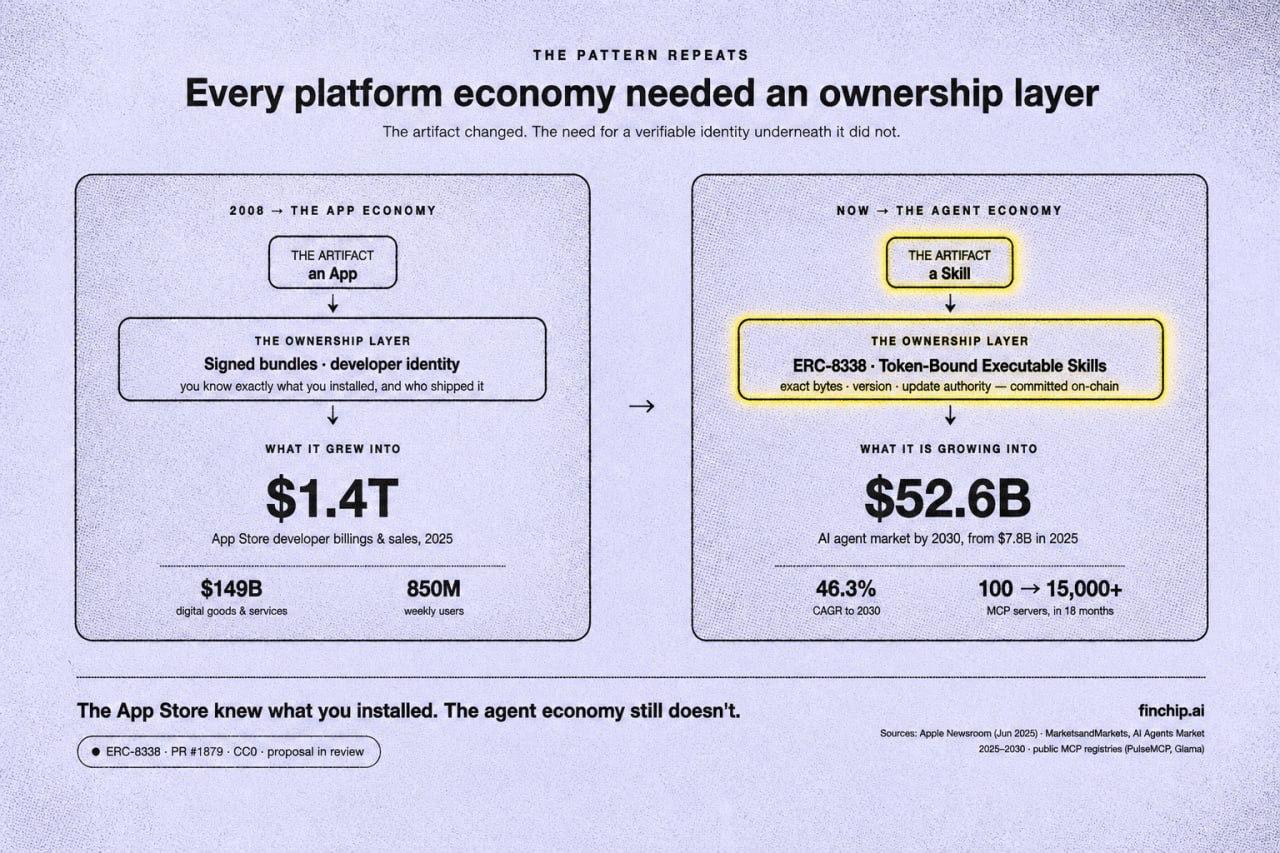
Every platform economy that mattered eventually needed the same thing: a way to know exactly what you were running, and who shipped it.
The app economy got it early. Signed bundles and developer identity meant an installed app was a known quantity — and on that foundation, the App Store ecosystem facilitated more than $1.4 trillion in developer billings and sales in 2025, including $149 billion in digital goods and services, serving 850 million weekly users, according to Apple.
The agent economy is being built in the opposite order. Skills are proliferating first, verification second. PulseMCP, a public directory of MCP servers, currently lists more than 22,000 servers — for a protocol only introduced in late 2024. The AI agent market is projected to grow from $7.8 billion in 2025 to $52.6 billion by 2030, a 46.3% compound annual growth rate, according to MarketsandMarkets.
Millions of executable artifacts are being produced, distributed, and run by autonomous software — on an integrity layer that does not exist yet. That is the layer ERC-8338 specifies.
In a new category, being first is not asserted. It is recorded. FinChip’s record is public:
The last point is the most counterintuitive and the most important. FinChip did not make the standard a moat; it built its commercial infrastructure on top of it. In this category, others compete on products. FinChip supplies the ground they compete on. In an open network, the layer everyone builds on is worth more than any single product built above it.
ERC-8338 extends ERC-721 so a token commits on-chain to the exact artifact it represents: a SHA-256 commitment to the instruction document an agent actually executes, a second commitment covering the full package so companion files cannot be altered undetected, and a monotonic version counter that turns a mutable file into a publication history.
Three separations distinguish it from registry-layer standards:
It is complementary to the registry standards now in progress, not competitive with them. ERC-8239 (Agent Skill Registry) and ERC-8257 (Agent Tool Registry) specify how skills and tools are listed, discovered, and attested. ERC-8338 addresses the layer beneath them: which exact bytes the token commits to.
Registries answer where a skill is listed. ERC-8338 answers what it actually is.
FinChip has released the complete reference implementation as v1.0.0 under CC0, comprising Solidity contracts, a packer and verifier, JSON schemas, and a Foundry test suite in which every normative clause maps to a passing assertion.
A working contract is deployed on the Sepolia testnet under the token name “Skill Token (SKILL),” with the genesis token published as an open test vector whose anchors are readable directly from the on-chain event log.
Six frozen test vectors — covering a public baseline, a companion-file-only change, encrypted key rotation, an atomic on-chain document update, license encryption, and a custom primary path — have been reproduced byte-for-byte across five independent machines.
The proposal has also drawn substantive review inside the standards community. An author of ERC-8299 and co-author of ERC-8323 examined the specification on the Ethereum Magicians forum, affirmed the separations it draws, mapped structural parallels to their own work, and proposed drafting a companion note connecting the standards.
For most of computing history, capability lived inside applications people opened. It is now moving into artifacts that machines fetch and run on their own, thousands of times a day, with no human in the loop to notice when something changes.
When that happens, the questions that decide whether an economy can exist at all become unavoidable:
What exactly is running? Who made it? Who is allowed to change it? Who gets paid when it is used?
Those questions are not features. They are the property system for a market that is arriving whether or not anyone builds it. Skills are on their way to becoming an asset class — bought, sold, licensed, and inherited between autonomous agents.
Assets require titles. ERC-8338 is a proposal to write the title deed.
Proposal discussion:
https://ethereum-magicians.org/t/erc-8338-token-bound-executable-skills/29005
Proposal in Ethereum’s ERC repository:
https://github.com/ethereum/ERCs/pull/1879
Reference implementation (CC0, v1.0.0):
https://github.com/garyyang-finchip/skill-token-standard/releases/tag/v1.0.0
Live Sepolia contract — “Skill Token (SKILL)”:
https://sepolia.etherscan.io/address/0x12cc1a5319c6F08bFB50982e3814A376A59fE550
FinChip is building the infrastructure for the on-chain AI skill economy — and wrote its foundational standard. Skills with APIs are not only valuable services; they are tokens that agents can define, own, and trade freely in an open network.
ERC-8338, the category’s underlying standard, was authored by FinChip and filed into Ethereum’s standards process.
FinChip is headquartered in Palo Alto, California.
Learn more: finchip.ai
Lucien
Email: lucien@finchip.ai
X: @finchip_ai
Disclaimer: This is a paid post and should not be treated as news/advice. LiveBitcoinNews is not responsible for any loss or damage resulting from the content, products, or services referenced in this press release.
Related News
Explore more