
Tom Lee’s Bitmine Adds 71K ETH, Now Holds $10.7B in Crypto and Cash

Latest in Ethereum ETF
Tom Lee’s Bitmine Adds 71K ETH, Now Holds $10.7B in Crypto and Cash
Bitmine Acquires 60,999 $ETH Pushing Total Holdings Past $10B Milestone
Ethereum Foundation sells 5000 ETH To BitMine As Tom Lee Buys Big Again Today
Tom Lee Bitmine Adds $123M in ETH, Pushing Holdings Past $9.2B With More Staked
Ethereum Drops Below $2,000 as Ethereum ETFs Shed $82.9M

Searches for “Ethereum ETF” and “Tom Lee Ethereum” often come from the same reader on the same afternoon, yet they point to entirely different products and people. One is a brokerage wrapper regulated under securities law. The other is the chairman of a public company that buys and stakes ether on its own balance sheet. Financial media covers both under the same “Ethereum ETF” umbrella most weeks, which is part of why the confusion persists.
This guide separates the pieces. It covers what an ETH ETF actually is across spot, staking, and self-custody framings, how to read inflow, outflow, and assets-under-management figures without mistaking them for a price floor, and why corporate ETH treasuries, including the BitMine coverage tied to Tom Lee, are a different instrument from an ETF share on a brokerage statement. A recurring checklist for reading ETF headlines week to week follows, along with a shorter look at income-style variants such as NEOS. Readers who want full price-forecasting depth can find that coverage in the Ethereum Price Analysis hub, while staking mechanics and validator economics get their own treatment in various articles.
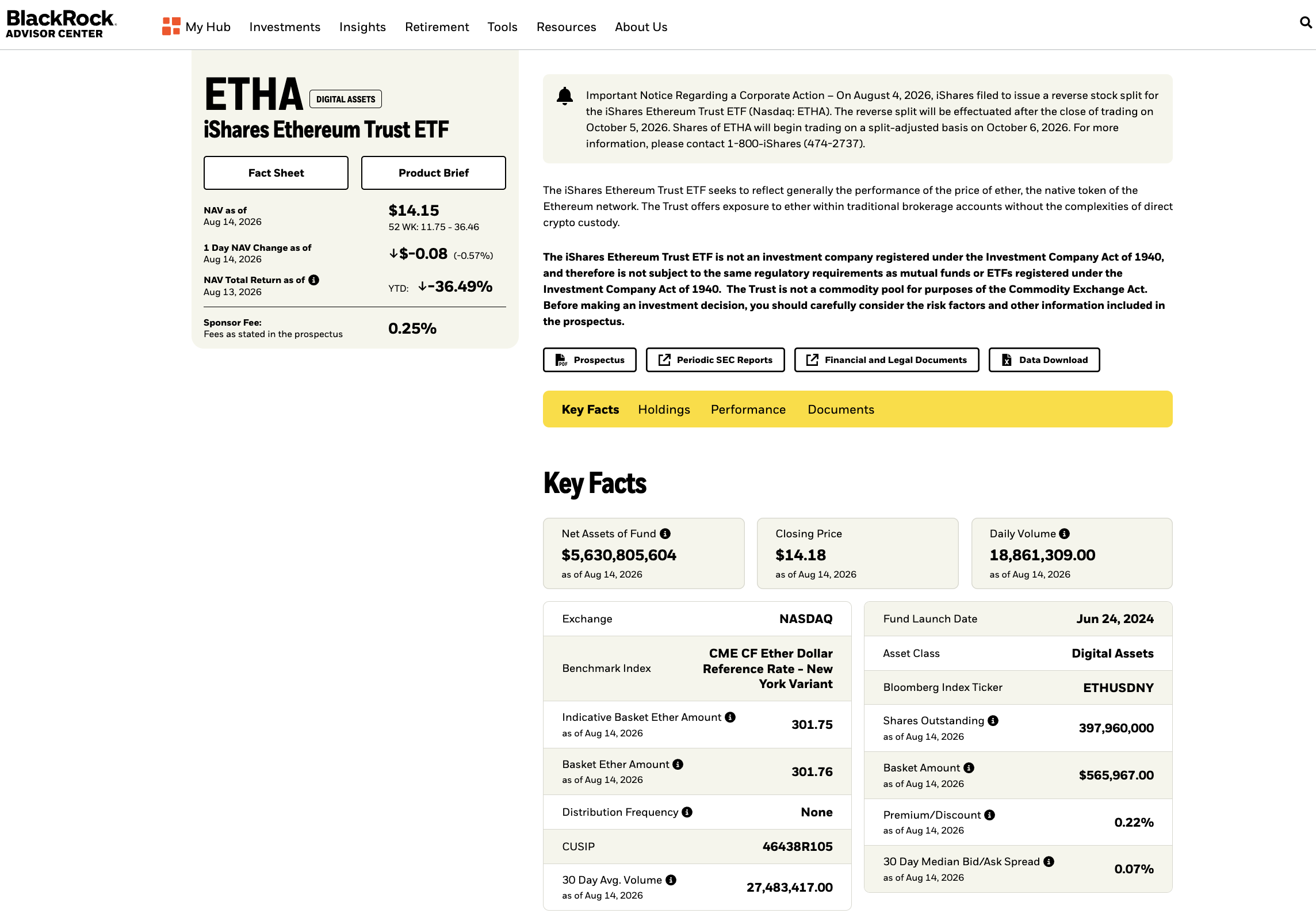
The Ethereum ETF category no longer refers to a single product type. Spot ETH ETFs, the original 2024 wrapper, hold ether directly and track its price minus fees. A newer generation adds staking economics inside the fund structure itself. BlackRock’s as one such product, pairing price exposure with staking yield in a single ticker, distinct from BlackRock’s earlier spot-only iShares Ethereum Trust (ETHA). Self-custody remains the separate, non-ETF path for investors who hold ETH directly through a wallet rather than a brokerage account.
The product mix keeps expanding. Grayscale has begun distributing Ethereum staking rewards to shareholders of its existing ETF-style products, a step that blurs the older line between spot exposure and staking exposure further. Each new filing tends to describe itself as an evolution of the spot template rather than a wholesale replacement, which makes reading the fine print on staking, custody, and yield mechanics necessary before assuming any two ETH-labeled tickers behave alike.
Spot Ethereum ETFs held a combined $10.74 billion in net assets as of August 7, 2026, equal to roughly 4.65% of Ethereum’s total market capitalization, according to SoSoValue’s ETF dashboard. Daily net inflow on that date measured $49.60 million, and cumulative net inflow since the July 2024 launch stood at $11.46 billion.
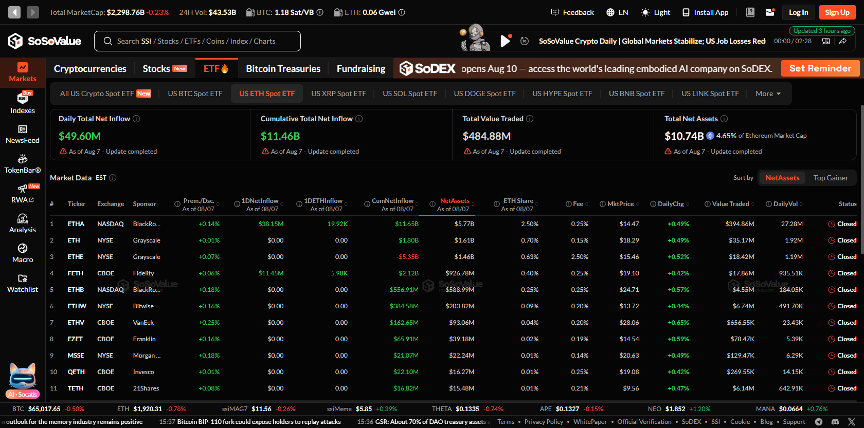
BlackRock’s ETHA carries the largest share of that total, with $5.77 billion in net assets and $11.65 billion in cumulative inflows tracked by the same dashboard, ahead of Grayscale’s older ETHE and ETH products and Fidelity’s FETH. Daily inflow figures move fast enough that any specific number printed here will already look dated within days. The pattern worth tracking is the direction of the streak and whether Bitcoin ETF flows are moving the same way that week, not the single-day figure in isolation.
BitMine Immersion Technologies, chaired by Fundstrat’s Tom Lee, announced on July 13, 2026, that its holdings had reached 5.77 million ETH, equal to 4.8% of Ethereum’s total supply of 120.7 million tokens.
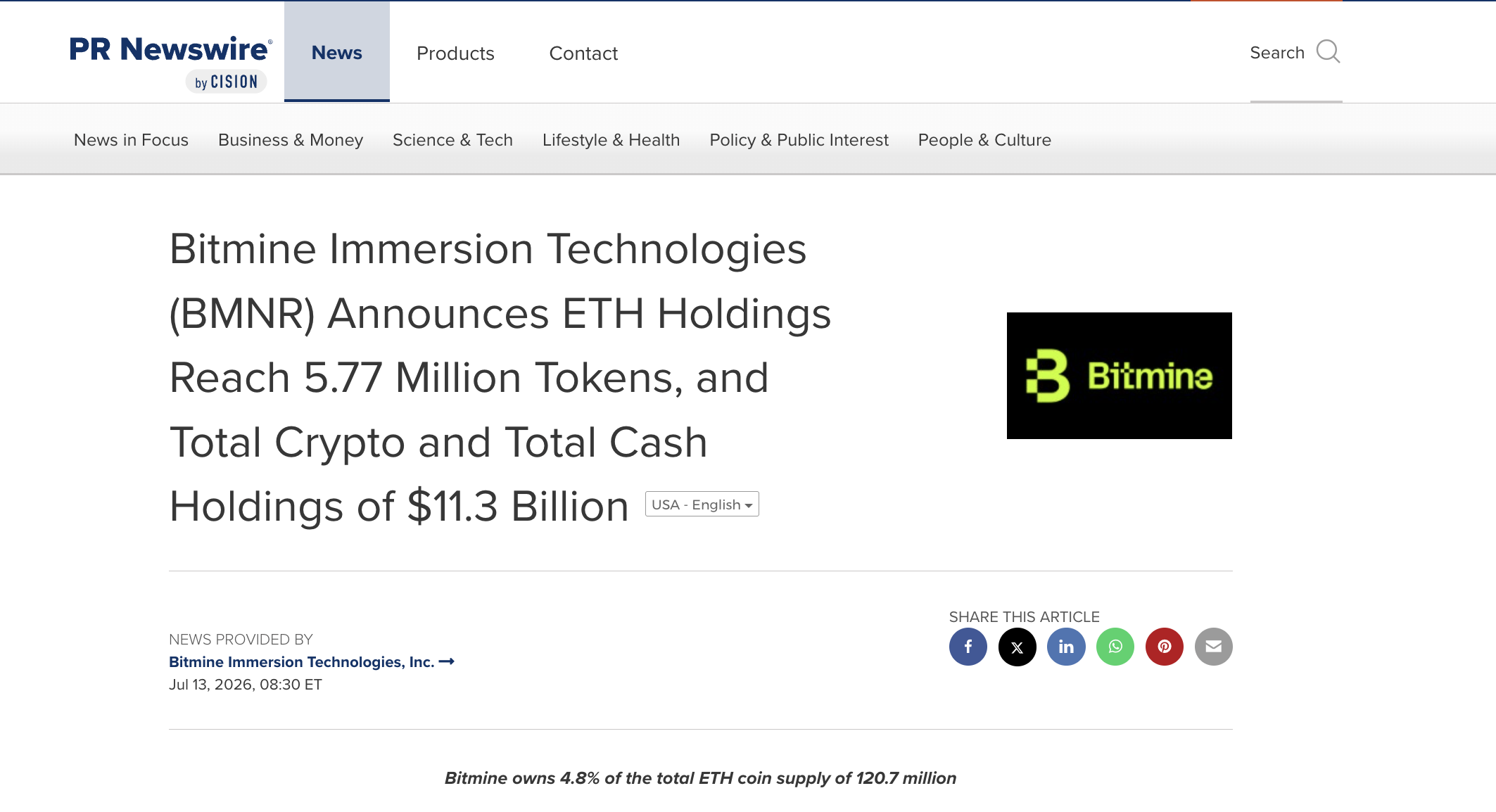
That treasury sits on BitMine’s own corporate balance sheet, funded through stock issuance and company cash, and has nothing to do with ETF share creation or redemption. Nearly five million of BitMine’s ETH is staked directly, generating validator rewards that flow back into the company’s own accounts rather than into any fund’s net asset value.
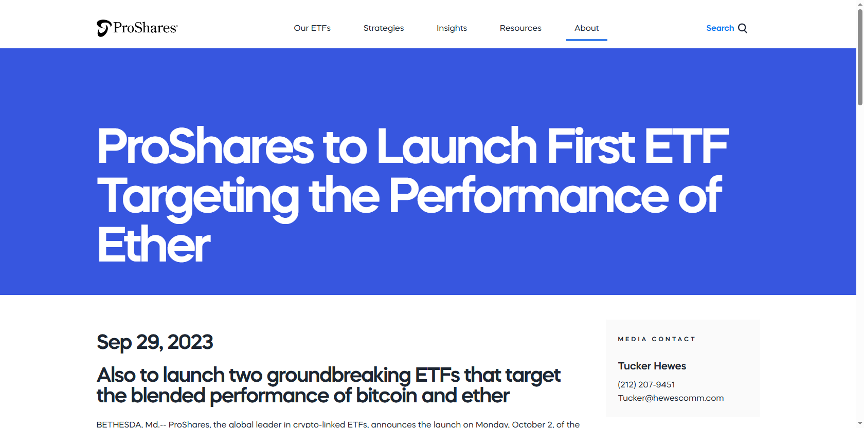
Regulated ether exposure began with futures contracts rather than the underlying asset. ProShares announced it would launch the first US ETF targeting ether’s performance on Monday, October 2, 2023, alongside two blended bitcoin-and-ether products, with VanEck and Bitwise bringing their own ether futures funds to market the same day. These funds held CME futures contracts rather than spot ether, giving institutional desks a regulated wrapper more than a year before any spot product existed.
The wait for spot exposure ended on July 23, 2024. The SEC declared registration statements effective for nine spot ether products a day earlier, clearing the way for BlackRock, Fidelity, VanEck, Franklin Templeton, Invesco, 21Shares, Bitwise, and Grayscale to begin trading, along with Grayscale’s converted Ethereum Trust and a newly created Ethereum Mini Trust. Direct brokerage exposure to ether, without running a wallet or managing a seed phrase, existed as a mainstream option from that date forward.
The category’s first year produced uneven but eventually strong results. Combined net inflows reached roughly $8.7 billion by the July 2025 anniversary, per SoSoValue’s own historical ETF flow data, with nearly half of that total arriving in just the final two weeks as ether’s price rallied. BlackRock’s ETHA crossed $10 billion in assets during that same stretch, reaching the milestone faster than all but two ETFs in US history, a scale reflected on BlackRock’s own iShares product page for the fund, and the pace barely slowed heading into August.
On August 11, spot ETH ETFs pulled in $1.02 billion in a single day, easily the category’s largest daily haul, and combined assets cleared $23 billion within the week that followed. That combined figure eventually cooled to near $19.6 billion by December 2025 as ether’s price pulled back from its mid-year highs, a reminder that AUM tracks price alongside flows and can fall even during weeks with net buying.
Public companies began building ether treasuries on a scale that rivaled the ETFs themselves. BitMine, under Tom Lee’s chairmanship, moved from a standing start to nearly 5.8 million ETH within roughly a year, staking most of that position rather than holding it idle. Coverage of the company’s weekly buying became a recurring feature of Ethereum news cycles through the back half of 2025 and into 2026, with each incremental purchase reported against the running percentage of total ETH supply the company controlled.
Other corporate holders followed a similar playbook at a smaller scale, and the framing shifted from “does a company hold crypto” toward “how large a share of one network’s supply can a single balance sheet responsibly hold.” Neither question has a settled answer, and BitMine’s own disclosures remain the only reliable source for its current position rather than any secondary aggregator.
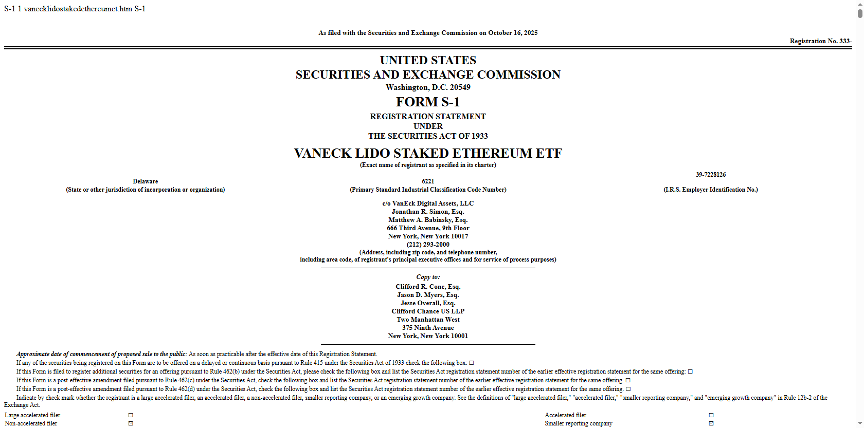
Asset managers spent late 2025 filing for the next generation of products. VanEck filed a Form S-1 registration statement with the SEC on October 16, 2025 for the VanEck Lido Staked Ethereum ETF, a Delaware-registered fund aiming to become the first US staked-ETH ETF if approved. Lido’s own project blog confirmed the filing the same week, noting the fund is designed to track a benchmark index blending ether’s price with staking rewards earned through the Lido protocol.
Trump Media’s Truth Social brand pursued a different combination, filing for a joint Bitcoin-and-Ethereum ETF that would include staking rewards on the ether portion. Reported allocations have varied across filings, with some describing a 75% Bitcoin and 25% Ethereum split and others closer to 60/40, and the product is proposed to carry a 0.95% management fee with custody, liquidity, and staking services handled through Crypto.com’s registered broker-dealer arm. A filing at this stage represents an application under SEC review, not a launched or trading product, and the distinction matters given how often filing headlines get mistaken for approval headlines in crypto media.
Spot ETH ETFs have settled into a pattern of alternating inflow and outflow stretches rather than one-directional growth. A single day in late July 2026 produced a net outflow near $6.4 million across the category, with ETHA, FETH, and Bitwise’s ETHW all closing in the red, before flows reversed into a four-day inflow streak by early August, per SoSoValue’s own daily flow data. These reversals tend to track the same risk-on or risk-off mood affecting Bitcoin ETFs in the same week rather than moving on ether-specific news alone, which is one reason a single day’s flow print rarely tells the full story on its own.
Sorting a given week’s ETH ETF headlines starts with identifying the product type behind the story, since spot exposure, staking-enabled funds, income-focused variants, and multi-asset filings all get covered under the same “ETF” label despite behaving differently. The issuer matters almost as much: a BlackRock or Fidelity filing tends to move through the SEC process differently than a newer entrant’s application, partly on the strength of existing regulatory relationships built through the 2024 spot launches.
Distinguishing a flow print from a treasury purchase resolves a large share of reader confusion on its own. ETF inflows represent new shares created against new ether held in trust; a treasury buy is a company purchase for its own balance sheet, and the two can print in the same news cycle without being related. Checking whether Bitcoin ETFs moved the same direction that week helps separate an Ethereum-specific catalyst from a broader crypto risk mood, and confirming whether a story describes a rumor, a Delaware trust registration, an SEC filing, or an actual trading launch prevents the common mistake of treating early-stage paperwork as a finished product.
Institutional ether access also now includes a futures lane that is not an ETF share. In September 2026, Singapore Exchange obtained CFTC authorization under Regulation 48.10 so eligible US institutions can access SGX bitcoin and ether perpetual futures through clearing members, without SGX registering as a separate US exchange. Authorization is market-structure news. It is not a spot ETH ETF listing, not ETF share creation, and not automatic trading live on day one of the order. Onboarding through US clearing members still has to finish before desks can treat the contracts as a working venue. Keep that futures path separate from ETHA, ETHB, or treasury purchase headlines when sorting the same week’s institutional ether coverage.
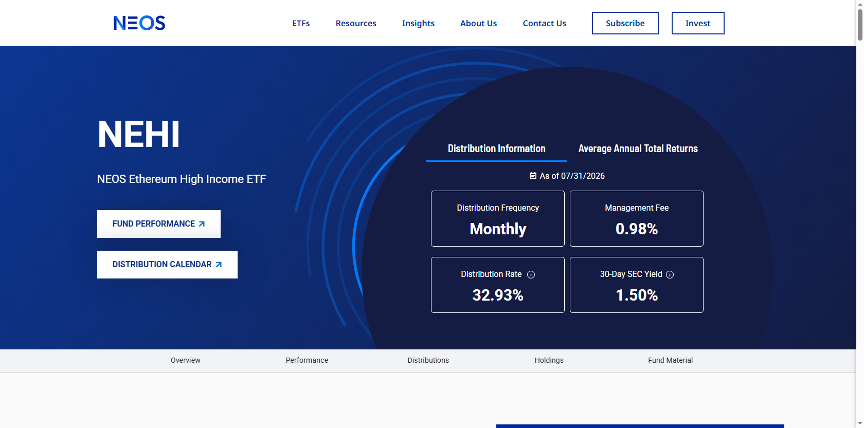
Not every Ethereum-linked ETF is built to track spot price directly. NEOS Investments runs the Ethereum High Income ETF (NEHI), which gains ether exposure indirectly through existing spot ETH ETPs and a controlled foreign corporation structure, then layers an options strategy on top: selling covered calls for monthly income while buying calls near the same strike to retain some upside participation. As of July 31, 2026, NEOS listed the fund’s 30-day SEC yield at 1.50%, a monthly distribution rate near 32.93%, and a 0.98% management fee.
Income-style funds like NEHI are not a substitute for plain spot beta, and NEOS’s own fund materials describe the options overlay rather than framing the product as a direct ether tracker. The trade-off is structural: covered-call income tends to cap upside during strong rallies in exchange for steadier monthly payouts, which suits a different investor goal than directly chasing ether’s price appreciation. Checking the current prospectus for fee and strategy detail before assuming parity with a spot fund remains the safer habit, since options-overlay terms can change between share classes and filing updates.
An ETH ETF is, at its simplest, a brokerage wrapper for ether exposure. Spot ETH ETFs aim to track the price of ether without requiring the holder to run a wallet or manage private keys, settling exposure through fund shares that trade on a stock exchange during normal market hours instead.
Staked-ETH ETF designs, including the products already trading under tickers like ETHB and the ones still pending SEC review such as VanEck’s Lido-linked filing, try to add staking economics inside that same wrapper. The fund itself stakes some or all of its underlying ether and passes a version of the reward back to shareholders, which changes the fee structure, the tax treatment, and the operational complexity compared with a plain spot fund holding idle ether.
Combined Bitcoin-and-Ethereum filings, including the Truth Social product working through SEC review, represent a third category again: multi-asset wrappers rather than pure-play ETH exposure. A reader searching “ethereum stock” is usually looking for one of these three wrapper types, or for a related public company such as BitMine, rather than a single equity that trades one-for-one with ether’s price. No such equity exists; the closest analogues are either an ETF share or a corporate stock whose balance sheet happens to hold a large ether position.
Net inflow figures measure new share creation minus redemptions on a given trading day, and record inflow days, or multi-day streaks of them, tend to reflect real institutional demand building over that window. Those streaks end. Outflow days follow inflow streaks regularly enough that a single red day rarely signals anything beyond ordinary profit-taking or portfolio rebalancing.
Assets under management is a moving snapshot rather than a running total. A fund’s AUM can fall on a day with positive net inflows if ether’s price drops enough to outweigh the new money coming in, and it can rise on a flat-flow day purely from price appreciation on existing holdings. Ethereum ETF flows have tended to share the same risk-on or risk-off weeks as Bitcoin ETF flows, which makes an isolated ETH-only explanation for any single week’s number worth double-checking against what Bitcoin funds did over the same days. Corporate treasury purchases and ETF redemptions can also land in the same reporting window without connection to each other, since they represent entirely different lanes of ether demand. None of these figures, alone or combined, function as a price floor; they describe demand at a point in time, not a guarantee about where price goes next.
Public companies including BitMine under Tom Lee’s chairmanship have built and staked ether treasuries large enough to influence Ethereum news cycles on their own. These positions can carry enormous paper drawdowns during price pullbacks while the underlying company continues buying, since the accounting treatment and the buying strategy operate independently of short-term price swings.
Treasury purchases can print in the same week as ETF inflows or as unrelated founder-sale headlines from a completely different project, without any of those stories being connected to one another. A treasury buy reported this week says nothing about next week’s ETF flow data, and a completely unrelated founder token sale sharing a headline slot does not imply coordination. Reading treasury coverage as a story about corporate balance-sheet strategy, rather than as investment guidance or as a stand-in for spot ETF literacy, keeps the two categories from blurring together. Nothing in this section, or elsewhere in this guide, constitutes financial or investment advice; it describes how these products and companies are structured, not a recommendation to buy or sell any of them.
It is a fund that trades on a stock exchange and gives investors exposure to ether’s price, or in newer designs to ether’s price plus staking rewards, without requiring the investor to hold ETH directly in a wallet.
Not in the sense of a single equity that tracks ether one-for-one. Searches for “ethereum stock” usually lead to a spot or staking ETH ETF, or to a public company such as BitMine that holds a large ether treasury on its balance sheet.
NEOS Investments runs NEHI, the Ethereum High Income ETF, which gains indirect ether exposure through existing ETH ETPs and adds a covered-call options strategy aimed at generating monthly income rather than tracking spot price directly.
Tom Lee chairs Fundstrat and also chairs BitMine Immersion Technologies, the public company whose corporate ether treasury has grown to roughly 4.8% of Ethereum‘s circulating supply. His name appears often in ETF-adjacent coverage even though BitMine’s treasury is a separate instrument from any ETF share.
No. Inflows reflect demand for fund shares at a point in time and have coincided with both rising and falling ether prices across 2025 and 2026. Outflow streaks follow inflow streaks as a normal part of the cycle rather than as a crisis signal by themselves.
VanEck registered a Delaware trust in October 2025 for a Lido-linked staked Ethereum ETF and followed with an SEC S-1 filing the same month. If approved, it would give investors exposure to ether staked through Lido’s protocol inside a single ETF share, though the filing remains under SEC review rather than trading.
Start by identifying the product type, the issuer, and whether the story describes a flow print, a treasury purchase, a filing, or an approval. Checking whether Bitcoin ETFs moved the same direction that week helps separate an Ethereum-specific catalyst from a broader market mood.
Explore more