
Latest in Cardano
764
Total stories
20
Writers
Cardano DRep Backs 9M ADA Strike Finance Bet With 10% Treasury Yield Target
July 17, 2026
Cardano Whales Hit 3.5-Year High as Retail Dumps ADA
July 14, 2026
Cardano Dev Activity Hits 233 Commits as ADA Eyes Return to Crypto Top 10 Soon
July 10, 2026
Cardano Whales Grab 67% of ADA Supply as Midnight Privacy Pivot Heats Up
July 5, 2026
Cardano (ADA): Governance, Network Health, Price, and News
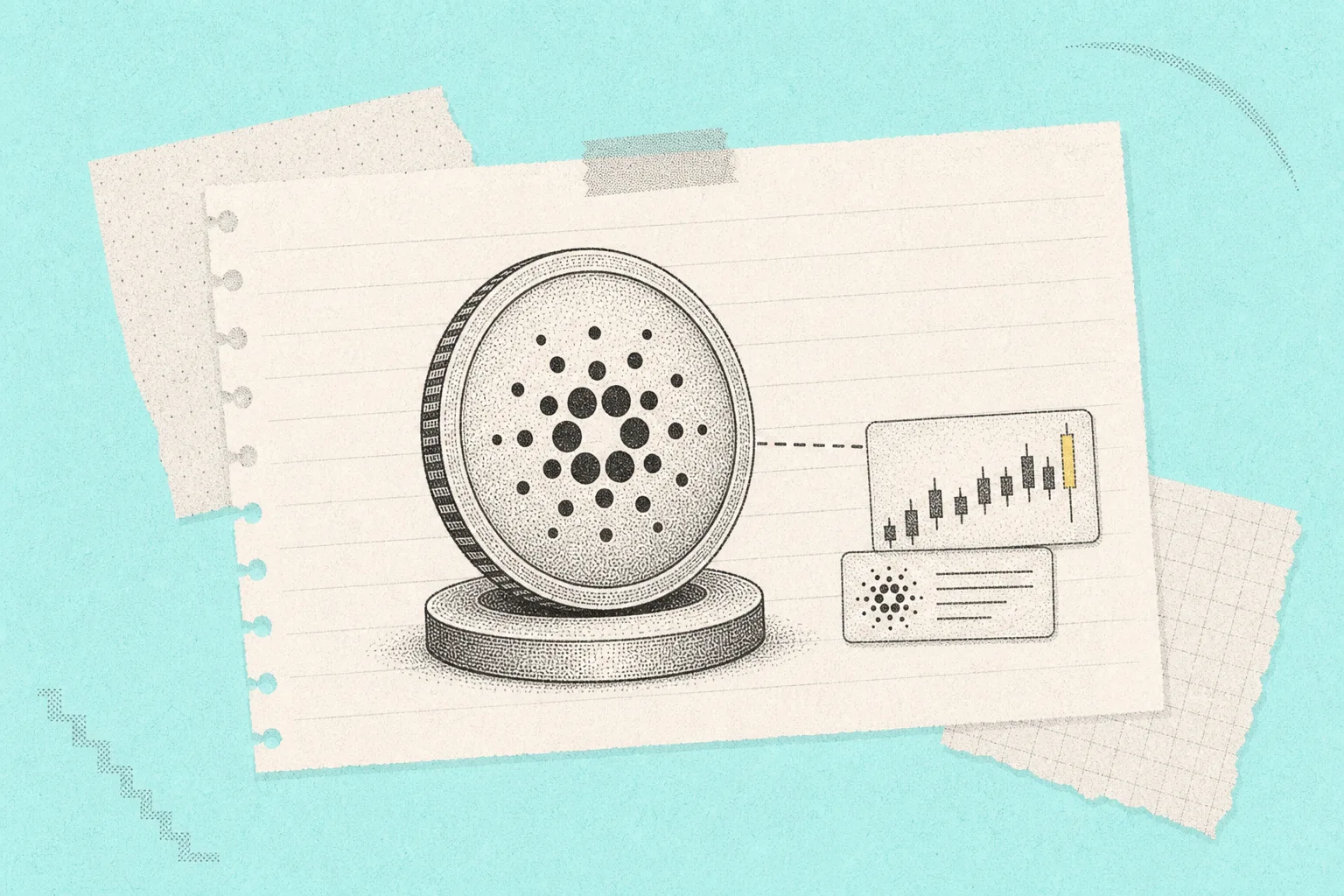
Cardano is a proof-of-stake Layer-1 blockchain built on peer-reviewed computer science research. ADA is the asset that keeps it running. Holders stake it to help secure the network, spend it on transaction fees, and use it to vote inside Cardano’s on-chain governance system.
The Cardano community has a running joke about diamond hands and the patience this project demands. There is truth buried in the joke. Cardano tends to ship on its own academic timeline, and ADA’s price has tested that patience more than once.
This page is built to answer the question of what is actually moving around Cardano right now. A governance vote that missed its threshold. A wallet incident that got confused for a network outage. Staking data, a payments pilot in Swiss supermarkets, what drives ADA’s price, and the full path from the 2017 mainnet launch to today’s Voltaire governance era. Keep reading for whichever part you came here for.
Governance Votes, Network Health, and ADA Flow Stories in Play
Three threads are worth tracking right now: what Cardano’s treasury is funding, whether the network is actually healthy underneath the headlines, and where ADA is quietly getting used.
Governance Votes and Treasury Proposals
The ask started big. A combined Cardano Foundation and EMURGO proposal wanted over 14 million ADA, enough for the Cardano Summit 2026 in Singapore plus a heavy TOKEN2049 presence in one go. DReps balked at the size of it. Organizers ended up splitting the ask into two separate votes instead. EMURGO’s standalone TOKEN2049 proposal passed. The reworked Summit proposal did not. It landed at 65.21% support, just short of the two-thirds threshold treasury withdrawals require, and the Cardano Foundation confirmed on X that the Summit would not happen this year as a result.
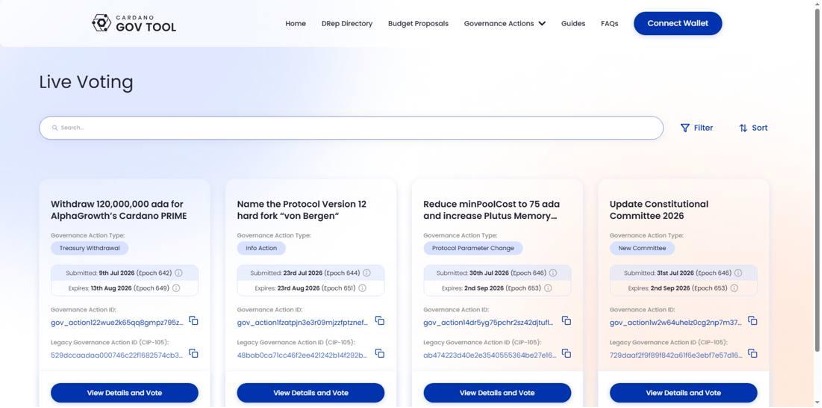
A separate measure tied to IOG’s 2026 research roadmap, covering quantum security and scaling architecture work, has drawn opposition from roughly 87% of voting DReps. Since then, the Cardano Foundation has put out its own budget review process for 2026. Every proposal that lands on its desk now gets scored in three ways: ecosystem growth, budget viability and how well it aligns with the Cardano 2030 roadmap. None of this happens behind closed doors, either. Cardano’s GovTool shows the live governance actions and exactly how each vote is trending, for anyone who wants to check.
Network-Health Headlines
SecondFi, the Cardano wallet that launched in April 2026 as the successor to EMURGO’s Yoroi, shut down for good after a signing flaw in a June Android update let attackers drain 16.1 million ADA from 374 wallets. EMURGO’s own update on the Cardano forum said SecondFi will not resume normal operations and is now acting purely as a recovery team for affected users.
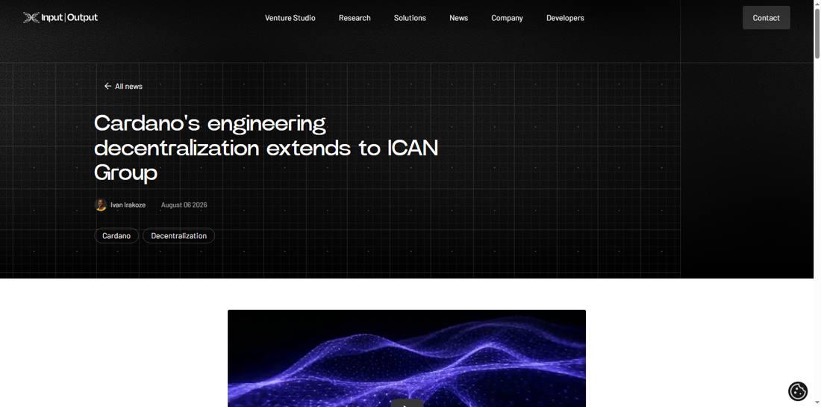
The Cardano blockchain itself kept producing blocks the entire time. Nothing about consensus broke. Meanwhile, the actual protocol work moved forward: Cardano’s Leios upgrade entered public testnet in June 2026, and IOG has laid out a plan to scale base-layer throughput by 10x to 65x without weakening the security model. IOG also keeps handing pieces of its own engineering work to outside teams. Daedalus wallet development moved to Se7en Labs, the Mithril protocol moved to Teragone, and in August 2026, four more engineering functions moved to ICAN Group, with the same leadership and staff following the work over.
On-Chain Activity and Payments Pilots
More than 63% of ADA’s circulating supply sits staked across roughly 3,000 active stake pools, which is a heavy security margin by any chain’s standard. On the payments side, the Cardano Foundation’s integration with Swiss platform DFX.swiss put ADA inside the checkout flow at 137 Spar supermarkets across Switzerland and Liechtenstein, letting shoppers pay by scanning a QR code at roughly a third of typical card processing cost. Read this as a utility and network-health story, not a price catalyst.
What Cardano Is and How ADA Works
Cardano runs on proof-of-stake, which means staked ADA secures the ledger here, not mining rigs. The project grew out of peer-reviewed academic research, not a fast-iteration startup playbook, and that habit stuck. It still shows. New features tend to ship slowly and carefully, sometimes to the visible frustration of people tracking the roadmap.
ADA pulls triple duty on this network. Transaction fees get paid in it. Stake it to a pool, and it helps secure the chain while earning rewards along the way. It also doubles as a governance vote, cast directly or handed off to a delegated representative.
Transactions here run on the extended unspent transaction output model, eUTXO for short. Think Bitcoin’s UTXO design more than Ethereum’s running account balance. Put plainly, discrete chunks of ADA move between addresses rather than a single balance ticking up or down. That is also part of why Cardano can quote a transaction fee before a transaction even goes out.
Charles Hoskinson co-founded the project and remains the face most people associate with IOG, the company that has handled most of Cardano’s core engineering up to now. His role matters here mostly as context. This page is not a biography of him.
Cardano vs Other Proof-of-Stake Layer-1s
Put it next to faster-shipping proof-of-stake rivals, and the difference shows fast. Cardano leans much harder on formal specification and academic peer review before anything reaches mainnet. That approach tends to produce fewer emergency patches. It also tends to produce a slower release cadence. Neither is a price call. It is a real tradeoff, and it shows up across almost every milestone below.
Byron to Voltaire: Cardano’s Path From Mainnet to On-Chain Governance
Cardano’s own development documentation lays out the eras below. Verify any date against that page before republishing it elsewhere, since Cardano occasionally revises phase boundaries as work slips or accelerates.
2017: Mainnet Launch and the Staking Era Begins
Cardano’s Byron-era mainnet went live on September 29, 2017, launching ADA as a proof-of-stake asset from its first block rather than bolting staking onto a proof-of-work chain later. The early identity of the project was already set: academic, peer-reviewed, and unhurried, in contrast to the faster iteration culture found elsewhere in crypto at the time.
2021: Smart Contract Capability Arrives (Alonzo Era)
Alonzo went live September 12, 2021, the hard fork that finally brought Plutus smart contracts to Cardano’s mainnet, nearly four years after the genesis block. Critics still cite that gap as proof that Cardano ships too slowly. Supporters read the same gap as evidence the team waited until the cryptography was actually ready.
2022-2023: Vasil Upgrade and Ecosystem Throughput Gains
Vasil landed on mainnet in September 2022, mostly fixing block propagation and developer tooling ahead of the governance work still to come. Nobody wrote breathless headlines about it the way they did for Alonzo. It just did the unglamorous plumbing work later upgrades ended up needing.
2023-2024: Conway Era Brings On-Chain Governance and DRep Voting
The Chang hard fork activated Cardano’s Conway ledger era by September 2024, introducing Delegated Representatives, a constitutional committee, and formal on-chain treasury voting for the first time. This is the exact mechanism behind the governance stories above. Anyone checking current DRep participation numbers should pull them fresh from GovTool rather than trusting a number printed here, since the voter base keeps shifting.
2024-2025: Treasury-Funded Upgrades and Tooling Milestones
Governance participation grew enough that real treasury-funded proposals started clearing the required threshold, and developer tooling built around Conway-era governance operations began showing up in third-party wallets and dashboards. The Cardano Foundation also grew its own community DRep delegation during this stretch, a pattern that continued into 2026 below.
2025-2026: Outage Literacy, Transaction Milestones, and Payments Experiments
In January 2026, the Cardano Foundation handed out another 220 million ADA across 11 community DReps. That pushed its total community delegation to 360 million ADA and shrank its own voting weight on purpose. The same stretch produced the SecondFi wallet incident, the Leios testnet launch, IOG’s ongoing engineering handovers, and the Spar Switzerland payments rollout, all of which are covered above. DeFi total value locked kept lagging peer Layer-1s across the same period even as ADA’s market cap stayed well ahead of it, which the next section covers honestly.
Staking, Governance Apps, and DeFi Experiments on Cardano
Staking remains the single most durable reason to hold and use ADA. Delegating to a stake pool earns rewards while adding to the network’s overall security, and it costs nothing to move a delegation between pools.
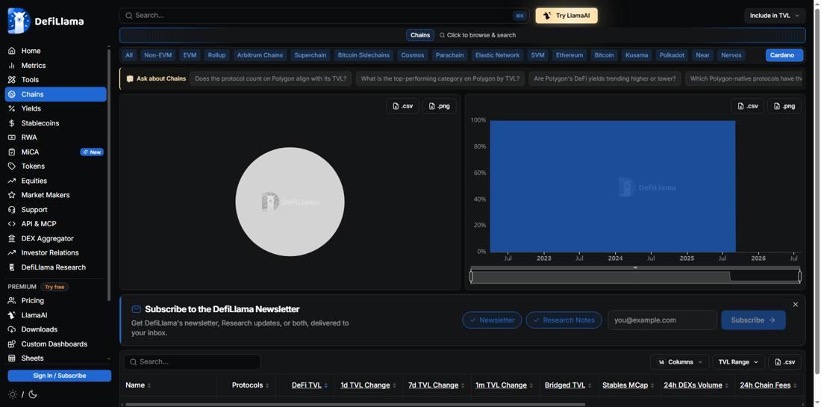
DeFi activity on Cardano is real but thin. DefiLlama’s own chain data puts Cardano’s total value locked at around $132 million, ranking it 27th among all chains and far behind Ethereum’s and Solana’s DeFi capital bases. That gap has persisted for years despite ADA’s market capitalization staying inside the top 10, and it is worth stating plainly rather than dressing up.
Merchant payment rails are a separate story from DeFi. The Spar Switzerland rollout mentioned above is a payments-utility play built on low, predictable Cardano fees, not a bet on smart contract liquidity.
What Actually Moves ADA Price
ADA’s price tends to move on a mix of broad crypto risk appetite, governance and upgrade headlines, shifts in how much ADA is staked versus liquid, and exchange flow data showing whether holders are moving coins toward or away from trading venues.
Single-indicator posts promising a specific dollar target are entertainment more than forecasting. A durable read on ADA price comes from tracking those four inputs together over time, not from any one chart pattern. For dated price analysis and prediction pieces built off current conditions, check LBN’s live Altcoin News coverage rather than treating anything on this page as a target.
Governance, Outages, and Price Noise: Separating Cardano Headlines
Cardano headlines tend to sort into four buckets. Governance and tech news covers DRep votes, hard forks, and roadmap funding. Network-health news covers outages, wallet incidents, and whether they touched consensus or just an app built on top of it. Whale and exchange-flow news covers large ADA movements between wallets and exchanges. Price-noise news covers day-to-day chart commentary that rarely holds up a week later.
Promotional posts dressed up as any of the above are worth discarding outright. For the day-to-day version of this sorting exercise, LBN’s live Altcoin News feed is the place to watch, not this page, which is built to stay accurate longer than a single news cycle.
Cardano Governance Can Fund Upgrades From the Treasury
Cardano’s on-chain governance is not only commentary. It can move treasury ADA into budgeted network work once voters clear the required threshold. DRep processes can approve proposals quickly when participation is strong, and developer tools built around Conway-era governance operations make those actions usable well beyond the GovTool interface itself. Readers should keep governance throughput separate from ADA price headlines. A funded upgrade path is an ecosystem mechanism, not a breakout guarantee.
How DRep Voting and Treasury Proposals Work
A DRep vote approves or rejects a specific governance action registered on GovTool, whether that is a treasury withdrawal, a protocol parameter change, or a hard fork initiation. The Cardano Summit 2026 vote above shows the mechanism working as designed: a large ask got scrutinized, split, and partly rejected, all transparently and on-chain. A fast DRep turnaround on a given proposal says something about governance health and voter engagement. It does not say anything about where ADA’s price is headed next.
“Cardano Is Down” Often Means Tools Broke, Not Consensus
Outages that block everyday wallets or third-party services can look like a full network failure from the outside. In plenty of real incidents, the chain keeps producing blocks while a meaningful share of users cannot transact through the specific app or service that broke. For Cardano news literacy, separate consensus health from front-end and integrator downtime before treating a crisis headline as proof that ADA itself is offline.
How to Read a Cardano Outage Headline
The SecondFi shutdown is the cleanest recent example. A signing flaw in a wallet app drained users’ funds and forced the app to shut down, and headlines briefly framed it as a Cardano crisis. The chain itself never stopped producing blocks. Before reacting to the next “Cardano is down” headline, ask one question: is block production actually interrupted, or is it just one wallet, exchange, or bridge that broke?
Activity and Staking Differ From DeFi Capital Depth
Cardano can post large cumulative transaction counts and heavy staking participation even when price looks weak. That is a different metric from DeFi total value locked, which can lag peer chains for long stretches despite a high ADA market cap. Merchant payment rails aim to turn Cardano’s low, predictable fees into checkout utility, a separate lever from DeFi liquidity entirely. Evaluate Cardano through multiple lenses at once: settlement activity, staking security, DeFi capital, and payments utility, rather than reading any single chart level as the whole story.
Reading Cardano’s On-Chain Metrics Correctly
Staking participation above 63% of supply across roughly 3,000 pools is a strong security signal on its own. DeFi TVL sitting near $132 million and ranked 27th tells a much weaker story about locked capital. Both numbers are true about the same network at the same time, and neither one cancels the other out. The Spar Switzerland pilot adds a third, separate lens again: payments-utility, running independently of both staking security and DeFi depth.
Governance Liquidity and DeFi Depth Gaps Still to Close
Governance participation and treasury-funded upgrades will continue testing whether DRep’s turnaround remains fast as the voter base grows beyond its current size.
Outage literacy will keep mattering. Third-party wallets and integrators, not consensus itself, remain the more common failure point, and SecondFi will not be the last incident that gets initially mislabeled as a network problem.
DeFi TVL growth remains the open question against Cardano’s transaction and staking scale, and IOG’s own 2026 roadmap treats it as close to make-or-break for Cardano’s DeFi ambitions.
Merchant payment pilots like Spar Switzerland could expand Cardano’s payments-utility story well beyond DeFi and speculation, assuming the integration keeps growing past its current 137 stores.
FAQ
What is Cardano?
Cardano is a proof-of-stake Layer-1 blockchain built on peer-reviewed research, with ADA as its native asset for fees, staking, and governance.
What is ADA used for?
ADA pays transaction fees on the Cardano network, gets staked to a pool to earn rewards and help secure the chain, and gives holders a governance vote either directly or through a delegated representative.
How does Cardano staking work?
ADA holders delegate their stake to a pool without locking or losing custody of their coins. The pool earns block rewards based on its stake weight and performance, then shares a portion back to delegators automatically each epoch.
What is DRep governance on Cardano?
DReps, short for delegated representatives, vote on governance actions on GovTool on behalf of ADA holders who delegate voting power to them. Actions include treasury withdrawals, protocol parameter changes, and hard fork initiations.
Is Cardano down right now?
Check whether block production is actually interrupted before assuming so. Recent incidents, including the SecondFi wallet shutdown, affected specific apps rather than Cardano’s underlying consensus.
Why does Cardano’s DeFi TVL lag other chains?
Cardano’s DeFi activity is still building critical mass in liquidity, stablecoin depth, and transaction frequency compared with Ethereum and Solana, even though ADA’s own market cap ranks far higher than its locked DeFi capital would suggest.
What drives Cardano price?
Broad crypto risk appetite, governance and upgrade news, shifts in staking participation, and exchange flow data all factor in together rather than any single indicator.
Will ADA reach $X?
No page can responsibly guarantee a price target. Treat any specific dollar prediction as one input to weigh, not a promise, and check dated price-analysis coverage for current context.
Where can I read about other altcoins?
The Altcoins hub covers the broader market, and sibling pages for Dogecoin, Solana, Pi Network, Hedera, and Shiba Inu each cover their own coin.
Key Takeaways
- Cardano is a research-led, proof-of-stake Layer-1. ADA stakes, pays fees, and funds governance.
- On-chain governance, DReps and treasury votes, can fund real upgrades. That is a mechanism, not a price signal.
- App or wallet outages are not always consensus failures. Check whether block production actually stopped.
- High transaction counts and staking participation can coexist with thin DeFi TVL. Use multiple lenses to judge network health.
- Price context built from flows, governance news, and staking shifts beats single-chart breakout stories.
- The Spar Switzerland pilot shows a payments-utility angle beyond DeFi and speculation.
- Sibling hubs (DOGE, SOL, Pi, HBAR, SHIB) and the Altcoins pillar cover their own coins.
Cardano Liquidation Data Exposes A Trap Under ADA’s Bounce
SecondFi Users Face NIGHT Claim Risk After 374 Wallets Compromised
Explore more
A Brief Introduction to Bitcoin Wallets & Security
AI & Meme Token Presales: How to Read Hype, Fair Launches, and “Best Meme Coin” Searches
Altcoins Explained: Altcoin Season, News, and the Full Coin Map
Bitcoin Basics: Bitcoin ETF, Institutional & Corporate Adoption
Bitcoin Basics: Bitcoin Investing & Valuation
Bitcoin Basics: Bitcoin Mining & Supply Economics